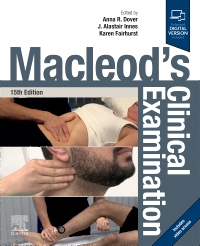

Macleod's Clinical Examination - Elsevier eBook on VitalSource, 15th Edition
Elsevier eBook on VitalSource
Now $41.29
Fifty years since it was first published and now fully revised, Macleod’s remains the textbook of choice for medical students, junior doctors, nurses and allied health practitioners who understand that excellence in clinical examination is integral to good practice.
The fifteenth edition will teach you how to take a history and carry out proficient clinical examination, in order to elicit the key clinical symptoms and signs of disease. It covers general principles, relevant history, examination and investigations for all the major body systems – and how to effectively apply these skills to specific clinical situations and prepare for assessment.
Macleod’s Clinical Examination is enhanced with 32 supplementary videos demonstrating key clinical examination routines described in the book, many new and revised for this edition in line with latest guidance and best practice.
-
- NEW! Nora AI - an AI-powered learning assistant exclusive to Elsevier ebooks on VitalSource's Bookshelf® platform - offers built-in AI learning support that provides personalized answers based on content from the Elsevier ebook
- Primarily focused on the practical skills required by medical students and early career stage clinicians
- Explains the physical basis of clinical signs to aid understanding
- Introduces the formulation of a differential diagnosis
- Provides logical initial investigations for each body system
- Comes with access to the complete, fully searchable and downloadable eBook
-
-
 Macleod's Clinical ExaminationPaperback
-
-
1. Managing clinical encounters with patients
2. General aspects of history taking
3. General aspects of examination
4. The cardiovascular system
5. The respiratory system
6. The gastrointestinal system
7. The nervous system
8. The visual system
9. The ear, nose and throat
10. The endocrine system
11. The reproductive system
12. The renal system
13. The musculoskeletal system
14. The skin, hair and nails
15. Babies and children
16. Patients with mental illness and learning disability
17. The frail patient
18. The deteriorating patient
19. The dying patient
20. Reaching and communicating a diagnosis
21. Adapting skills for practice
22. Preparing for assessment -
-
Ways of Reading
- The appearance of the text and page layout can be modified according to the capabilities of the reading system (font family and font size, spaces between paragraphs, sentences, words, and letters, as well as color of background and text)
- This e-publication is accessible to the full extent that the file format and types of content allow, on a specific reading device, by default, without necessarily including any additions such as textual descriptions of images or enhanced navigation
- No information about nonvisual reading is available
-
Conformance
- No information is available
-
Navigation
- Table of contents to all chapters of the text via links
- Page list to go to pages from the print source version
-
Rich Content
- No information is available
-
Hazards
- No information is available
-
Product Content
- No information is available
-
Legal Considerations
- No information is available
-
Additional Accessibility Information
- Page breaks included from the original print source
- For readers with color vision deficiency, use of color (e.g., in diagrams, graphics and charts, in prompts, or on buttons inviting a response) is not the sole means of graphical distinction or of conveying information
- E-publication includes basic navigation (usually less detailed than TOC-based navigation)
- Where links, controls or buttons are included in the content, the purpose or functionality of each link, control or button is apparent from the associated text alone - or where it is unclear, separate link, control or button descriptions are provided
- All (or substantially all) textual matter is arranged in a single logical reading order (including text that is visually presented as separate from the main text flow, e.g., in boxouts, captions, tables, footnotes, endnotes, citations, etc.). Non-textual content is also linked from within this logical reading order. (Purely decorative non-text content can be ignored).
- The language of the text has been specified (e.g., via the HTML or XML lang attribute) to optimise text-to-speech (and other alternative renderings), both at the whole document level and, where appropriate, for individual words, phrases or passages in a different language.
-
Ways of Reading

 as described in our