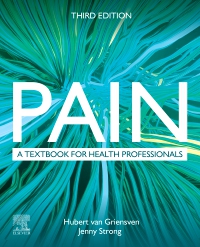

Pain - Elsevier E-book on VitalSource, 3rd Edition
Elsevier eBook on VitalSource
Now $55.29
Pain: A textbook for health professionals provides a comprehensive guide to pain and pain management with a focus on interprofessional practice.
Written by internationally acclaimed authors and fully updated to reflect latest evidence and understanding, this book bridges the gap between theoretical underpinning and practice for assessment and management of patients with persistent pain – all in clear and accessible language.
Now in its third edition, the text emphasises personal aspects of pain and the therapeutic alliance, as well as social and cultural aspects of pain, pain education for patients, and multidisciplinary and interdisciplinary working. It will provide both students and clinicians with a new lens through which to understand a person’s pain experience, as well as tools for effective management.
-
- Comprehensive information about all aspects of pain and pain management
- Relevant to a wide audience – suitable for physiotherapists, occupational therapists, social workers, nurses and GPs, as well as undergraduate students
- Factual and informative for clinicians in everyday practice
- Includes information on acute as well as chronic pain
-
-
 PainPaperback
-
-
1. Introduction to pain
2. The patient’s voice
3. Developing your communication toolkit: a practical guide for healthcare professionals
4. Social determinants of pain
Section 1: Overview: what is pain?
5. The psychology of pain: implications for the assessment and management of people in pain
6. Neuroanatomy of the nociceptive system
7. Neurophysiology of pain
Section 2: Assessment and management of pain
8. Assessing pain
9. Pain education for patients
10. Participating in life roles through self-management
11. Exercise therapy
12. Psychological management of pain
13. Neuropathic pain and complex regional pain syndrome
14. Manual therapy and influence on pain perception
15. Pain pharmacology and the pharmacological management of pain
16. Transcutaneous electrical nerve stimulation and acupuncture
17. Workplace rehabilitation
Section 3: Special issues
18. Multidisciplinary and interprofessional working
19. Pain in childhood
20. Pain in older adults
21. Cancer pain
22. Inequities in pain: pain in low- and middle-income countries and among indigenous peoples
23. Chronic pain and psychiatric problems
24. Acute pain
25. Persistent pain and the law: legal aspects of persistent pain management
26. Conclusions: the future -
-
Ways of Reading
- The appearance of the text and page layout can be modified according to the capabilities of the reading system (font family and font size, spaces between paragraphs, sentences, words, and letters, as well as color of background and text)
- This e-publication is accessible to the full extent that the file format and types of content allow, on a specific reading device, by default, without necessarily including any additions such as textual descriptions of images or enhanced navigation
- No information about nonvisual reading is available
-
Conformance
- No information is available
-
Navigation
- Table of contents to all chapters of the text via links
- Page list to go to pages from the print source version
-
Rich Content
- No information is available
-
Hazards
- No information is available
-
Product Content
- No information is available
-
Legal Considerations
- No information is available
-
Additional Accessibility Information
- Page breaks included from the original print source
- For readers with color vision deficiency, use of color (e.g., in diagrams, graphics and charts, in prompts, or on buttons inviting a response) is not the sole means of graphical distinction or of conveying information
- E-publication includes basic navigation (usually less detailed than TOC-based navigation)
- Where links, controls or buttons are included in the content, the purpose or functionality of each link, control or button is apparent from the associated text alone - or where it is unclear, separate link, control or button descriptions are provided
- All (or substantially all) textual matter is arranged in a single logical reading order (including text that is visually presented as separate from the main text flow, e.g., in boxouts, captions, tables, footnotes, endnotes, citations, etc.). Non-textual content is also linked from within this logical reading order. (Purely decorative non-text content can be ignored).
- The language of the text has been specified (e.g., via the HTML or XML lang attribute) to optimise text-to-speech (and other alternative renderings), both at the whole document level and, where appropriate, for individual words, phrases or passages in a different language.
-
Ways of Reading

 as described in our