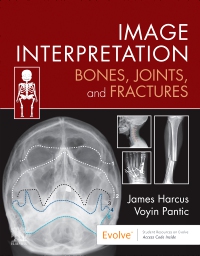

Image Interpretation: Bones, Joints, and Fractures - Elsevier E-Book on VitalSource, 1st Edition
Elsevier eBook on VitalSource
Now $42.29
Interpreting X-ray images correctly is essential for diagnostic radiographers, as well as a widely used skill for emergency department doctors, nurse practitioners, and many other healthcare professions. This new title provides a systematic, methodical approach to musculoskeletal image interpretation and its role in the evaluation and treatment of injury.
A companion to the eighth edition of Bones and Joints, this book covers the basic principles for interpreting images and then follows a simple regional approach to common radiographic projections. It goes on to consider common and important fracture patterns and other injuries related to that region, as well as the differences between normal and abnormal images.
Image Interpretation is an ideal learning guide for undergraduates, those transitioning to graduate roles or clinical practice, and other healthcare professionals wanting to supplement their training.
-
- User-friendly format: readers will be able to use the text to seamlessly explore the concepts between normal anatomy and abnormal radiographic appearances
- Systematic approach provided for each common radiographic projection
- Online case studies for readers to test and apply their clinical knowledge
- Key important learning points (‘Insights’)
- Annotated radiographic images and examples to support learning
-
1. Principles of Image Interpretation
2. Normal appearances of bones and joints
3. Fractures and Joint Trauma
4. Upper limb
5. Shoulder girdle and thorax
6. Lower limb
7. Pelvic girdle
8. Spine
9. Facial bones and mandible
10. Practical applications of image interpretation -
-
Ways of Reading
- The appearance of the text and page layout can be modified according to the capabilities of the reading system (font family and font size, spaces between paragraphs, sentences, words, and letters, as well as color of background and text)
- This e-publication is accessible to the full extent that the file format and types of content allow, on a specific reading device, by default, without necessarily including any additions such as textual descriptions of images or enhanced navigation
- No information about nonvisual reading is available
-
Conformance
- No information is available
-
Navigation
- Table of contents to all chapters of the text via links
- Page list to go to pages from the print source version
-
Rich Content
- No information is available
-
Hazards
- No information is available
-
Product Content
- No information is available
-
Legal Considerations
- No information is available
-
Additional Accessibility Information
- Page breaks included from the original print source
- For readers with color vision deficiency, use of color (e.g., in diagrams, graphics and charts, in prompts, or on buttons inviting a response) is not the sole means of graphical distinction or of conveying information
- E-publication includes basic navigation (usually less detailed than TOC-based navigation)
- Where links, controls or buttons are included in the content, the purpose or functionality of each link, control or button is apparent from the associated text alone - or where it is unclear, separate link, control or button descriptions are provided
- All (or substantially all) textual matter is arranged in a single logical reading order (including text that is visually presented as separate from the main text flow, e.g., in boxouts, captions, tables, footnotes, endnotes, citations, etc.). Non-textual content is also linked from within this logical reading order. (Purely decorative non-text content can be ignored).
- The language of the text has been specified (e.g., via the HTML or XML lang attribute) to optimise text-to-speech (and other alternative renderings), both at the whole document level and, where appropriate, for individual words, phrases or passages in a different language.
-
Ways of Reading



 as described in our