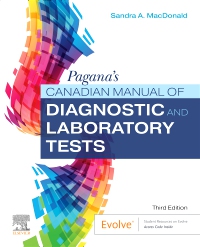

Pagana's Canadian Manual of Diagnostic and Laboratory Tests - Elsevier eBook on VitalSource, 3rd Edition
Elsevier eBook on VitalSource
Written exclusively for a Canadian market, Pagana’s Canadian Manual of Diagnostic and Laboratory Tests, 3rd Edition, provides clear, concise coverage of more than 700 of the most commonly performed tests, with Canadian lab values, SI units, Canadian cultural considerations, and unique Canadian content. Its many student-friendly features include an easy-to-understand writing style, full-colour illustrations, and a logical organization. Each test entry is presented in a consistent format to provide quick access to information on specimen collection, normal findings, indications, test explanation, procedure and patient care, and test results and clinical significance, as well as any applicable contraindications, potential complications, critical values, interfering factors, and related tests. This edition has been updated to reflect the latest procedures, equipment, and techniques, along with 35 of the most current laboratory and diagnostic tests. Plus, Canadian guidelines are highlighted by a maple leaf icon for easy reference!
-
- NEW! Coverage includes 35 of the most current laboratory and diagnostic tests, including Coronavirus testing
- NEW! Guidelines for Patient Preparation and Procedures chapter consolidates and streamlines routine guidelines and procedures for obtaining blood specimens into one chapter. Subsequent chapters refer to this content as appropriate
- NEW! Critical Values feature has expanded into Critical Values Alerts, with real-life case studies to alert the reader to the impact of the critical value on patient care
- NEW! Icon in Procedure and Patient Care sections indicates when blood will need to be collected
- NEW! Additional tests are available on the Evolve companion website
- NEW! Updated photographs and illustrations clarify key concepts and reflect the latest procedures, equipment, and techniques
- NEW! Illustration shows how to accurately obtain a nasopharyngeal specimen
-
1. Guidelines for Patient Preparation and Procedures
2. Blood Studies
3. Electrodiagnostic Tests
4. Endoscopic Studies
5. Fluid Analysis Studies
6. Manometric Studies
7. Microscopic Examinations
8. Nuclear Scanning
9. Stool Tests
10. Ultrasound Studies
11. Urine Studies
12. X-Ray Studies
13. Additional Studies
Appendixes
A. Alphabetical List of Tests
B. List of Tests by Body System
C. Common Testing Profiles
D. Common Abbreviations and Acronyms
E. List of Common Blood Tests and Values
Bibliography
Illustration Credits
Index
Inside Back Cover: Common Units of Measurement -
-
Ways of Reading
- The appearance of the text and page layout can be modified according to the capabilities of the reading system (font family and font size, spaces between paragraphs, sentences, words, and letters, as well as color of background and text)
- This e-publication is accessible to the full extent that the file format and types of content allow, on a specific reading device, by default, without necessarily including any additions such as textual descriptions of images or enhanced navigation
- No information about nonvisual reading is available
-
Conformance
- No information is available
-
Navigation
- Table of contents to all chapters of the text via links
- Page list to go to pages from the print source version
-
Rich Content
- No information is available
-
Hazards
- No information is available
-
Product Content
- No information is available
-
Legal Considerations
- No information is available
-
Additional Accessibility Information
- Page breaks included from the original print source
- For readers with color vision deficiency, use of color (e.g., in diagrams, graphics and charts, in prompts, or on buttons inviting a response) is not the sole means of graphical distinction or of conveying information
- E-publication includes basic navigation (usually less detailed than TOC-based navigation)
- Where links, controls or buttons are included in the content, the purpose or functionality of each link, control or button is apparent from the associated text alone - or where it is unclear, separate link, control or button descriptions are provided
- All (or substantially all) textual matter is arranged in a single logical reading order (including text that is visually presented as separate from the main text flow, e.g., in boxouts, captions, tables, footnotes, endnotes, citations, etc.). Non-textual content is also linked from within this logical reading order. (Purely decorative non-text content can be ignored).
- The language of the text has been specified (e.g., via the HTML or XML lang attribute) to optimise text-to-speech (and other alternative renderings), both at the whole document level and, where appropriate, for individual words, phrases or passages in a different language.
-
Ways of Reading



 as described in our