
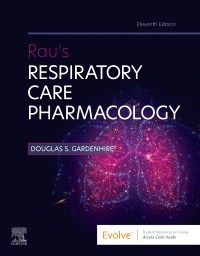

Rau's Respiratory Care Pharmacology Elsevier eBook on VitalSource, 11th Edition
Elsevier eBook on VitalSource
Now $92.39
**Selected for Doody’s Core Titles® 2024 in Respiratory Therapy**
You can breathe a little easier knowing there’s a proven way to master respiratory pharmacology! For more than 30 years, Rau’s Respiratory Care Pharmacology has been the preeminent text on the subject. With easy-to-grasp terminology, relatable explanations, and reader-friendly writing, it simplifies the process of learning pharmacology material like never before. Rau’s is organized into three logical sections, covering the basics of respiratory care, frequently used drugs, and critical care medications. New to the 11th edition are recently approved FDA drugs, information on drug approvals, COVID-19 coverage, and new and updated Clinical Connection boxes that focus on important clinical questions, assisting you in connecting the information in the text to the clinical setting and addressing how Respiratory Therapists can help educate patients.
-
-
 Workbook for Rau's Respiratory Care Pharmacology - Elsevier EBook on VitalSourceElsevier eBook on VitalSource
 -

-

-
-
- Clinical scenarios with follow-up SOAP assessment help you assess your comprehension of the material
- Self-assessment questions offer you thought-provoking opportunities to test your comprehension of key concepts
- Learning objectives parallel the levels tested by the NBRC® exams to help you identify important information that goes beyond memorization and recall
- Key terms with definitions provide easy access to the pharmacologic vocabulary you should embrace
- Key points boxes in each chapter highlight important concepts in the lesson
- Glossary of all key terms in the text aids you in understanding the terminology associated with respiratory care pharmacology
- Appendices on common Units and Systems of Measurement and Acceptable Mixtures provide references to need-to-know information such as abbreviations, conversion charts for temperatures, liquid metric and solids, and a simple drug compatibility chart for drug mixtures
- Alphabetical drug index provides a direct index to look up information based on drug name
-
- NEW and UPDATED! Clinical Connection boxes assist you in connecting information in the text to the clinical setting, including providing patients a better understanding of their clinical conditions as related to their drug treatments
- UPDATED! Chapter 1 reflects changes to drug approval
- UPDATED! Chapter 3 reflects changes in aerosol medication devices and addresses aerosol-generating device issues and COVID-19
- UPDATED! The latest FDA-approved medications are referenced in all chapters
- UPDATED! Current asthma (GINA) and COPD (GOLD) guidelines include COVID-19 treatment protocols
- Enhanced readability helps you more easily understand difficult material
-
Unit A: Basic Concepts and Principles in Pharmacology
1. Introduction to Respiratory Care Pharmacology
2. Principles of Drug Action
3. Administration of Aerosolized Agents
4. Calculating Drug Doses
5. Central and Peripheral Nervous Systems
Unit B: Drugs Used to Treat the Respiratory System
6. Adrenergic (Sympathomimetic) Bronchodilators
7. Anticholinergic (Parasympatholytic) Bronchodilators
8. Xanthines
9. Mucus-Controlling Drug Therapy
10. Surfactant Agents
11. Corticosteroids in Respiratory Care
12. Nonsteroidal Antiasthma Agents
13. Aerosolized Antiinfective Agents
14. Antimicrobial Agents
15. Cold and Cough Agents
16. Selected Agents of Pulmonary Value
17. Neonatal and Pediatric Aerosolized Drug Therapy
Unit C: Critical Care, Cardiovascular, and Polysomnography Agents
18. Skeletal Muscle Relaxants (Neuromuscular Blocking Agents)
19. Diuretic Agents
20. Drugs Affecting the Central Nervous System
21. Vasopressors, Inotropes, and Antiarrhythmic Agents
22. Drugs Affecting Circulation: Antihypertensives, Antianginals, Antithrombotics
23. Sleep and Sleep Pharmacology
Appendixes
A Answers to Self-Assessment Questions and Clinical Scenarios
B Units and Systems of Measurement
C Acceptable Mixtures of Most Commonly Prescribed Respiratory Care Drugs
Glossary of Selected Terms
Index
Abbreviations, Inside back cover -
-
Ways of Reading
- The appearance of the text and page layout can be modified according to the capabilities of the reading system (font family and font size, spaces between paragraphs, sentences, words, and letters, as well as color of background and text)
- This e-publication is accessible to the full extent that the file format and types of content allow, on a specific reading device, by default, without necessarily including any additions such as textual descriptions of images or enhanced navigation
- All content can be read as read aloud speech or dynamic braille
- Has alternative text descriptions for images
-
Conformance
- The publication contains a conformance statement that it meets the EPUB Accessibility 1.1, WCAG 2.1, Level AA standard. Please see https://bornaccessible.benetech.org/certified-publishers/ for further details of our compatibility testing.
- The certifier's credential is https://bornaccessible.benetech.org/certified-publishers/
- For detailed accessibility information, see Elsevier's website at https://www.elsevier.com/about/accessibility
- For queries regarding accessibility information, contact [email protected]
- The publication was certified on 11-02-2026
-
Navigation
- Table of contents to all chapters of the text via links
- Index with links to referenced entries
- Elements such as headings, tables, etc. for structured navigation
- Page list to go to pages from the print source version
-
Rich Content
- Information-rich images are described by extended descriptions
-
Hazards
- The publication contains no hazards
-
Product Content
- Content includes any type of illustrations.
- The primary content is text.
- Content includes a significant number of actionable (clickable) web links to external content, downloadable resources, supplementary material, etc.
- Content includes a significant number of actionable (clickable) cross-references, hyperlinked notes and annotations, or with other actionable links between largely textual elements (e.g., quiz/test questions, 'choose your own ending', etc.).
- Content includes figures, diagrams, charts and/or graphs, including other 'mechanical' (i.e. non-photographic) illustrations.
- Content includes a significant number of web links (printed URLs, QR codes etc.).
- Content includes text within images, including text-as-text embedded in diagrams, charts, or within images containing speech balloons, thought bubbles, captions, etc.
- Content includes chemical notations, formulae.
- Content includes mathematical notations, formulae.
-
Legal Considerations
- No information is available
-
Additional Accessibility Information
- Content is enhanced with ARIA roles to optimize organization and facilitate navigation
- Page breaks included from the original print source
- For readers with color vision deficiency, use of color (e.g., in diagrams, graphics and charts, in prompts, or on buttons inviting a response) is not the sole means of graphical distinction or of conveying information
- The body text is presented with a contrast ratio of at least 4.5:1 (or 3:1 for large/heading text)
- Ultra-high contrast between text and background
- E-publication includes basic navigation (usually less detailed than TOC-based navigation)
- Where links, controls or buttons are included in the content, the purpose or functionality of each link, control or button is apparent from the associated text alone - or where it is unclear, separate link, control or button descriptions are provided
- All (or substantially all) textual matter is arranged in a single logical reading order (including text that is visually presented as separate from the main text flow, e.g., in boxouts, captions, tables, footnotes, endnotes, citations, etc.). Non-textual content is also linked from within this logical reading order. (Purely decorative non-text content can be ignored).
- Content provides explanations for unusual words, abbreviations, acronyms, idioms, jargon in an accessible form, such as glossaries, scripted pop-ups.
- Where interactive content is included in the product, controls are provided (e.g., for speed, pause and resume, reset) and labelled to make their use clear.
- The language of the text has been specified (e.g., via the HTML or XML lang attribute) to optimise text-to-speech (and other alternative renderings), both at the whole document level and, where appropriate, for individual words, phrases or passages in a different language.
-
Ways of Reading

 as described in our