ISBN:
9780323872560
Copyright:
2026
Publication Date:
11-10-2025
Imprint:
Elsevier
List Price:
$111.99

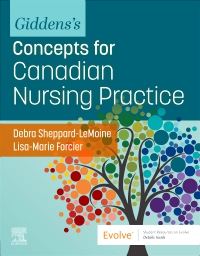
Giddens’s Concepts for Canadian Nursing Practice - Elsevier E-Book on VitalSource, 1st Edition
by Debra (Debbie) Sheppard-LeMoine, RN, PhD and Lisa-Marie Forcier
Elsevier eBook on VitalSource
ISBN:
9780323872560
Copyright:
2026
Publication Date:
11-10-2025
Imprint:
Elsevier
List Price:
$111.99
Was
$111.99
Now $78.39
Or $0.00 with a valid access code
Learn the core concepts of Canadian nursing care and how to apply them to the clinical setting! Giddens’s Concepts for Canadian Nursing Practice uses a simplified, intuitive approach to describe 64 important concepts relating to all areas of nursing practice in a Canadian health care context, including Indigenous health, racism, and gender diversity. Integrating the latest Canadian statistics, research, and cultural considerations, this text emphasizes cultural safety, interprofessional collaboration, and health equity. To reinforce understanding, this book also makes connections among related concepts and links you to other Elsevier nursing textbooks. Exemplars for each concept provide useful examples and models, showing how concepts are successfully applied to practice. Essential tools and case studies for clinical reasoning in nursing help you confidently prepare for almost any clinical nursing situation.
-
- NEW! Nora AI - an AI-powered learning assistant exclusive to Elsevier ebooks on VitalSource's Bookshelf® platform - offers built-in AI learning support that provides personalized answers based on content from the Elsevier ebook
- Fully adapted text reflects Canada’s unique health care context and cultural landscape
- Comprehensive inclusion of Canadian statistics, research, references and resources, guidelines, assessment and screening tools, and more
- Canadian cultural considerations, as they relate to race/ethnicity, Indigenous Peoples, gender identity, 2SLGBTQI+ community, family composition, recent immigrants, refugees and vulnerable persons are threaded throughout all applicable text chapters
- Uniquely Canadian chapters include Holistic Health: Indigenous Perspectives; Racism; and Gender Diversity
- Current content throughout addresses COVID-19, Bill C-14 Medical Assistance in Dying (MAiD), and gender identity considerations as exemplars, reflecting the latest research evidence and national and international health care guidelines
- Features Canadian concepts of Person-Centred Practice, Evidence-Informed Practice, Interprofessional Collaboration and Delegation, and Care in the Community
- Next-Generation NCLEX® (NGN) exam–style case studies and review questions on the Evolve companion website challenge you to apply critical thinking and clinical judgement, providing optimal preparation for the NGN
- Authoritative content written by expert Canadian contributors and grounded in concept-based curriculum (CBC) expert Jean Giddens’ standard for the growing CBC movement
- Logical framework of concepts by units and themes helps you form immediate connections among related concepts — a key to conceptual learning
- Case studies in each chapter make it easier for you to apply knowledge of nursing concepts to real-world situations
- Clearly defined and analyzed nursing concepts span the areas of patient physiology, patient behaviour, and the professional nursing environment
- Featured Exemplars sections describe selected exemplars related to each nursing concept, covering the entire lifespan and all clinical settings, and help you assimilate concepts into practice
- Integrated exemplar links connect you to concept exemplars in other purchased RN- and PN-level Canadian Elsevier nursing titles
- Emphasis on cultural assessment/considerations and caring for Indigenous and vulnerable populations
- NEW! Companion Study Guide helps reinforce your understanding of key concepts. Sold separately.
- Key topics include cultural safety; interprofessional collaboration; systems thinking; the nurse’s role in promoting health equity; equipping nurses to respond to emergencies and other public health crises; and promoting the wellness of nurses
- Coverage provides the most-up-to-date Canadian statistics, references and resources, protocols, documentation standards, delegation rules, Canadian nursing best practice guidelines, metric measurements, and more
- Interrelated Concepts illustrations provide visual cues to understanding and help you make connections across concepts
- Content is “levelled” from concept to concept and chapter to chapter to enhance comprehension
- All topics, skills, and examples conform to Canadian provincial and territorial scopes of practice and Canadian standards in nursing practice
-
UNIT I HEALTH CARE RECIPIENT CONCEPTS
THEME ONE ATTRIBUTES, RESOURCES, AND PREFERENCES
CONCEPT 1. Development
CONCEPT 2. Functional Ability
CONCEPT 3. Family Dynamics
CONCEPT 4. Culture
CONCEPT 5. Self-Management
CONCEPT 6. Spirituality
CONCEPT 7. Adherence
UNIT II HEALTH AND ILLNESS CONCEPTS
THEME TWO HOMEOSTASIS AND REGULATION
CONCEPT 8. Fluid and Electrolytes
CONCEPT 9. Acid–Base Balance
CONCEPT 10. Thermoregulation
CONCEPT 11. Sleep
CONCEPT 12. Cellular Regulation
CONCEPT 13. Intracranial Regulation
CONCEPT 14. Hormonal Regulation
CONCEPT 15. Glucose Regulation
CONCEPT 16. Nutrition
CONCEPT 17. Elimination
CONCEPT 18. Perfusion
CONCEPT 19. Clotting
CONCEPT 20. Gas Exchange
THEME THREE SEXUALITY AND REPRODUCTION
CONCEPT 21. Reproduction
CONCEPT 22. Sexuality
THEME FOUR PROTECTION AND MOVEMENT
CONCEPT 23. Immunity
CONCEPT 24. Inflammation
CONCEPT 25. Infection
CONCEPT 26. Mobility
CONCEPT 27. Tissue Integrity
CONCEPT 28. Sensory Perception
CONCEPT 29. Pain
CONCEPT 30. Fatigue
THEME FIVE MOOD, COGNITION, BEHAVIOUR
CONCEPT 31. Stress and Coping
CONCEPT 32. Mood and Affect
CONCEPT 33. Anxiety
CONCEPT 34. Cognition
CONCEPT 35. Psychosis
CONCEPT 36. Substance Use and Addiction
CONCEPT 37. Interpersonal Violence
UNIT III PROFESSIONAL NURSING AND HEALTH CARE CONCEPTS
THEME SIX PERSONAL DEVELOPMENT
CONCEPT 38. Professional Identity
CONCEPT 39. Well-Being, Hardiness, and Resilience
CONCEPT 40. Leadership
CONCEPT 41. Evidence
CONCEPT 42. Clinical Judgement
THEME SEVEN HOLISTIC CARE
CONCEPT 43. Person-Centred Practice
CONCEPT 44. Ethics
CONCEPT 45. Holistic Health: Indigenous Perspectives
CONCEPT 46. Racism
CONCEPT 47. Gender Diversity
THEME EIGHT CARE COMPETENCIES
CONCEPT 48. Communication
CONCEPT 49. Collaboration
CONCEPT 50. Safety
CONCEPT 51. Health Care Quality
CONCEPT 52. Technology and Informatics
CONCEPT 53. Health Disparities and Health Equity
CONCEPT 54. Care Coordination
CONCEPT 55. Caregiving
CONCEPT 56. Health Promotion
CONCEPT 57. Patient Education
CONCEPT 58. Palliative Care
CONCEPT 59. Population Health
CONCEPT 60. Public Health Emergencies
THEME NINE HEALTH CARE INFRASTRUCTURE
CONCEPT 61. Health Care Organizations
CONCEPT 62. Health Care Economics
CONCEPT 63. Health Policy
CONCEPT 64. Health Care Law -
-
Ways of Reading
- The appearance of the text and page layout can be modified according to the capabilities of the reading system (font family and font size, spaces between paragraphs, sentences, words, and letters, as well as color of background and text)
- This e-publication is accessible to the full extent that the file format and types of content allow, on a specific reading device, by default, without necessarily including any additions such as textual descriptions of images or enhanced navigation
- All content can be read as read aloud speech or dynamic braille
- Has alternative text descriptions for images
-
Conformance
- The certifier's credential is https://bornaccessible.benetech.org/certified-publishers/
- For detailed accessibility information, see Elsevier's website at https://www.elsevier.com/about/accessibility
- For queries regarding accessibility information, contact [email protected]
- The publication was certified on 25-03-2026
-
Navigation
- Table of contents to all chapters of the text via links
- Index with links to referenced entries
- Elements such as headings, tables, etc. for structured navigation
- Page list to go to pages from the print source version
-
Rich Content
- Math formulas in accessible format (MathML)
- Information-rich images are described by extended descriptions
-
Hazards
- The publication contains no hazards
-
Product Content
- Content includes any type of illustrations.
- The primary content is text.
- Content includes a significant number of actionable (clickable) web links to external content, downloadable resources, supplementary material, etc.
- Content includes a significant number of actionable (clickable) cross-references, hyperlinked notes and annotations, or with other actionable links between largely textual elements (e.g., quiz/test questions, 'choose your own ending', etc.).
- Content includes additional textual content such as an interview, feature article, essay, bibliography, quiz/test, other background material, or text that is not included in a primary or 'unenhanced' version.
- Content includes figures, diagrams, charts and/or graphs, including other 'mechanical' (i.e. non-photographic) illustrations.
- Content includes a significant number of web links (printed URLs, QR codes etc.).
- Content includes mathematical notations, formulae.
- Product includes actionable (clickable) links to external interactive content.
-
Legal Considerations
- No information is available
-
Additional Accessibility Information
- Content is enhanced with ARIA roles to optimize organization and facilitate navigation
- Page breaks included from the original print source
- For readers with color vision deficiency, use of color (e.g., in diagrams, graphics and charts, in prompts, or on buttons inviting a response) is not the sole means of graphical distinction or of conveying information
- The body text is presented with a contrast ratio of at least 4.5:1 (or 3:1 for large/heading text)
- Text-to-speech has been optimized through provision of PLS lexicons, SSML or CSS Speech synthesis hints or other speech synthesis markup languages or hinting
- Ultra-high contrast between text and background
- E-publication includes basic navigation (usually less detailed than TOC-based navigation)
- Where links, controls or buttons are included in the content, the purpose or functionality of each link, control or button is apparent from the associated text alone - or where it is unclear, separate link, control or button descriptions are provided
- All (or substantially all) textual matter is arranged in a single logical reading order (including text that is visually presented as separate from the main text flow, e.g., in boxouts, captions, tables, footnotes, endnotes, citations, etc.). Non-textual content is also linked from within this logical reading order. (Purely decorative non-text content can be ignored).
- Content provides explanations for unusual words, abbreviations, acronyms, idioms, jargon in an accessible form, such as glossaries, scripted pop-ups.
- Where interactive content is included in the product, controls are provided (e.g., for speed, pause and resume, reset) and labelled to make their use clear.
- The language of the text has been specified (e.g., via the HTML or XML lang attribute) to optimise text-to-speech (and other alternative renderings), both at the whole document level and, where appropriate, for individual words, phrases or passages in a different language.
-
Ways of Reading


Was
$111.99
Now $78.39
Or $0.00 with a valid access code

 as described in our