ISBN:
9780323872980
Copyright:
2024
Publication Date:
11-13-2023
Page Count:
1264
Imprint:
Elsevier
List Price:
$117.99

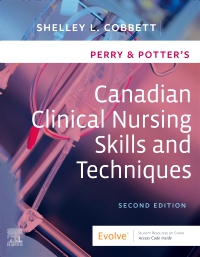
Perry & Potter's Canadian Clinical Nursing Skills and Techniques - Elsevier eBook on VitalSource, 2nd Edition
by Shelley Cobbett, RN, BN, GnT, MN, EdD
Elsevier eBook on VitalSource
ISBN:
9780323872980
Copyright:
2024
Publication Date:
11-13-2023
Page Count:
1264
Imprint:
Elsevier
List Price:
$117.99
Was
$117.99
Now $82.59
Or $0.00 with a valid access code
Perry & Potter’s Canadian Clinical Nursing Skills and Techniques, 2nd Edition helps equip you with the skills you need to successfully care for patients within the Canadian social and institutional context. Offering comprehensive coverage of more than 200 basic, intermediate, and advanced skills, this textbook features nearly 1,000 full-colour photographs and illustrations, a nursing process framework, step-by-step instructions with rationales, and a focus on critical thinking and evidence-informed practice. New to this edition are unit openers, safety alerts, documentation examples, COVID-19 precautions and protocols, and case studies and questions for the Next-Generation NCLEX®.
-
- NEW! Nora AI - an AI-powered learning assistant exclusive to Elsevier ebooks on VitalSource's Bookshelf® platform - offers built-in AI learning support that provides personalized answers based on content from the Elsevier ebook
- Includes the most-up-to-date Canadian statistics, references and resources, protocols, documentation standards, delegation rules, Canadian nursing best practice guidelines, metric measurements, and more!
- All topics, skills, and sample documentation conform to Canadian provincial and territorial scopes of practice and Canadian standards in nursing practice
- NEW! Unit openers explain the importance of clinical judgement in performing the skills covered in the unit safely and correctly. These openers also demonstrate the impact of environmental factors and interdisciplinary collaboration on safe patient care
- NEW! Safety Alerts highlight the importance and need for special monitoring or intervention in some circumstances
- NEW! Documentation examples provide guidance on documentation for various aspects of nursing care
- NEW! Care in the Community: Home Management subsections in Care and Community highlight specific home care issues related to applicable skills
- NEW! COVID-19 precautions and protocols are included in relevant skills
- NEW! Hand and hygiene icon added to “hand hygiene moments” provides a quick visual prompt to this important protocol
- NEW! Case studies for the Next-Generation NCLEX® on the Evolve companion website, with accompanying questions for the Next-Generation NCLEX®, challenge you to apply critical thinking and clinical judgement, providing optimal preparation for the exam
- UNIQUE! Evidence-Informed Nursing Practice chapter covers the entire process of conducting research, including collecting, evaluating, and applying evidence from published research
- UNIQUE! Unexpected Outcomes and Related Interventions sections alert you to what might go wrong and how to appropriately intervene
- Coverage includes the Canadian concepts of person-centred care, evidence-informed practice, interprofessional collaboration and delegation, and care in the community
- Emphasis on cultural assessment/considerations and caring for Indigenous and vulnerable populations
- Comprehensive coverage includes more than 200 basic, intermediate, and advanced nursing skills
- Streamlined theory content in each chapter features a quick, easy-to-read bullet format to help reduce repetition and emphasize the clinical focus of the book
- Case-based review questions at the end of each chapter focus on issues such as managing conflict, care prioritization, patient safety, and decision-making to help you better prepare for the clinical setting
- Nursing process framework incorporates the areas of delegation and collaboration; reporting and recording; safety guidelines; and teaching, pediatric, geriatric, and home care considerations
- Basic skills presented in streamlined procedural guidelines format makes it easy learn and review basic nursing skills
- Critical Decision Points within skills address key safety issues or possible skill modifications for specific patient needs
- Rationales for each skill step explain why steps are performed in a specific way, including their clinical significance and benefit, and incorporate the latest research findings
- Video clip icons indicate video clips that are related to skills and procedures in the book and related lessons in Nursing Skills Online
- Online checklists and video clips may be downloaded to mobile devices
-
Unit I: Supporting the Patient Through the Health Care System
1. Evidence-Informed Nursing Practice
2. Transitions in Care
3. Communication and Collaboration
4. Documentation and Informatics
Unit II: Infection Control
5. Medical Asepsis
6. Sterile Technique
Unit III: Vital Signs and Physical Assessment
7. Vital Signs
8. Health Assessment
Unit IV: Special Procedures
9. Specimen Collection
10. Diagnostic Procedures (e-only chapter)
Unit V: Activity and Mobility
11. Safe Patient Handling, Transfer, and Positioning
12. Exercise, Mobility, and Immobilization Devices
13. Support Surfaces and Special Beds
Unit VI: Safety and Comfort
14. Patient Safety
15. Emergency Preparedness and Disaster Management
16. Pain Assessment and Management
17. Palliative and End-of-Life Care
Unit VII: Hygiene
18. Personal Hygiene and Bed Making
19. Care of the Eye and Ear
Unit VIII: Medications
20. Safe Medication Preparation
21. Nonparenteral Medications
22. Parenteral Medications
Unit IX: Oxygenation
23. Airway Management
24. Performing Chest Physiotherapy
25. Oxygen Therapy
26. Cardiac Monitoring
27. Closed Chest Drainage Systems
28. Emergency Measures for Life Support
Unit X: Fluid Balance
29. Vascular Access and Infusion Therapy
30. Blood Therapy
Unit XI: Nutrition
31. Oral Nutrition
32. Enteral Nutrition
33. Parenteral Nutrition
Unit XII: Elimination
34. Urinary Elimination and Catheterization
35. Bowel Elimination and Gastric Intubation
36. Ostomy Care
Unit XIII: Care of the Surgical Patient
37. Preoperative and Postoperative Care
38. Intraoperative Care
Unit XIV: Dressings and Wound Care
39. Prevention and Care of Skin Breakdown
40. Wound Care Management and Dressings
41. Therapeutic Use of Heat and Cold
Unit XV: Nursing in the Community
42. Safety in the Community -
-
Ways of Reading
- The appearance of the text and page layout can be modified according to the capabilities of the reading system (font family and font size, spaces between paragraphs, sentences, words, and letters, as well as color of background and text)
- This e-publication is accessible to the full extent that the file format and types of content allow, on a specific reading device, by default, without necessarily including any additions such as textual descriptions of images or enhanced navigation
- All content can be read as read aloud speech or dynamic braille
- Has alternative text descriptions for images
-
Conformance
- The certifier's credential is https://bornaccessible.benetech.org/certified-publishers/
- The publication was certified on 24-03-2026
-
Navigation
- Table of contents to all chapters of the text via links
- Index with links to referenced entries
- Elements such as headings, tables, etc. for structured navigation
- Page list to go to pages from the print source version
-
Rich Content
- Math formulas in accessible format (MathML)
- Chemical formulas in accessible format (MathML)
- Information-rich images are described by extended descriptions
-
Hazards
- The publication contains no hazards
-
Product Content
- Content includes any type of illustrations.
- The primary content is text.
- Content includes maps and/or other cartographic content.
- Content includes a significant number of actionable (clickable) web links to external content, downloadable resources, supplementary material, etc.
- Content includes a significant number of actionable (clickable) cross-references, hyperlinked notes and annotations, or with other actionable links between largely textual elements (e.g., quiz/test questions, 'choose your own ending', etc.).
- Content includes photographs, whether in a plate section / insert or not.
- Content includes figures, diagrams, charts and/or graphs, including other 'mechanical' (i.e. non-photographic) illustrations.
- Content is enhanced with additional images or graphical content such as supplementary photographs that are not included in a primary or 'unenhanced' version.
- Content includes images displayed in a specific order for the purpose of graphic storytelling or giving information (e.g. graphic novels, comics and manga). May include text integrated into the image (as speech and thought bubbles, textual 'sound' effects, captions etc.).
- Content includes text within images, including text-as-text embedded in diagrams, charts, or within images containing speech balloons, thought bubbles, captions, etc.
- Content includes visual content that is purely decorative and is not necessary to understanding of the content.
- Content includes mathematical notations, formulae.
- At least some text - including text within other images - is 'text as an image' (i.e., a picture of text).
- Product includes actionable (clickable) links to external interactive content.
-
Legal Considerations
- No information is available
-
Additional Accessibility Information
- Content is enhanced with ARIA roles to optimize organization and facilitate navigation
- Page breaks included from the original print source
- For readers with color vision deficiency, use of color (e.g., in diagrams, graphics and charts, in prompts, or on buttons inviting a response) is not the sole means of graphical distinction or of conveying information
- The body text is presented with a contrast ratio of at least 4.5:1 (or 3:1 for large/heading text)
- Ultra-high contrast between text and background
- E-publication includes basic navigation (usually less detailed than TOC-based navigation)
- Where links, controls or buttons are included in the content, the purpose or functionality of each link, control or button is apparent from the associated text alone - or where it is unclear, separate link, control or button descriptions are provided
- All (or substantially all) textual matter is arranged in a single logical reading order (including text that is visually presented as separate from the main text flow, e.g., in boxouts, captions, tables, footnotes, endnotes, citations, etc.). Non-textual content is also linked from within this logical reading order. (Purely decorative non-text content can be ignored).
- Content provides explanations for unusual words, abbreviations, acronyms, idioms, jargon in an accessible form, such as glossaries, scripted pop-ups.
- Where interactive content is included in the product, controls are provided (e.g., for speed, pause and resume, reset) and labelled to make their use clear.
- The language of the text has been specified (e.g., via the HTML or XML lang attribute) to optimise text-to-speech (and other alternative renderings), both at the whole document level and, where appropriate, for individual words, phrases or passages in a different language.
-
Ways of Reading


Was
$117.99
Now $82.59
Or $0.00 with a valid access code

 as described in our