ISBN:
9780323874588
Copyright:
2023
Publication Date:
10-21-2022
Page Count:
720
Imprint:
Elsevier
List Price:
$95.99

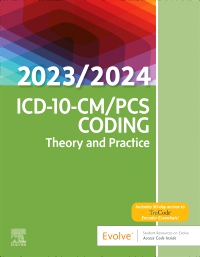
ICD-10-CM/PCS Coding: Theory and Practice, 2023/2024 Edition - Elsevier E-Book on VitalSource, 1st Edition
by Elsevier Inc
Elsevier eBook on VitalSource
ISBN:
9780323874588
Copyright:
2023
Publication Date:
10-21-2022
Page Count:
720
Imprint:
Elsevier
List Price:
$95.99
Was
$95.99
Now $67.19
Or $0.00 with a valid access code
Learn facility-based coding by actually working with codes. ICD-10-CM/PCS Coding: Theory and Practice provides an in-depth understanding of inpatient diagnosis and procedure coding to those who are just learning to code, as well as to experienced professionals who need to solidify and expand their knowledge. Featuring basic coding principles, clear examples, and challenging exercises, this text helps explain why coding is necessary for reimbursement, the basics of the health record, and rules, guidelines, and functions of ICD-10-CM/PCS coding.
New Edition Expected Availability: 08-26-2024

ICD-10-CM/PCS Coding: Theory and Practice, 2025/2026 Edition-Elsevier E-Book on VitalSource
Elsevier eBook on VitalSource
ISBN: 9780443261046
-
- NEW! Updated ICD-10 codes and coding guidelines revisions ensure students have the most up-to-date information available
-
- 30-day access to TruCode® Encoder Essentials gives students experience with using an encoder software, plus access to additional encoder practice exercises on the Evolve website
- ICD-10-CM and ICD-10-PCS Official Guidelines for Coding and Reporting provide fast, easy access to instructions on proper application of codes
- Coverage of both common and complex procedures prepares students for inpatient procedural coding using ICD-10-PCS
- Numerous and varied examples and exercises within each chapter break the material into manageable segments and help students gauge learning while reinforcing important concepts
- Illustrations and examples of key diseases help in understanding how commonly encountered conditions relate to ICD-10-CM coding
- Strong coverage of medical records provides a context for coding and familiarizes students with documents they will encounter on the job
- Illustrated, full-color design emphasizes important content such as anatomy and physiology and visually reinforces key concepts
- Evolve website offers students online access to additional practice exercises, coding guidelines, answer keys, coding updates, and more
-
1. The Rationale for and History of Coding
2. The Health Record as the Foundation of Coding
3. ICD-10-CM Format and Conventions
4. Basic Steps of Coding
5. General Coding Guidelines for Diagnosis
6. Introduction to ICD-10-PCS
7. General Coding Guidelines for Other Medical- and Surgical-Related Procedures and Ancillary Procedures
8. Coding Medical and Surgical Procedures
9. Symptoms, Signs, and Abnormal Clinical and Laboratory Findings Not Elsewhere Classified, and Z Codes (ICD-10-CM Chapters 18 and 21, Codes R00-R99, Z00-Z99)
10. Certain Infectious and Parasitic Diseases (ICD-10-CM Chapters 1 and 22, Codes A00-B99, U07.1, U09.9)
11. Neoplasms (ICD-10-CM Chapter 2, Codes C00-D49)
12. Diseases of the Blood and Blood-Forming Organs and Certain Disorders Involving the Immune Mechanism (ICD-10-CM Chapter 3, Codes D50-D89)
13. Endocrine, Nutritional, and Metabolic Diseases (ICD-10-CM Chapter 4, Codes E00-E89)
14. Mental, Behavioral, and Neurodevelopmental Disorders (ICD-10-CM Chapter 5, Codes F01-F99)
15. Diseases of the Nervous System, Diseases of the Eye and Adnexa, and Diseases of the Ear and Mastoid Process (ICD-10-CM Chapter 6, Codes G00-G99, Chapter 7,Codes H00-H59, and Chapter 8, Codes H60-H95)
16. Diseases of the Circulatory System (ICD-10-CM Chapter 9, Codes I00-I99)
17. Diseases of the Respiratory System (ICD-10-CM Chapters 10 and 22, Codes J00-J99, U07.0)
18. Diseases of the Digestive System (ICD-10-CM Chapter 11, Codes K00-K95)
19. Diseases of the Skin and Subcutaneous Tissue (ICD-10-CM Chapter 12, Codes L00-L99)
20. Diseases of the Musculoskeletal System and Connective Tissue (ICD-10-CM Chapter 13, Codes M00-M99)
21. Diseases of the Genitourinary System (ICD-10-CM Chapter 14, Codes N00-N99)
22. Pregnancy, Childbirth, and the Puerperium (ICD-10-CM Chapter 15, Codes O00-O9A)
23. Certain Conditions Originating in the Perinatal Period, and Congenital Malformations, Deformations, and Chromosomal Abnormalities (ICD-10-CM Chapter 16, Codes P00-P96 and Chapter 17, Codes Q00-Q99)
24. Injury and Certain Other Consequences of External Causes and External Causes of Morbidity (ICD-10-CM Chapter 19, Codes S00-T88 and Chapter 20, Codes V00-Y99)
25. Burns, Adverse Effects, and Poisonings (ICD-10-CM Chapters 19 and 20, Codes S00-Y99)
26. Complications of Surgical and Medical Care -
-
Ways of Reading
- The appearance of the text and page layout can be modified according to the capabilities of the reading system (font family and font size, spaces between paragraphs, sentences, words, and letters, as well as color of background and text)
- This e-publication is accessible to the full extent that the file format and types of content allow, on a specific reading device, by default, without necessarily including any additions such as textual descriptions of images or enhanced navigation
- No information about nonvisual reading is available
-
Conformance
- No information is available
-
Navigation
- Table of contents to all chapters of the text via links
- Page list to go to pages from the print source version
-
Rich Content
- No information is available
-
Hazards
- No information is available
-
Product Content
- No information is available
-
Legal Considerations
- No information is available
-
Additional Accessibility Information
- Page breaks included from the original print source
- For readers with color vision deficiency, use of color (e.g., in diagrams, graphics and charts, in prompts, or on buttons inviting a response) is not the sole means of graphical distinction or of conveying information
- E-publication includes basic navigation (usually less detailed than TOC-based navigation)
- Where links, controls or buttons are included in the content, the purpose or functionality of each link, control or button is apparent from the associated text alone - or where it is unclear, separate link, control or button descriptions are provided
- All (or substantially all) textual matter is arranged in a single logical reading order (including text that is visually presented as separate from the main text flow, e.g., in boxouts, captions, tables, footnotes, endnotes, citations, etc.). Non-textual content is also linked from within this logical reading order. (Purely decorative non-text content can be ignored).
- The language of the text has been specified (e.g., via the HTML or XML lang attribute) to optimise text-to-speech (and other alternative renderings), both at the whole document level and, where appropriate, for individual words, phrases or passages in a different language.
-
Ways of Reading

Was
$95.99
Now $67.19
Or $0.00 with a valid access code

 as described in our