ISBN:
9780323874939
Copyright:
2014
Publication Date:
03-18-2021
Page Count:
368
Imprint:
Saunders
List Price:
$117.99

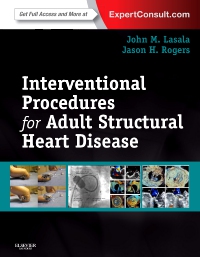
Interventional Procedures for Adult Structural Heart Disease - Elsevier E-Book on VitalSource, 1st Edition
by John M Lasala, MD, PhD and Jason H. Rogers, MD, FACC, FSCAI
Elsevier eBook on VitalSource
ISBN:
9780323874939
Copyright:
2014
Publication Date:
03-18-2021
Page Count:
368
Imprint:
Saunders
List Price:
$117.99
Was
$117.99
Now $106.19
Or $0.00 with a valid access code
2014 BMA Medical Book Awards Highly Commended in Cardiology category!
Apply the latest percutaneous techniques with the practical, highly illustrated Interventional Procedures for Structural Heart Disease. This brand-new medical reference book presents full-color images, numerous tables, and invaluable clinical pearls to help you utilize today's hottest techniques and technologies for each disease, so you can offer your patients the most desirable outcomes possible.
-
- Master today's hottest percutaneous procedures for structural heart disease as perfected by experts from around the world, including transcatheter aortic valve replacement (TAVR), percutaneous paravalvular leak closure, transcatheter mitral valve interventions, a wide variety of adult congenital cardiovascular defect interventions, and more
- Grasp the specific knowledge you will need for success in a variety of clinical scenarios, as well as the patient selection criteria for each invasive procedure
- Make informed, evidence-based decisions with the latest clinical trial results and evidence integrated into each chapter
- Visualize the newest techniques and technologies more clearly through a full-color design featuring illustrations, tables, clinical pearls, complications, and current evidence boxes
- Seamlessly search the full text online at Expert Consult
-
1. The Growing Specialty of Adult Structural Heart Disease
2. Imaging in Structural Heart Disease
3. Vascular Access for Structural Heart Disease
4. Transseptal Heart Catheterization
5. Aortic and Pulmonic Balloon Valvuloplasty
6. Transcatheter Aortic Valve Replacement: Edwards SAPIEN Valve
7. Self-Expanding Transcatheter Aortic Valve Replacement Using the Core Valve Transcatheter Heart Valve
8. Percutaneous Pulmonary Valve Implantation
9. Percutaneous Balloon Valvuloplasty for Patients with Rheumatic Mitral and Tricuspid Stenosis
10. Percutaneous Approaches for Treating Mitral Regurgitation
11. The MitraClip Device and Procedural Overview
12. Percutaneous Repair of Paravalvular Leaks
13. Valve-in-Valve Therapy
14. Alcohol Septal Ablation for Obstructive Hypertrophic Cardiomyopathy
15. Percutaneous Approach to Pericardial Window
16. Transcatheter Left Atrial Appendage Occlusion
17. Percutaneous Closure of Congenital, Acquired and Postinfarction Ventricular Septal Defects
18. Percutaneous Closure of Aortic, Coronary and Ventricular Pseudoaneurysms, Coronary Fistulae
19. Percutaneous Treatment of Pulmonary Vein Stenosis
20. Patent Foramen Ovale
21. Atrial Septal Defect Creation
22. Unwanted Vascular Communications: Patent Ductus Arteriosus, Coronary Fistulas, Pulmonary Vascular Malformations, and Aorto-Pulmonary Collaterals
23. Percutaneous Relief of Vascular Obstruction: Potpourri -
-
Ways of Reading
- The appearance of the text and page layout can be modified according to the capabilities of the reading system (font family and font size, spaces between paragraphs, sentences, words, and letters, as well as color of background and text)
- This e-publication is accessible to the full extent that the file format and types of content allow, on a specific reading device, by default, without necessarily including any additions such as textual descriptions of images or enhanced navigation
- No information about nonvisual reading is available
-
Conformance
- No information is available
-
Navigation
- Table of contents to all chapters of the text via links
- Page list to go to pages from the print source version
-
Rich Content
- No information is available
-
Hazards
- No information is available
-
Product Content
- No information is available
-
Legal Considerations
- No information is available
-
Additional Accessibility Information
- Page breaks included from the original print source
- For readers with color vision deficiency, use of color (e.g., in diagrams, graphics and charts, in prompts, or on buttons inviting a response) is not the sole means of graphical distinction or of conveying information
- E-publication includes basic navigation (usually less detailed than TOC-based navigation)
- Where links, controls or buttons are included in the content, the purpose or functionality of each link, control or button is apparent from the associated text alone - or where it is unclear, separate link, control or button descriptions are provided
- All (or substantially all) textual matter is arranged in a single logical reading order (including text that is visually presented as separate from the main text flow, e.g., in boxouts, captions, tables, footnotes, endnotes, citations, etc.). Non-textual content is also linked from within this logical reading order. (Purely decorative non-text content can be ignored).
- The language of the text has been specified (e.g., via the HTML or XML lang attribute) to optimise text-to-speech (and other alternative renderings), both at the whole document level and, where appropriate, for individual words, phrases or passages in a different language.
-
Ways of Reading
Was
$117.99
Now $106.19
Or $0.00 with a valid access code

 as described in our