
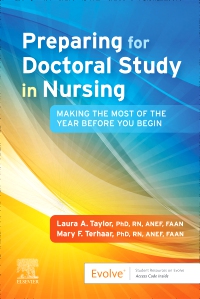

Preparing for Doctoral Study in Nursing - Elsevier E-Book on VitalSource, 1st Edition
Elsevier eBook on VitalSource
Now $54.55
**American Journal of Nursing (AJN) Book of the Year Awards, 3rd Place in Nursing Education/Professional Development, 2024**
Are you ready to take your nursing career to the next level? Preparing for Doctoral Study in Nursing: Making the Most of the Year Before You Begin helps you make an informed decision about entering doctoral studies and choosing the nursing credential that helps you reach your career goals. Noted educators and doctoral mentors Laura A. Taylor and Mary F. Terhaar — along with a team of nursing leaders and scholars — describe the big picture for nurses educated at the highest level of scholarship, including the rising demand for advanced practice nurses and the future of nursing. The first and only comprehensive guide to preparing for a doctorate in nursing, this book helps you choose your path, make your decision, and develop a plan for success in doctoral study.

-
- Grounded in more than a decade of experience in preparing nurses for doctoral study, this one-of-a-kind text is the first comprehensive guide to the year before you apply
- Fifteen chapters provide practical information and guidance to help you navigate the challenges on your journey
- Historical overview of doctoral education in nursing creates a clear picture of present and future demand
- Clear explanation of the different degrees and the careers they support helps to build confidence in your decision about which to pursue
- Sixteen personal narratives describe a broad range of career paths open to nurses who earn doctoral degrees and introduce the nurse leaders who have walked them
- Online Evolve Resources include podcasts that bring the experiences of contributing authors to life
- Additional Evolve Resources include practical forms, worksheets, planners, and representations of models referenced in the text
- Illustrations clarify complex content, helping to make it more memorable and useful, and links to additional online resources serve as a springboard for additional learning
- The diversity of the contributors, backgrounds, interests, and accomplishments gives you a sense that you belong and that your authentic self will add value to our discipline and to global health
- At once scholarly and warm, the style of this book makes it a must-read for nurses who aspire to careers of importance and leadership
-
SECTION 1 The Big Picture of Nurses Educated at the Highest Level
1. The Demand for the Doctorally Prepared Nurse
2. The Story of the Doctorally Prepared Nurse
3. Building Nursing for the Future
4. Reflection on Challenges: The Nursing Workforce Shortage
SECTION 2 Choosing Your Path, Making Your Decision, and Developing Your Plan
5. Clarifying Your Options
6. Clarifying Your Aspirations
7. Common Impediments to Success
8. Mentoring for the Next Generation of Nurse Scholars
9. Understanding and Managing Expenses: Financing Your Education
10. Presenting a Strong and Authentic Application
11. Using Timely Wisely and Well
12. Becoming a Write
13. Determining Good Fit
14. Staying Motivated, Confident, and Well Focused as a Doctoral Student
SECTION 3 Shared Experiences of Doctorally Prepared Nurses on the Edge of Tomorrow
15. The Nurse Scientist Narrative
16. The Primary Care DNP Narrative
17. The Entrepreneur Narrative
18. The Postdoc Narrative
19. The Academic Narratives
20. The Nurse Informatician Narratives
21. The Population Health Nurse Narratives
22. The Policy Expert Narrative
23. The Nurse on the Board Narrative
24. The Leader Narrative
25. The Advocate Narrative
26. The Military Nurse Narratives
27. The Systems Executive Narrative
28. The Telehealth Nurse Narrative
29. The Researcher Nurse Narratives
30. The Health Disparities Nurse Narrative
31. The Practice Nurse Narratives
32. The Psychiatric Mental Health Clinician Narrative
SECTION 4 A Toolkit for Preparation for Doctoral Study
33. Tools for the Journey -
-
Ways of Reading
- The appearance of the text and page layout can be modified according to the capabilities of the reading system (font family and font size, spaces between paragraphs, sentences, words, and letters, as well as color of background and text)
- This e-publication is accessible to the full extent that the file format and types of content allow, on a specific reading device, by default, without necessarily including any additions such as textual descriptions of images or enhanced navigation
- No information about nonvisual reading is available
-
Conformance
- For detailed accessibility information, see Elsevier's website at https://www.elsevier.com/about/accessibility
- For queries regarding accessibility information, contact [email protected]
- The publication was certified on 03-11-2025
-
Navigation
- Table of contents to all chapters of the text via links
-
Rich Content
- No information is available
-
Hazards
- No information is available
-
Product Content
- No information is available
-
Legal Considerations
- No information is available
-
Additional Accessibility Information
- For readers with color vision deficiency, use of color (e.g., in diagrams, graphics and charts, in prompts, or on buttons inviting a response) is not the sole means of graphical distinction or of conveying information
- E-publication includes basic navigation (usually less detailed than TOC-based navigation)
- Where links, controls or buttons are included in the content, the purpose or functionality of each link, control or button is apparent from the associated text alone - or where it is unclear, separate link, control or button descriptions are provided
- All (or substantially all) textual matter is arranged in a single logical reading order (including text that is visually presented as separate from the main text flow, e.g., in boxouts, captions, tables, footnotes, endnotes, citations, etc.). Non-textual content is also linked from within this logical reading order. (Purely decorative non-text content can be ignored).
- The language of the text has been specified (e.g., via the HTML or XML lang attribute) to optimise text-to-speech (and other alternative renderings), both at the whole document level and, where appropriate, for individual words, phrases or passages in a different language.
-
Ways of Reading


 as described in our