ISBN:
9780323878609
Copyright:
2023
Publication Date:
06-20-2022
Page Count:
400
Imprint:
Mosby
List Price:
$36.99

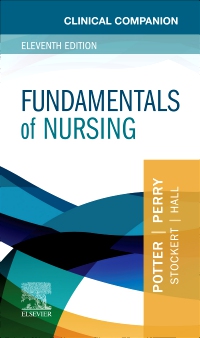
Clinical Companion for Fundamentals of Nursing - Elsevier eBook on VitalSource, 11th Edition
by Patricia A. Potter, RN, MSN, PhD, FAAN, Anne G. Perry, RN, MSN, EdD, FAAN, Patricia A. Stockert, RN, BSN, MS, PhD and Amy Hall, RN, BSN, MS, PhD, CNE
Elsevier eBook on VitalSource
ISBN:
9780323878609
Copyright:
2023
Publication Date:
06-20-2022
Page Count:
400
Imprint:
Mosby
List Price:
$36.99
Was
$36.99
Now $33.29
Or $0.00 with a valid access code
To find the clinical facts you need to know, make this pocket guide your constant companion! Clinical Companion for Fundamentals of Nursing, 11th Edition includes the hard-to-remember facts, lab values, and abbreviations that are essential to providing optimal nursing care. Organized by the major concepts and principles of your nursing fundamentals course, this reference features a quick-access format with summary tables and bulleted lists. The Clinical Companion makes retrieving, reviewing, and retaining clinical facts and figures easier than ever!
New Edition Expected Availability: 05-27-2025

Clinical Companion for Fundamentals of Nursing - Elsevier E-Book on VitalSource
Elsevier eBook on VitalSource
ISBN: 9780443278334
-
- NEW! A Clinical Judgment and the Nursing Process chapter is added to this edition
-
- Basic facts and figures, standard values, care guidelines and more provide the background frequently needed in a reference for clinical practice
- At-a-glance content is provided in outline, list, and tabular formats for easy lookup and review
- Detailed information on medications helps to prevent medication errors and ensure safe practice, with topics including dosage calculations, compatibilities, conversions, and administration
- Vital Signs chapter contains everything you need to know to quickly and accurately obtain vital signs
- Physical Assessment chapter provides a systematic and thorough approach to health assessment
- Interprofessional Collaboration and Delegation chapter explains the role of the nurse within the larger healthcare team
- Pressure injury information includes prevention and care guidelines
- Medical, Nursing, and Health Professions Terminology chapter acts as a quick medical terminology refresher and helps you understand clinical terms as they are encountered.
- Concise, pocket-sized format ensures portability for use in the clinical setting
-
-
 Fundamentals of Nursing - Elsevier eBook on VitalSourceElsevier eBook on VitalSource
-
-
1. Medical, Nursing, and Health
Professions Terminology
2. Communication
3. Interprofessional Collaboration and Delegation
4. Clinical Judgment and the Nursing Process
5. Documentation
6. Patient Interview
7. Vital Signs
8. Physical Assessmen
9. Pain Assessment
10. Skin, Hair, and Nail Assessment
11. Head, Eyes, Ears, Nose, and Throat Assessment (HEENT)
12. Respiratory Assessment
13. Cardiac and Peripheral Vascular Assessment
14. Musculoskeletal Assessment
15. Neurological Assessment
16. Abdominal Assessment
17. Breast and Genital Assessment
18. Safety
19. Equivalents and Dosage Calculation
20. Medication Administration
21. Infection Control
22. Mobility and Positioning
23. Personal Care
24. Wound Care
25. Oxygen Administration
26. Nutrition and Diets
27. Diagnostic Testing and Procedures
28. Preoperative and Postoperative Care
29. Emergent Clinical Situations
30. Death and Dying -
-
Ways of Reading
- The appearance of the text and page layout can be modified according to the capabilities of the reading system (font family and font size, spaces between paragraphs, sentences, words, and letters, as well as color of background and text)
- This e-publication is accessible to the full extent that the file format and types of content allow, on a specific reading device, by default, without necessarily including any additions such as textual descriptions of images or enhanced navigation
- No information about nonvisual reading is available
-
Conformance
- No information is available
-
Navigation
- Table of contents to all chapters of the text via links
- Page list to go to pages from the print source version
-
Rich Content
- No information is available
-
Hazards
- No information is available
-
Product Content
- No information is available
-
Legal Considerations
- No information is available
-
Additional Accessibility Information
- Page breaks included from the original print source
- For readers with color vision deficiency, use of color (e.g., in diagrams, graphics and charts, in prompts, or on buttons inviting a response) is not the sole means of graphical distinction or of conveying information
- E-publication includes basic navigation (usually less detailed than TOC-based navigation)
- Where links, controls or buttons are included in the content, the purpose or functionality of each link, control or button is apparent from the associated text alone - or where it is unclear, separate link, control or button descriptions are provided
- All (or substantially all) textual matter is arranged in a single logical reading order (including text that is visually presented as separate from the main text flow, e.g., in boxouts, captions, tables, footnotes, endnotes, citations, etc.). Non-textual content is also linked from within this logical reading order. (Purely decorative non-text content can be ignored).
- The language of the text has been specified (e.g., via the HTML or XML lang attribute) to optimise text-to-speech (and other alternative renderings), both at the whole document level and, where appropriate, for individual words, phrases or passages in a different language.
-
Ways of Reading
Was
$36.99
Now $33.29
Or $0.00 with a valid access code

 as described in our