ISBN:
9780323878708
Copyright:
2025
Publication Date:
11-27-2024
Page Count:
1032
Imprint:
Elsevier
List Price:
$230.99
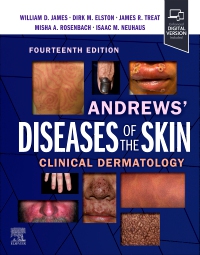
Andrews' Diseases of the Skin, 14th Edition
by William D. James, MD, Dirk M. Elston, MD, James R. Treat, MD and Misha Rosenbach, MD
Hardcover
ISBN:
9780323878708
Copyright:
2025
Publication Date:
11-27-2024
Page Count:
1032
Imprint:
Elsevier
List Price:
$230.99
In Stock
Most review copies are eBooks – how fast!
A review copy request is most likely to be fulfilled as an eBook on VitalSource rather than a print product, unless no eBook is available. eBooks become available in as little as a few hours. Print products will take between 7 and 10 days to arrive. To request a print copy, please contact us through the Evolve Support Center for further assistance or contact your Elsevier Sales Rep.
-
- Utilizes a concise, clinically focused, user-friendly format that clearly covers the full range of common and rare skin diseases. The small team author approach provides consistency and clearly conveys the authors’ first-hand experience
- Features expanded coverage of skin of color—now 46% of all images—including distinct distribution or presentations, how to recognize disease states, and how treatment responses may differ
- Works in tandem with the companion Andrews’ Diseases of the Skin Clinical Atlas, 2nd Edition, which contains over 3,000 images—one-third of which are skin of color images
- Offers outstanding visual support with more than 1,500 illustrations—more than one-third are of skin of color, and more tables and figures to help compare genetic syndromes
- Provides access to more than 20 videos online, depicting venous lake treatment using long-pulsed Nd: YAG laser, chemical peels, Q-switched laser tattoo removal, ED&C (electrodesiccation and curettage), nerve block, and more
- Includes up-to-date coverage of monoclonal antibodies; new cosmetic treatment modalities; new tools in the diagnosis and treatment of lymphoma; new staging, diagnostic modalities, and treatment for melanoma and non-melanoma skin cancers; and new treatment paradigms for hair disorders
- Keeps you current with newly defined genetic syndromes, environmental changes and alterations in infectious disease states and heat- and cold-related conditions; new contact allergens; new devices such as the 1726 nm laser for acne intervention; and new molecular investigative techniques
- Covers new biologics for psoriasis, atopic dermatitis, itch and hidradenitis suppurativa, and JAK inhibitors for alopecia area and vitiligo, with decision grids to help choose the appropriate drug for each patient
- An eBook version is included with purchase. The eBook allows you to access all of the text, figures, and references, with the ability to search, customize your content, make notes and highlights, and have content read aloud. Additional digital ancillary content may publish up to 6 weeks following the publication date
-
1. Skin: Basic Structure and Function
2. Cutaneous Signs and Diagnosis
3. Dermatoses Resulting From Physical Factors
4. Pruritus and Neurocutaneous Dermatoses
5. Eczema, Atopic Dermatitis, and Noninfectious Immunodeficiency Disorders
6. Contact Dermatitis and Drug Eruptions
7. Erythema and Urticaria
8. Connective Tissue Diseases
9. Mucinoses
10. Papulosquamous, Pustular, and Keratotic Disorders
11. Acne
12. Bacterial Infections
13. Diseases Resulting From Fungi and Yeasts
14. Viral Diseases
15. Parasitic Infestations, Stings, and Bites
16. Chronic Blistering Dermatoses
17. Nutritional Diseases
18. Diseases of Subcutaneous Fat
19. Endocrine Diseases
20. Abnormalities of Dermal Fibrous and Elastic Tissue
21. Errors in Metabolism
22. Genodermatoses and Congenital Anomalies
23. Dermal and Subcutaneous Tumors
24. Epidermal Nevi, Neoplasms, and Cysts
25. Melanocytic Nevi and Neoplasms
26. Macrophage/Monocyte Disorders
27. Cutaneous Lymphoid Hyperplasia, Lymphoma, and Other Clonal Lymphoid Processes
28. Diseases of the Skin Appendages
29. Disorders of the Mucous Membranes
30. Cutaneous Vascular Diseases
31. Disturbances of Pigmentation
32. Dermatologic Surgery
33. Cutaneous Laser Surgery
34. Cosmetic Dermatology -
No accessibility information is available for this product.
In Stock
Most review copies are eBooks – how fast!
A review copy request is most likely to be fulfilled as an eBook on VitalSource rather than a print product, unless no eBook is available. eBooks become available in as little as a few hours. Print products will take between 7 and 10 days to arrive. To request a print copy, please contact us through the Evolve Support Center for further assistance or contact your Elsevier Sales Rep.

 as described in our