
ISBN:
9780323930833
Copyright:
2024
Publication Date:
12-19-2023
Page Count:
416
Imprint:
Elsevier
List Price:
$61.99

Pediatric Physical Examination - Elsevier EBook on VitalSource, 4th Edition
by Karen G. Duderstadt, PhD, RN, CPNP, FAAN and Victoria F. Keeton, PhD, RN, CPNP-PC, CNS
Elsevier eBook on VitalSource
ISBN:
9780323930833
Copyright:
2024
Publication Date:
12-19-2023
Page Count:
416
Imprint:
Elsevier
List Price:
$61.99
Was
$61.99
Now $54.55
Or $0.00 with a valid access code
**American Journal of Nursing (AJN) Book of the Year Awards, 3rd Place in Child Health, 2024**
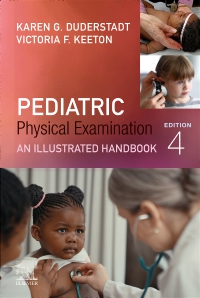
Known for its accuracy, consistency, and portability, Pediatric Physical Examination: An Illustrated Handbook, 4th Edition teaches the unique range of skills that Nurse Practitioners and primary care providers need to assess children of all ages. Spiral-bound for quick reference in clinical settings, this photo-rich, step-by-step guide to physical examination prepares you to expertly examine children from birth through adolescence. Body system chapters begin with fetal development and take you through the key developmental stages of childhood. This edition features new sections with Telehealth Tips and Considerations for Special Populations in many chapters, as well as expanded coverage of maltreatment, mental health, and social disparities of health.
Known for its accuracy, consistency, and portability, Pediatric Physical Examination: An Illustrated Handbook, 4th Edition teaches the unique range of skills that Nurse Practitioners and primary care providers need to assess children of all ages. Spiral-bound for quick reference in clinical settings, this photo-rich, step-by-step guide to physical examination prepares you to expertly examine children from birth through adolescence. Body system chapters begin with fetal development and take you through the key developmental stages of childhood. This edition features new sections with Telehealth Tips and Considerations for Special Populations in many chapters, as well as expanded coverage of maltreatment, mental health, and social disparities of health.

-
- Expert guidance for the pediatric physical exam employs the "quiet-to-active" approach, starting with the listening parts of the physical exam and moving on to the hands-on components, the physical assessment approach that yields the best results in the pediatric age group.
- Quick-reference features include special tables/boxes, such as Information Gathering, Conditions, Pediatric Pearls, Red Flags, Interprofessional Collaboration Notes, Evidence-Based Practice, and EHR Documentation.
- Easy-to-use layout provides quick access to concise guidance for the pediatric physical exam.
- Richly illustrated, full-color format facilitates readability and learning with more than 300 photos and line drawings of assessment techniques and common assessment findings.
- Inclusive and ethnically diverse illustrations better represent the diverse populations pediatric health care providers work with every day.
-
- NEW! Telehealth Tips section added to chapters reflects the greatly expanded use of telehealth visits in clinical practice
- NEW! Information on maltreatment, mental and behavioral health, and social determinants of health explored throughout the chapters
- NEW! Considerations for special needs populations added to most chapters
- NEW! Guidance on use of screen time for early childhood and advice for families
-
UNIT I Pediatric General Assessment
1. Approach to Care and Assessment of Children and Adolescents
2. Assessment of Growth and Vital Signs
3. Developmental, Emotional, and Behavioral Surveillance and Screening
4. Comprehensive Information Gathering
5. Environmental Health History
6. Newborn Assessment
UNIT II System-Specific Assessment
7. Skin Assessment
8. Heart and Vascular Assessment
9. Chest and Respiratory Assessment
10. Eyes
11. Ears
12. Nose, Mouth, and Throat
13. Neck and Lymphatic System Assessment
14. Abdomen and Rectum
15. Penis, Testicles, and Scrotum
16. Breast
17. Vulva, Vagina, and Internal Pelvic Assessment
18. Musculoskeletal Assessment
19. Head and Neurological System -
-
Ways of Reading
- The appearance of the text and page layout can be modified according to the capabilities of the reading system (font family and font size, spaces between paragraphs, sentences, words, and letters, as well as color of background and text)
- This e-publication is accessible to the full extent that the file format and types of content allow, on a specific reading device, by default, without necessarily including any additions such as textual descriptions of images or enhanced navigation
- No information about nonvisual reading is available
-
Conformance
- For detailed accessibility information, see Elsevier's website at https://www.elsevier.com/about/accessibility
- For queries regarding accessibility information, contact [email protected]
- The publication was certified on 18-11-2025
-
Navigation
- Table of contents to all chapters of the text via links
-
Rich Content
- No information is available
-
Hazards
- No information is available
-
Product Content
- No information is available
-
Legal Considerations
- No information is available
-
Additional Accessibility Information
- For readers with color vision deficiency, use of color (e.g., in diagrams, graphics and charts, in prompts, or on buttons inviting a response) is not the sole means of graphical distinction or of conveying information
- E-publication includes basic navigation (usually less detailed than TOC-based navigation)
- Where links, controls or buttons are included in the content, the purpose or functionality of each link, control or button is apparent from the associated text alone - or where it is unclear, separate link, control or button descriptions are provided
- All (or substantially all) textual matter is arranged in a single logical reading order (including text that is visually presented as separate from the main text flow, e.g., in boxouts, captions, tables, footnotes, endnotes, citations, etc.). Non-textual content is also linked from within this logical reading order. (Purely decorative non-text content can be ignored).
- The language of the text has been specified (e.g., via the HTML or XML lang attribute) to optimise text-to-speech (and other alternative renderings), both at the whole document level and, where appropriate, for individual words, phrases or passages in a different language.
-
Ways of Reading
Was
$61.99
Now $54.55
Or $0.00 with a valid access code

 as described in our