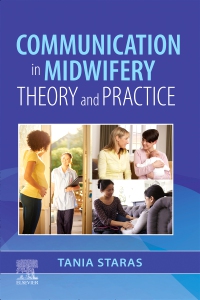

Communication in Midwifery - Elsevier E-Book on VitalSource, 1st Edition
Elsevier eBook on VitalSource
Now $32.39
Kind, honest and open communication is at the heart of midwifery care and maternity practice, and is vital in providing safe, person-centred care.
This new book explores communication in midwifery from a range of perspectives and across different settings. It considers the theoretical and practical dimensions of communication, including how and why we communicate and who we communicate with. It uses case studies and practical examples to put ideas into real-world context and to explore topic areas in ways which are thought-provoking, accessible and useful to practitioners.
Above all, Communication in Midwifery supports midwives in developing their theoretical understanding around communication and building a practical toolkit of ideas and strategies for use in a range of settings and with diverse groups of people. It helps midwives and other caregivers in navigating the nuanced and complex situations they encounter every day where clear, honest and collaborative communication is vital.
-
- Covers communication in pregnancy, birth and the postnatal period; the use of written, verbal and non-verbal approaches; and complex scenarios where communication may be challenging, such as diverse groups, trauma and loss
- Explores new methods of communicating, including the use of the internet and social media, and their benefits and challenges
- Highlights the importance of communication between professions and ways this can be enhanced
- Covers contemporary issues of consent, risk and safety in maternity care
- Useful at all stages of a midwife’s career from undergraduate to qualified midwife
-
-
 Communication in MidwiferyPaperback
-
-
1. Introduction
2. On the Receiving End: The Service User’s Perspective
PART 1 Theories and Concepts
3. Principles of Communication
4. Theories of Communication and Counselling
5. Communicating Ideas
PART 2 Responsive Communication
6. Culturally Competent Communication
7. Public Health
8. Communication and Complex Care Planning
9. Communication Around Loss and Trauma
PART 3 Communication in Practice
10. Pregnancy
11. Labour
12. The Postnatal Period and Infant Feeding
PART 4 Professional Communication and Personal Development
13. Communicating With Others
14. Spreading the Word
15. Reflection, Development and Challenges in Communication
16. Conclusion -
-
Ways of Reading
- The appearance of the text and page layout can be modified according to the capabilities of the reading system (font family and font size, spaces between paragraphs, sentences, words, and letters, as well as color of background and text)
- This e-publication is accessible to the full extent that the file format and types of content allow, on a specific reading device, by default, without necessarily including any additions such as textual descriptions of images or enhanced navigation
- No information about nonvisual reading is available
-
Conformance
- No information is available
-
Navigation
- Table of contents to all chapters of the text via links
- Page list to go to pages from the print source version
-
Rich Content
- No information is available
-
Hazards
- No information is available
-
Product Content
- No information is available
-
Legal Considerations
- No information is available
-
Additional Accessibility Information
- Content is enhanced with ARIA roles to optimize organization and facilitate navigation
- Page breaks included from the original print source
- For readers with color vision deficiency, use of color (e.g., in diagrams, graphics and charts, in prompts, or on buttons inviting a response) is not the sole means of graphical distinction or of conveying information
- E-publication includes basic navigation (usually less detailed than TOC-based navigation)
- Where links, controls or buttons are included in the content, the purpose or functionality of each link, control or button is apparent from the associated text alone - or where it is unclear, separate link, control or button descriptions are provided
- All (or substantially all) textual matter is arranged in a single logical reading order (including text that is visually presented as separate from the main text flow, e.g., in boxouts, captions, tables, footnotes, endnotes, citations, etc.). Non-textual content is also linked from within this logical reading order. (Purely decorative non-text content can be ignored).
- The language of the text has been specified (e.g., via the HTML or XML lang attribute) to optimise text-to-speech (and other alternative renderings), both at the whole document level and, where appropriate, for individual words, phrases or passages in a different language.
-
Ways of Reading

 as described in our