
ISBN:
9780323931786
Copyright:
2026
Publication Date:
10-31-2025
Page Count:
1032
Imprint:
Elsevier
List Price:
$95.99

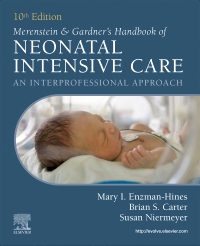
Merenstein & Gardner's Handbook of Neonatal Intensive Care - Elsevier eBook on VitalSource, 10th Edition
by Mary I. Enzman-Hines, APRN, PhD, CNS, CPNP, APHN-BC, Brian S. Carter, MD, FAAP and Susan Niermeyer, MD, MPH, FAAP
Elsevier eBook on VitalSource
ISBN:
9780323931786
Copyright:
2026
Publication Date:
10-31-2025
Page Count:
1032
Imprint:
Elsevier
List Price:
$95.99
Was
$95.99
Now $86.39
Or $0.00 with a valid access code
**Selected for 2026 Doody's Core Titles in Critical Care**
Co-edited by a team of physicians and nurses, Merenstein & Gardner’s Handbook of Neonatal Intensive Care: An Interprofessional Approach, Tenth Edition, is the leading resource for interprofessional collaborative care of critically ill newborns. Now printed in full color, it offers comprehensive coverage with a unique interprofessional collaborative approach and a real-world perspective that make it a practical guide for both nurses and physicians. This edition features updated content throughout to reflect the latest evidence-informed/evidence-based practice, national and international guidelines, and current protocols; a new Interprofessional Collaborative Practice chapter that provides a foundation for the team approach applied throughout the book; an expanded focus on parent teaching that reflects today’s diversity of family structures; an enhanced focus on gender and racial/ethnic inclusivity; and much more!
Co-edited by a team of physicians and nurses, Merenstein & Gardner’s Handbook of Neonatal Intensive Care: An Interprofessional Approach, Tenth Edition, is the leading resource for interprofessional collaborative care of critically ill newborns. Now printed in full color, it offers comprehensive coverage with a unique interprofessional collaborative approach and a real-world perspective that make it a practical guide for both nurses and physicians. This edition features updated content throughout to reflect the latest evidence-informed/evidence-based practice, national and international guidelines, and current protocols; a new Interprofessional Collaborative Practice chapter that provides a foundation for the team approach applied throughout the book; an expanded focus on parent teaching that reflects today’s diversity of family structures; an enhanced focus on gender and racial/ethnic inclusivity; and much more!
-
- NEW! Updated content throughout reflects the latest evidence-informed/evidence-based practice, national and international guidelines, and current protocols for interprofessional collaborative practice in the NICU
- NEW! Interprofessional Collaborative Practice chapter provides a foundation for the team approach applied throughout the book
- NEW! Expanded focus on parent teaching, particularly in today’s diversity of family structures (including LGBTQ+ parents, surrogate parents, and removing the stigma of single parenthood), equips you for the contemporary milieu of the NICU
- NEW! Enhanced focus on gender and racial/ethnic inclusivity puts special emphasis on inclusive language and on the growing challenge of identifying genetically linked conditions (such as G6PD, immune disorders, and sickle cell disease) in patients of mixed backgrounds, prepares you to provide effective and culturally competent care
- NEW! Content addresses the latest information and advances on key topics such as NICU follow-up, combatting healthcare disparities, the Immediate Kangaroo Mother Care (IKMC) protocol, the unique challenges of global pandemics in the NICU, discharge planning, and the growing problem of aggression from family members seeking information or access to pediatric patients
- NEW! Now printed in full color, with a full-color illustration program for improved usability and reference value
- UNIQUE! Core editor team of an advanced practice nurse and two physicians gives this internationally recognized reference a true interprofessional collaborative approach that is unmatched by any other resource
- Consistent organization within clinical chapters includes Physiology/Pathophysiology, Etiology, Prevention, Data Collection (History, Signs and Symptoms, and Laboratory Data), Treatment/Intervention, Complications, and Parent Teaching sections
- UNIQUE! Color-highlighted point-of-care clinical content makes high-priority clinical content quick and easy to find
- UNIQUE! Parent Teaching boxes outline the relevant information to be shared with a newborn patient’s caregivers
- Critical Findings boxes outline symptoms and diagnostic findings that require immediate attention to help you prioritize assessment data and steps in initial care
- Case Studies demonstrate how to apply essential content to realistic clinical scenarios for application-based learning
-
UNIT 1 Foundations for Practice
1. Interprofessional Collaboration and Evidence-Based Practice: Promoting Exceptional Care
UNIT 2 Support of the Neonate
2. Prenatal Environment Effect on Neonatal Outcome
3. Perinatal Transport and Levels of Care
4. Care at Birth
5. Immediate Newborn Care After Birth
6. Heat Balance
7. Physiologic Monitoring
8. Acid-Base Homeostasis and Oxygenation
9. Diagnostic Imaging in the Neonate
10. Pharmacology in Neonatal Care
11. Drug Withdrawal in the Neonate
12. Pain and Pain Relief
13. The Neonate and the Environmental Impact on Development
UNIT 3 Metabolic and Nutritional Care of the Neonate
14. Fluid and Electrolyte Management
15. Glucose Homeostasis
16. Total Parenteral Nutrition
17. Enteral Nutrition
18. Breastfeeding the Neonate With Special Needs
19. Skin and Skin Care
UNIT 4 Infection and Hematologic Diseases of the Neonate
20. Newborn Hematology
21. Neonatal Hyperbilirubinemia
22. Infection in the Neonate
UNIT 5 Common Systemic Diseases of the Neonate
23. Respiratory Diseases
24. Cardiovascular Diseases and Surgical Interventions
25. Neonatal Nephrology
26. Neurologic Disorders
27. Genetic Disorders, Malformations, and Inborn Errors of Metabolism
28. Neonatal Surgery
UNIT 6 Psychosocial Aspects of Neonatal Care
29. NICU Families in Crisis
30. Bereavement in the Neonatal Intensive Care Unit (NICU): Health Equity in Context
31. Discharge Planning and Follow-Up of the NICU Infant
32. Ethics, Values, and Palliative Care in Neonatal Intensive Care -
-
Ways of Reading
- The appearance of the text and page layout can be modified according to the capabilities of the reading system (font family and font size, spaces between paragraphs, sentences, words, and letters, as well as color of background and text)
- This e-publication is accessible to the full extent that the file format and types of content allow, on a specific reading device, by default, without necessarily including any additions such as textual descriptions of images or enhanced navigation
- No information about nonvisual reading is available
-
Conformance
- No information is available
-
Navigation
- Table of contents to all chapters of the text via links
- Page list to go to pages from the print source version
-
Rich Content
- No information is available
-
Hazards
- No information is available
-
Product Content
- No information is available
-
Legal Considerations
- No information is available
-
Additional Accessibility Information
- Content is enhanced with ARIA roles to optimize organization and facilitate navigation
- Page breaks included from the original print source
- For readers with color vision deficiency, use of color (e.g., in diagrams, graphics and charts, in prompts, or on buttons inviting a response) is not the sole means of graphical distinction or of conveying information
- E-publication includes basic navigation (usually less detailed than TOC-based navigation)
- Where links, controls or buttons are included in the content, the purpose or functionality of each link, control or button is apparent from the associated text alone - or where it is unclear, separate link, control or button descriptions are provided
- All (or substantially all) textual matter is arranged in a single logical reading order (including text that is visually presented as separate from the main text flow, e.g., in boxouts, captions, tables, footnotes, endnotes, citations, etc.). Non-textual content is also linked from within this logical reading order. (Purely decorative non-text content can be ignored).
- The language of the text has been specified (e.g., via the HTML or XML lang attribute) to optimise text-to-speech (and other alternative renderings), both at the whole document level and, where appropriate, for individual words, phrases or passages in a different language.
-
Ways of Reading
Was
$95.99
Now $86.39
Or $0.00 with a valid access code

 as described in our