ISBN:
9780323931977
Copyright:
2025
Publication Date:
01-16-2024
Page Count:
336
Imprint:
Elsevier
List Price:
$46.99

Mistake-Based Learning: Cardiology - Elsevier E-Book on VitalSource, 1st Edition
by Bliss J. Chang, MD
Elsevier eBook on VitalSource
ISBN:
9780323931977
Copyright:
2025
Publication Date:
01-16-2024
Page Count:
336
Imprint:
Elsevier
List Price:
$46.99
Was
$46.99
Now $32.89
Or $0.00 with a valid access code
Medical errors are one of the leading causes of death.
Deliver the highest quality care to your patients by recognizing and minimizing common mistakes.
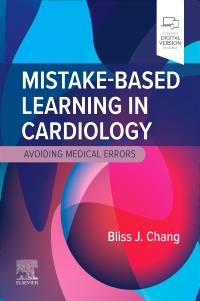
Providing quality care free of clinical errors isn’t just a matter of knowing what to do in any given situation—it’s about actively knowing what not to do. Mistake-Based Learning in Cardiology: Avoiding Medical Errors provides healthcare professionals with a summary of the common ways to inadvertently cause medical errors for each major clinical action. This resource also provides valuable information on why the mistake may be made and openly discusses medical errors to facilitate growth, learning, and psychological safety in today’s workplace.
Deliver the highest quality care to your patients by recognizing and minimizing common mistakes.
Providing quality care free of clinical errors isn’t just a matter of knowing what to do in any given situation—it’s about actively knowing what not to do. Mistake-Based Learning in Cardiology: Avoiding Medical Errors provides healthcare professionals with a summary of the common ways to inadvertently cause medical errors for each major clinical action. This resource also provides valuable information on why the mistake may be made and openly discusses medical errors to facilitate growth, learning, and psychological safety in today’s workplace.
-
- NEW! Nora AI - an AI-powered learning assistant exclusive to Elsevier ebooks on VitalSource's Bookshelf® platform - offers built-in AI learning support that provides personalized answers based on content from the Elsevier ebook
- Identifies the most common errors associated with each disease and clinical action
- Dissects each mistake into potential reasoning errors and pinpoints the major clinical principles related to the error
- Helps you understand why the mistake was made and how to avoid similar mistakes, empowering you with pre-emptive thoughts that act as an excellent first-line defense against medical mistakes
- Supports you with timely, point-of-care solutions if the medical error were to occur
- Uses a concise, templated format for quick reference and review
- Helps prepare you for clinical rotations and future practice, as well as for the medicine and cardiology board exams
- An eBook version is included with purchase. The eBook allows you to access all of the text, figures and references, with the ability to search, customize your content, make notes and highlights, and have content read aloud
-
-
 Mistake-Based Learning in CardiologyPaperback
-
-
1. Mistake-Based Learning
2. Fundamentals of Clinical Decision-Making
3. Electrocardiogram Interpretation
4. Cardiac Imaging
5. Devices
6. Coronary Artery Disease
7. Acute Coronary Syndromes
8. Heart Failure
9. Arrhythmias
10. Valvular Disease
11. Pulmonary Hypertension
12. Pericardial Disease
13. Vascular Cardiology
14. Venous Thromboembolism
15. Hypertension -
-
Ways of Reading
- The appearance of the text and page layout can be modified according to the capabilities of the reading system (font family and font size, spaces between paragraphs, sentences, words, and letters, as well as color of background and text)
- This e-publication is accessible to the full extent that the file format and types of content allow, on a specific reading device, by default, without necessarily including any additions such as textual descriptions of images or enhanced navigation
- No information about nonvisual reading is available
-
Conformance
- No information is available
-
Navigation
- Table of contents to all chapters of the text via links
- Page list to go to pages from the print source version
-
Rich Content
- No information is available
-
Hazards
- No information is available
-
Product Content
- No information is available
-
Legal Considerations
- No information is available
-
Additional Accessibility Information
- Content is enhanced with ARIA roles to optimize organization and facilitate navigation
- Page breaks included from the original print source
- For readers with color vision deficiency, use of color (e.g., in diagrams, graphics and charts, in prompts, or on buttons inviting a response) is not the sole means of graphical distinction or of conveying information
- E-publication includes basic navigation (usually less detailed than TOC-based navigation)
- Where links, controls or buttons are included in the content, the purpose or functionality of each link, control or button is apparent from the associated text alone - or where it is unclear, separate link, control or button descriptions are provided
- All (or substantially all) textual matter is arranged in a single logical reading order (including text that is visually presented as separate from the main text flow, e.g., in boxouts, captions, tables, footnotes, endnotes, citations, etc.). Non-textual content is also linked from within this logical reading order. (Purely decorative non-text content can be ignored).
- The language of the text has been specified (e.g., via the HTML or XML lang attribute) to optimise text-to-speech (and other alternative renderings), both at the whole document level and, where appropriate, for individual words, phrases or passages in a different language.
-
Ways of Reading
Was
$46.99
Now $32.89
Or $0.00 with a valid access code

 as described in our