
ISBN:
9780323933018
Copyright:
2024
Publication Date:
06-06-2023
Page Count:
604
Imprint:
Elsevier
List Price:
$62.99

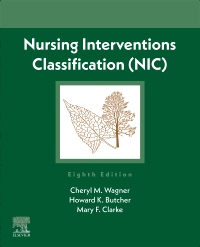
Nursing Interventions Classification (NIC) - Elsevier EBook on VitalSource, 8th Edition
by Cheryl M. Wagner, RN, PhD, MBA/MSN, Howard K. Butcher, RN, PhD and Mary F. Clarke, PhD, RN-BC, NE-BC
Elsevier eBook on VitalSource
ISBN:
9780323933018
Copyright:
2024
Publication Date:
06-06-2023
Page Count:
604
Imprint:
Elsevier
List Price:
$62.99
Was
$62.99
Now $55.43
Or $0.00 with a valid access code
Select nursing interventions with the book that standardizes nursing language! Nursing Interventions Classification (NIC), 8th Edition provides a research-based clinical tool to help you choose appropriate interventions. It standardizes and defines the knowledge base for nursing practice as it communicates the nature of nursing. More than 610 nursing interventions are described — from general practice to all specialty areas. From an expert author team led by Cheryl Wagner, this book is an ideal tool for practicing nurses and nursing students, educators seeking to enhance nursing curricula, and nursing administrators seeking to improve patient care. It’s the only comprehensive taxonomy of nursing-sensitive interventions available!
-
- 614 research-based nursing intervention labels — with 60 new to this edition — are included, along with specific activities used to carry out interventions
- Specialty core interventions are provided for 57 specialties
- Descriptions of each intervention include a definition, a list of activities, a publication facts line, and references
-
- NEW! 60 interventions are added to this edition, including several related to the care of patients with COVID considerations
- UPDATED! Approximately 220 existing interventions have been revised
-
Part 1: Overview and Application of the NIC in Practice, Education, and Research
Part 2: Taxonomy of Nursing Interventions
Part 3: The Classification
Part 4: Core Interventions for Nursing Specialty Areas
Part 5: Estimated Time and Education Level Necessary to Perform NIC Interventions
Part 6: Nursing Interventions and Nursing Outcomes Linked to Clinical Conditions
Part 7: Appendixes
Appendix A. Interventions: New, Revised, and Retired Since the Seventh Edition
Appendix B. Guidelines for Submission of a New or Revised NIC Intervention
Appendix C. Timeline and Highlights for NIC
Appendix D. Abbreviations
Appendix E. Previous Editions and Translations
Index -
-
Ways of Reading
- The appearance of the text and page layout can be modified according to the capabilities of the reading system (font family and font size, spaces between paragraphs, sentences, words, and letters, as well as color of background and text)
- This e-publication is accessible to the full extent that the file format and types of content allow, on a specific reading device, by default, without necessarily including any additions such as textual descriptions of images or enhanced navigation
- No information about nonvisual reading is available
-
Conformance
- For detailed accessibility information, see Elsevier's website at https://www.elsevier.com/about/accessibility
- For queries regarding accessibility information, contact [email protected]
- The publication was certified on 18-11-2025
-
Navigation
- Table of contents to all chapters of the text via links
-
Rich Content
- No information is available
-
Hazards
- No information is available
-
Product Content
- No information is available
-
Legal Considerations
- No information is available
-
Additional Accessibility Information
- For readers with color vision deficiency, use of color (e.g., in diagrams, graphics and charts, in prompts, or on buttons inviting a response) is not the sole means of graphical distinction or of conveying information
- E-publication includes basic navigation (usually less detailed than TOC-based navigation)
- Where links, controls or buttons are included in the content, the purpose or functionality of each link, control or button is apparent from the associated text alone - or where it is unclear, separate link, control or button descriptions are provided
- All (or substantially all) textual matter is arranged in a single logical reading order (including text that is visually presented as separate from the main text flow, e.g., in boxouts, captions, tables, footnotes, endnotes, citations, etc.). Non-textual content is also linked from within this logical reading order. (Purely decorative non-text content can be ignored).
- The language of the text has been specified (e.g., via the HTML or XML lang attribute) to optimise text-to-speech (and other alternative renderings), both at the whole document level and, where appropriate, for individual words, phrases or passages in a different language.
-
Ways of Reading
Was
$62.99
Now $55.43
Or $0.00 with a valid access code

 as described in our