
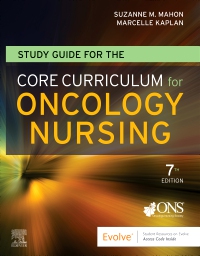

Study Guide for the Core Curriculum for Oncology Nursing - Elsevier EBook on VitalSource, 7th Edition
Elsevier eBook on VitalSource
Now $62.47
Prepare for success on the OCN® Exam with the definitive Q&A review from the Oncology Nursing Society! Based on the latest test blueprint for the OCN® Exam, this study guide is the only question-and-answer review developed in collaboration with the Oncology Nursing Society. Chapters correspond to the chapters in the Core Curriculum for Oncology Nursing, 7th Edition, and practice questions match the format and Test Plan for the OCN® Exam. Detailed rationales are provided for both correct and incorrect answers, reinforcing your understanding of oncology nursing. A new companion Evolve website includes all of the Study Guide content in a fully interactive quizzing engine that simulates an actual OCN® Exam in either Study Mode (with immediate question feedback) or Exam Mode (with feedback only at the end of the simulated exam). Choose the definitive Q&A study resource for OCN® certification!
-
-
 Core Curriculum for Oncology Nursing - Elsevier eBook on VitalSourceElsevier eBook on VitalSource
 -
 Core Curriculum for Oncology NursingPaperback
 -

-

-
-
- UNIQUE! The only Q&A review book developed in collaboration with and endorsed by the Oncology Nursing Society
- UNIQUE! In-depth Q&A review reflects the latest OCN® Test Plan and essential content from the Core Curriculum for Oncology Nursing, including the full continuum of cancer care, the scientific basis for practice, palliation of symptoms, oncologic emergencies, and professional performance
- More than 1,000 review questions are written by OCN®-certified experts to ensure high quality and consistency with the ONS Core Curriculum and OCN® Exam, with a strong emphasis on patient safety and quality care
- Answer Key includes detailed rationales for correct and incorrect responses
-
- NEW! Updated content reflects the exam blueprint for the 2022 OCN® Examination, along with the latest research evidence and important changes in cancer treatment and related nursing care
- NEW! Fully interactive quizzing engine on a new Evolve website includes all of the Study Guide content, simulating an actual OCN® Exam in either Study Mode (with immediate question feedback) or Exam Mode (with feedback only at the end of the simulated exam)
-
PART ONE: THE CARE CONTINUUM
1. Epidemiology, Prevention, and Health Promotion
2. Screening and Early Detection
3. Survivorship
4. Palliative and End-of-Life Care
5. Nurse Navigation Across the Cancer Continuum
6. Communication and Shared Decision-Making
PART TWO: SCIENTIFIC BASIS FOR PRACTICE
7. Carcinogenesis
8. Immunology
9. Precision Medicine
10. Genetics and Cancer
11. Research Protocols and Clinical Trials
PART THREE: SITE-SPECIFIC CANCERS
12. Bone and Soft Tissue Cancers
13. Breast Cancer
14. Gastrointestinal Cancers
15. Genitourinary Cancers
16. Head and Neck Cancers
17. Infection-Related Cancers
18. Leukemia
19. Lung Cancer
20. Lymphoma
21. Multiple Myeloma
22. Myelofibrosis
23. Neurologic System Cancers
24. Reproductive System Cancers
25. Skin Cancer
PART FOUR: TREATMENT MODALITIES
26. Surgery
27. Hematopoietic Stem Cell Transplantation and CAR T-Cell Therapy
28. Radiation Therapy
29. Chemotherapy, Hormonal Therapy, and Oral Adherence
30. Biotherapies: Targeted Therapies and Immunotherapies
31. Support Therapies and Access Devices
32. Pharmacologic Interventions
33. Complementary and Integrative Modalities
PART FIVE: PALLIATION OF SYMPTOMS
34. Cardiovascular Symptoms
35. Cognitive Symptoms
36. Endocrine Symptoms
37. Fatigue
38. Gastrointestinal Symptoms
39. Genitourinary Symptoms
40. Hematologic and Immune Symptoms
41. Integumentary Symptoms
42. Musculoskeletal Symptoms
43. Neurological Symptoms
44. Nutritional Issues
45. Pain
46. Respiratory Symptoms
47. Sleep Disturbances
PART SIX: ONCOLOGIC EMERGENCIES
48. Metabolic Emergencies
49. Structural Emergencies
PART SEVEN: PSYCHOLOGICAL, SOCIAL, CULTURAL
50. Body Image Considerations
51. Caregiver Burden
52. Social Determinants of Health and Financial Toxicity
53. Cultural and Spiritual Care
54. Psychosocial Disturbances and Coping
55. Sexuality and Sexual Dysfunction
PART EIGHT: PROFESSIONAL PRACTICE
56. Standards of Practice and Professional Performance
57. Evidence-Based Practice
58. Principles of Education and Learning
59. Legal Issues
60. Ethical Issues
61. Professional Issues
62. Compassion Fatigue -
-
Ways of Reading
- The appearance of the text and page layout can be modified according to the capabilities of the reading system (font family and font size, spaces between paragraphs, sentences, words, and letters, as well as color of background and text)
- This e-publication is accessible to the full extent that the file format and types of content allow, on a specific reading device, by default, without necessarily including any additions such as textual descriptions of images or enhanced navigation
- All content can be read as read aloud speech or dynamic braille
- Has alternative text descriptions for images
-
Conformance
- The publication contains a conformance statement that it meets the EPUB Accessibility 1.1, WCAG 2.1, Level AA standard. Please see https://bornaccessible.benetech.org/certified-publishers/ for further details of our compatibility testing.
- The certifier's credential is https://bornaccessible.benetech.org/certified-publishers/
- For detailed accessibility information, see Elsevier's website at https://www.elsevier.com/about/accessibility
- For queries regarding accessibility information, contact [email protected]
- The publication was certified on 24-03-2026
-
Navigation
- Table of contents to all chapters of the text via links
- Elements such as headings, tables, etc. for structured navigation
- Page list to go to pages from the print source version
-
Rich Content
- Information-rich images are described by extended descriptions
-
Hazards
- The publication contains no hazards
-
Product Content
- Content includes any type of illustrations.
- The primary content is text.
- Content includes maps and/or other cartographic content.
- Content includes a significant number of actionable (clickable) web links to external content, downloadable resources, supplementary material, etc.
- Content includes photographs, whether in a plate section / insert or not.
- Content includes figures, diagrams, charts and/or graphs, including other 'mechanical' (i.e. non-photographic) illustrations.
- Content includes images displayed in a specific order for the purpose of graphic storytelling or giving information (e.g. graphic novels, comics and manga). May include text integrated into the image (as speech and thought bubbles, textual 'sound' effects, captions etc.).
- Content includes text within images, including text-as-text embedded in diagrams, charts, or within images containing speech balloons, thought bubbles, captions, etc.
- Content includes visual content that is purely decorative and is not necessary to understanding of the content.
- At least some text - including text within other images - is 'text as an image' (i.e., a picture of text).
-
Legal Considerations
- No information is available
-
Additional Accessibility Information
- Content is enhanced with ARIA roles to optimize organization and facilitate navigation
- Page breaks included from the original print source
- For readers with color vision deficiency, use of color (e.g., in diagrams, graphics and charts, in prompts, or on buttons inviting a response) is not the sole means of graphical distinction or of conveying information
- The body text is presented with a contrast ratio of at least 4.5:1 (or 3:1 for large/heading text)
- Ultra-high contrast between text and background
- E-publication includes basic navigation (usually less detailed than TOC-based navigation)
- Where links, controls or buttons are included in the content, the purpose or functionality of each link, control or button is apparent from the associated text alone - or where it is unclear, separate link, control or button descriptions are provided
- All (or substantially all) textual matter is arranged in a single logical reading order (including text that is visually presented as separate from the main text flow, e.g., in boxouts, captions, tables, footnotes, endnotes, citations, etc.). Non-textual content is also linked from within this logical reading order. (Purely decorative non-text content can be ignored).
- Where interactive content is included in the product, controls are provided (e.g., for speed, pause and resume, reset) and labelled to make their use clear.
- The language of the text has been specified (e.g., via the HTML or XML lang attribute) to optimise text-to-speech (and other alternative renderings), both at the whole document level and, where appropriate, for individual words, phrases or passages in a different language.
-
Ways of Reading

 as described in our