
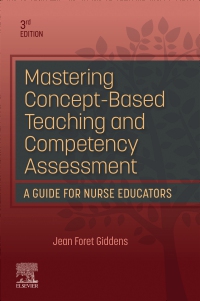

Mastering Concept-Based Teaching and Competency Assessment - Elsevier eBook on VitalSource, 3rd Edition
Elsevier eBook on VitalSource
Now $53.67
**Selected for 2025 Doody’s Core Titles® in Education**
Learn how to develop and implement a successful concept-based curriculum and competency assessment! Written specifically for nursing faculty by thought-leader Jean Giddens, Mastering Concept-Based Teaching and Competency Assessment, 3rd Edition provides the understanding and expertise you need to make the transition from traditional content-focused instruction to a conceptual approach to teaching and learning, and from knowledge assessment to competency assessment. New to this edition is a new chapter on differentiating concept-based and competency-based approaches. A perfect complement to Giddens’ student-oriented textbook Concepts for Nursing Practice, this book is ideal for both undergraduate and graduate faculty, and also serves as a helpful study tool for faculty preparing for the Certified Nurse Educator exam.
-
- Framework for a concept-based curriculum (CBC) begins with an overview of the conceptual approach and then discusses the steps used in developing a CBC, using concepts as the infrastructure for the curriculum
- Strong foundation in how to teach within a CBC examines the nature of concepts, their function in the process of learning, and the importance of being consistent in the selection and implementation of concepts
- Balanced teaching strategies engage students with an open environment and learning activities demonstrating the application of information to multiple situations
- Success evaluation criteria explain the importance of analyzing evaluation data to measure the achievement of student learning and for evaluating a CBC program
- Misconceptions and Clarifications boxes reflect the latest research in conceptual learning to help clarify important concepts
-
- NEW! Differentiating Concept-Based and Competency-Based Approaches chapter explains the close interrelationship of concepts and competencies
- NEW! Updated content reflects the latest evidence and literature on the conceptual approach and the application of competencies within the conceptual approach
- NEW! Improved graphic design and layout makes the content more visually appealing and promotes understanding
-
1. The Conceptual Approach: Background and Benefits
2. Differentiating Concept-Based and Competency-Based Approaches
3. Concepts for the Nursing Discipline
4. Developing a Concept-Based Curriculum
5. Conceptual Learning
6. Concept-Based Instruction for the Classroom
7. Concept-Based Instruction for Clinical Education
8. Assessment and Evaluation
9. Advancing the Conceptual Approach in Nursing -
-
Ways of Reading
- The appearance of the text and page layout can be modified according to the capabilities of the reading system (font family and font size, spaces between paragraphs, sentences, words, and letters, as well as color of background and text)
- This e-publication is accessible to the full extent that the file format and types of content allow, on a specific reading device, by default, without necessarily including any additions such as textual descriptions of images or enhanced navigation
- No information about nonvisual reading is available
-
Conformance
- For detailed accessibility information, see Elsevier's website at https://www.elsevier.com/about/accessibility
- For queries regarding accessibility information, contact [email protected]
- The publication was certified on 03-11-2025
-
Navigation
- Table of contents to all chapters of the text via links
-
Rich Content
- No information is available
-
Hazards
- No information is available
-
Product Content
- No information is available
-
Legal Considerations
- No information is available
-
Additional Accessibility Information
- For readers with color vision deficiency, use of color (e.g., in diagrams, graphics and charts, in prompts, or on buttons inviting a response) is not the sole means of graphical distinction or of conveying information
- E-publication includes basic navigation (usually less detailed than TOC-based navigation)
- Where links, controls or buttons are included in the content, the purpose or functionality of each link, control or button is apparent from the associated text alone - or where it is unclear, separate link, control or button descriptions are provided
- All (or substantially all) textual matter is arranged in a single logical reading order (including text that is visually presented as separate from the main text flow, e.g., in boxouts, captions, tables, footnotes, endnotes, citations, etc.). Non-textual content is also linked from within this logical reading order. (Purely decorative non-text content can be ignored).
- The language of the text has been specified (e.g., via the HTML or XML lang attribute) to optimise text-to-speech (and other alternative renderings), both at the whole document level and, where appropriate, for individual words, phrases or passages in a different language.
-
Ways of Reading

 as described in our