
ISBN:
9780323934886
Copyright:
2025
Publication Date:
03-29-2024
Page Count:
352
Imprint:
Elsevier
List Price:
$53.99

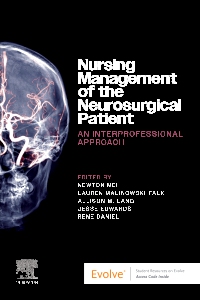
Nursing Management of the Neurosurgical Patient: An Interprofessional Approach - Elsevier E-Book on VitalSource, 1st Edition
by Newton Mei, MD, Lauren Malinowski-Falk, CRNP, Allison M. Lang, MSN, CRNP, AGACNP-BC, Jesse Edwards, MD and René Daniel, MD, PhD, FACP, FHM
Elsevier eBook on VitalSource
ISBN:
9780323934886
Copyright:
2025
Publication Date:
03-29-2024
Page Count:
352
Imprint:
Elsevier
List Price:
$53.99
Was
$53.99
Now $47.51
Or $0.00 with a valid access code
Use this new text/reference from a nationally recognized center of excellence to ensure high quality nursing care of neurosurgical patients! Nursing Management of the Neurosurgical Patient: An Interprofessional Approach is a concise new resource for best practices in both neurosurgery-specific nursing care and general hospital care. Topics include everything from preoperative assessment and bedside management to common procedures and pathophysiology of the brain and spine; neurosurgical issues such as diabetes, acute kidney injury, and coronary conditions; and pain management, substance abuse, and rehabilitation. A reader-friendly style includes photos, algorithms, flowcharts, and checklists to make it easy to find essential information quickly. Written by experienced neuroscience nurses and Nurse Practitioners, neurosurgeons, and hospitalist physicians, this book uses a team-based, collaborative approach to neurosurgical nursing care.
-
- Team-based, interprofessional collaborative, evidence-based approach provides an in-depth guide to neurosurgical nursing care
- Consistent, streamlined format serves well as both a textbook and a reference for clinical settings
- Abundant, easy-to-reference algorithms help you respond quickly and effectively to resolve neurosurgical patient problems
- Discussion and Nursing Considerations sections are provided in every chapter to describe the practical application of key chapter content
- Case study with application-level questions is included in every chapter to help you apply key content to neurosurgical nursing practice
- Answer key for each case study is provided in every chapter to reinforce understanding and provide remediation
- Interprofessional collaborative authorship provides wide-ranging expertise, with each chapter written by a team consisting of a neuroscience nurse or Nurse Practitioner, a neurosurgeon, and a hospitalist physician
-
SECTION 1 Introduction to Neurosurgery and Medical Management
1. Preoperative Assessment and Perioperative Bedside Management
2. Nursing Approach to the Neurologic Exam
SECTION 2 Common Procedures and Pathology of the Brain
3. Management of the Patient With Subarachnoid Hemorrhage
4. Pathophysiology and Nursing Management of Brain Bleeds
5. Nursing Management of the Patient With Acute Ischemic Stroke
6. Nursing Management of the Patient With a Brain Tumor
7. Nursing Management of the Patient With a Headache Disorder
8. Nursing Management of the Patient With Encephalitis or Meningitis
9. Nursing Management of the Patient With Acute Encephalopathy
SECTION 3 Common Procedures and Pathology of the Spine
10. Nursing Protocol for Elective Spine Surgery
11. Nursing Management of the Patient With Acute Traumatic Spinal Cord Injury
12. Spinal Cord Stimulator Management for Nurses
13. Nursing Management of Neoplastic Spinal Cord Compression
14. Nursing Management of Vertebral Osteomyelitis and Spinal Epidural Abscess
SECTION 4 Medical Management of Common Neurosurgical Issues
15. Diabetes Management in the Neurosurgical Patient
16. Nursing Management of Acute Kidney Injury
17. Nursing Management of the Patient With Arrhythmias and Acute Coronary Syndrome
18. Anticoagulation for Venothromboembolism
19. Nursing Management of the Airway and Shortness of Breath
20. Sodium Disorders in Neurosurgical Patients
21. Identification and Management of Hypopituitarism
22. Nursing Management of Anemia
23. Nursing Management of Thrombocytopenia
24. Nursing Management of Dysautonomia: Autonomic Dysreflexia and Paroxysmal Sympathetic Hypersensitivity
25. Medical Management of Constipation
26. Nursing Management of the Patient With Postoperative Ileus
27. Nursing Management of Nutrition in Neurosurgical Patients
28. Wound Care in the Surgical Setting
29. Nursing Management of Postoperative Fever
SECTION 5 Complex Issues in Pain Management and Substance Abuse
30. Pain Management Using Multimodal Analgesia in the Neurosurgical Spine Patient
31. Nursing Management of the Patient With Opioid Use Disorder
32. Social Work Management of the Patient With Opioid Use Disorder
SECTION 6 Posthospitalization Care
33. Rehabilitation of the Neurosurgical Patient -
-
Ways of Reading
- The appearance of the text and page layout can be modified according to the capabilities of the reading system (font family and font size, spaces between paragraphs, sentences, words, and letters, as well as color of background and text)
- This e-publication is accessible to the full extent that the file format and types of content allow, on a specific reading device, by default, without necessarily including any additions such as textual descriptions of images or enhanced navigation
- No information about nonvisual reading is available
-
Conformance
- For detailed accessibility information, see Elsevier's website at https://www.elsevier.com/about/accessibility
- For queries regarding accessibility information, contact [email protected]
- The publication was certified on 03-11-2025
-
Navigation
- Table of contents to all chapters of the text via links
-
Rich Content
- No information is available
-
Hazards
- No information is available
-
Product Content
- No information is available
-
Legal Considerations
- No information is available
-
Additional Accessibility Information
- For readers with color vision deficiency, use of color (e.g., in diagrams, graphics and charts, in prompts, or on buttons inviting a response) is not the sole means of graphical distinction or of conveying information
- E-publication includes basic navigation (usually less detailed than TOC-based navigation)
- Where links, controls or buttons are included in the content, the purpose or functionality of each link, control or button is apparent from the associated text alone - or where it is unclear, separate link, control or button descriptions are provided
- All (or substantially all) textual matter is arranged in a single logical reading order (including text that is visually presented as separate from the main text flow, e.g., in boxouts, captions, tables, footnotes, endnotes, citations, etc.). Non-textual content is also linked from within this logical reading order. (Purely decorative non-text content can be ignored).
- The language of the text has been specified (e.g., via the HTML or XML lang attribute) to optimise text-to-speech (and other alternative renderings), both at the whole document level and, where appropriate, for individual words, phrases or passages in a different language.
-
Ways of Reading
Was
$53.99
Now $47.51
Or $0.00 with a valid access code

 as described in our