
ISBN:
9780323935241
Copyright:
2024
Publication Date:
05-19-2023
Page Count:
888
Imprint:
Elsevier
List Price:
$63.99

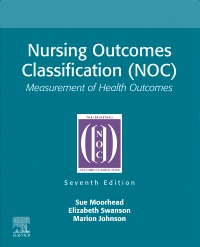
Nursing Outcomes Classification (NOC) - Elsevier eBook on VitalSource, 7th Edition
by Sue Moorhead, RN, PhD, FAAN, Elizabeth Swanson, RN, PhD and Marion Johnson, RN, PhD
Elsevier eBook on VitalSource
ISBN:
9780323935241
Copyright:
2024
Publication Date:
05-19-2023
Page Count:
888
Imprint:
Elsevier
List Price:
$63.99
Was
$63.99
Now $56.31
Or $0.00 with a valid access code
Enhance your care with the standardized measurement of nursing interventions! Nursing Outcomes Classification (NOC), 7th Edition standardizes the terminology and criteria needed to measure and evaluate outcomes in all care settings and with all patient populations. A total of 612 research-based nursing outcome labels — including 82 that are NEW to this edition — provide clinically useful language to help you deliver treatment and document outcomes. Specific indicators are included to make it easier to evaluate and rate the patient in relation to outcome achievement. Written by an expert team of authors led by Sue Moorhead, this book is also ideal for healthcare administrators seeking to improve billing, recordkeeping, and cost containment.
-
- 612 research-based nursing outcome labels provide standardized terminology for individual, family, or community outcomes
- Overview of the use of NOC within the nursing process introduces the importance of measuring outcomes of nursing care, and describes linkages with other classifications
- Outcomes structured with a label name include code, definition, set of indicators with codes, five-point Likert measurement scales, publication facts lines, and selected references
- Core outcomes are provided for an expanded list of nursing specialties
- Linkages between NOC knowledge-focused outcomes and NOC behavioral outcomes focused on the concept or condition are examined
-
- NEW! 82 new outcomes are added to the Classification, allowing you to better define patient outcomes that are responsive to nursing care
- NEW! 402 existing outcomes are reviewed or revised based on research-based outcomes
- NEW! A new section focused on resources supports research, implementation, and educational strategies
- NEW! Revised taxonomic structure includes two new classes and expanded family and community outcomes
-
PART ONE: Nursing Outcomes Classification (NOC)
Overview and Use of Nursing Outcomes Classification (NOC)
PART TWO: NOC Taxonomy
Overview of the NOC Taxonomy
PART THREE: Outcomes
Outcomes
PART FOUR: NOC Performance Outcomes Related to NOC Knowledge Outcomes
NOC Performance Outcomes Related to NOC Knowledge Outcomes
PART FIVE: Core Outcomes for Nursing Specialties
Core Outcomes for Nursing Specialties
PART SIX: Appendices -
-
Ways of Reading
- The appearance of the text and page layout can be modified according to the capabilities of the reading system (font family and font size, spaces between paragraphs, sentences, words, and letters, as well as color of background and text)
- This e-publication is accessible to the full extent that the file format and types of content allow, on a specific reading device, by default, without necessarily including any additions such as textual descriptions of images or enhanced navigation
- No information about nonvisual reading is available
-
Conformance
- For detailed accessibility information, see Elsevier's website at https://www.elsevier.com/about/accessibility
- For queries regarding accessibility information, contact [email protected]
- The publication was certified on 18-11-2025
-
Navigation
- Table of contents to all chapters of the text via links
-
Rich Content
- No information is available
-
Hazards
- No information is available
-
Product Content
- No information is available
-
Legal Considerations
- No information is available
-
Additional Accessibility Information
- For readers with color vision deficiency, use of color (e.g., in diagrams, graphics and charts, in prompts, or on buttons inviting a response) is not the sole means of graphical distinction or of conveying information
- E-publication includes basic navigation (usually less detailed than TOC-based navigation)
- Where links, controls or buttons are included in the content, the purpose or functionality of each link, control or button is apparent from the associated text alone - or where it is unclear, separate link, control or button descriptions are provided
- All (or substantially all) textual matter is arranged in a single logical reading order (including text that is visually presented as separate from the main text flow, e.g., in boxouts, captions, tables, footnotes, endnotes, citations, etc.). Non-textual content is also linked from within this logical reading order. (Purely decorative non-text content can be ignored).
- The language of the text has been specified (e.g., via the HTML or XML lang attribute) to optimise text-to-speech (and other alternative renderings), both at the whole document level and, where appropriate, for individual words, phrases or passages in a different language.
-
Ways of Reading
Was
$63.99
Now $56.31
Or $0.00 with a valid access code

 as described in our