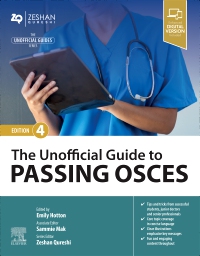

The Unofficial Guide to Passing OSCEs - Elsevier E-Book on VitalSource, 4th Edition
Elsevier eBook on VitalSource
Now $27.99
The unique and award-winning Unofficial Guides series is a collaboration between senior students, junior doctors and specialty experts. This combination of contributors understands what is essential to excel on your course, in exams and in practice – as well as the importance of presenting information in a clear, fun and engaging way. Packed with hints and tips from those in the know, when you are in a hurry and need a study companion you can trust, reach for an Unofficial Guide.
This guide has everything you need in one place – including common questions, model answers, how to present your answers to examiners, and numerous practical tips for success – all written by doctors and students who have recently completed the exam process.
Ideal for OSCE candidates wanting to blitz their exams, this book will also make a useful day-to-day reference guide for professionals.
-
- Over 100 common scenarios – including medical history taking, clinical examination, practical skills and communication skills
- Covers specialities including orthopaedics, paediatrics, psychiatry, radiology, prescribing, O&G, ophthalmology, ENT
- Over 300 full colour clinical photos to bring the text to life, including images of patients with disease features
- Clearly outlines how to relay the assessment of a patient to an examiner or to other doctors on a ward round
- Model answers to key OSCE questions
- Written and reviewed by doctors and senior medical students – essential guidance from those in the know
-
-
 The Unofficial Guide to Passing OSCEsPaperback
-
-
1. OSCE hints and tips
2. History Taking
3. Clinical Examination
4. Orthopaedic Examinations
5. Communication Skills
6. Data Interpretation
7. Practical Skills
8. Obstetrics and Gynaecology
9. Psychiatry
10. Paediatrics
11. Ophthalmology
12. Prescribing
13. Hospital Documentation -
-
Ways of Reading
- The appearance of the text and page layout can be modified according to the capabilities of the reading system (font family and font size, spaces between paragraphs, sentences, words, and letters, as well as color of background and text)
- This e-publication is accessible to the full extent that the file format and types of content allow, on a specific reading device, by default, without necessarily including any additions such as textual descriptions of images or enhanced navigation
- No information about nonvisual reading is available
-
Conformance
- No information is available
-
Navigation
- Table of contents to all chapters of the text via links
- Page list to go to pages from the print source version
-
Rich Content
- No information is available
-
Hazards
- No information is available
-
Product Content
- No information is available
-
Legal Considerations
- No information is available
-
Additional Accessibility Information
- Page breaks included from the original print source
- For readers with color vision deficiency, use of color (e.g., in diagrams, graphics and charts, in prompts, or on buttons inviting a response) is not the sole means of graphical distinction or of conveying information
- E-publication includes basic navigation (usually less detailed than TOC-based navigation)
- Where links, controls or buttons are included in the content, the purpose or functionality of each link, control or button is apparent from the associated text alone - or where it is unclear, separate link, control or button descriptions are provided
- All (or substantially all) textual matter is arranged in a single logical reading order (including text that is visually presented as separate from the main text flow, e.g., in boxouts, captions, tables, footnotes, endnotes, citations, etc.). Non-textual content is also linked from within this logical reading order. (Purely decorative non-text content can be ignored).
- The language of the text has been specified (e.g., via the HTML or XML lang attribute) to optimise text-to-speech (and other alternative renderings), both at the whole document level and, where appropriate, for individual words, phrases or passages in a different language.
-
Ways of Reading

 as described in our