
ISBN:
9780323937313
Copyright:
2025
Publication Date:
03-04-2024
Page Count:
186
Imprint:
Elsevier
List Price:
$88.99

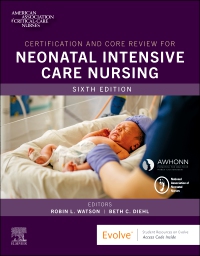
Certification and Core Review for Neonatal Intensive Care Nursing - Elsevier E-book on VitalSource, 6th Edition
by AACN
Elsevier eBook on VitalSource
ISBN:
9780323937313
Copyright:
2025
Publication Date:
03-04-2024
Page Count:
186
Imprint:
Elsevier
List Price:
$88.99
Was
$88.99
Now $78.31
Or $0.00 with a valid access code
Get ready for your neonatal intensive care nursing certification exam with the only exam review developed in collaboration with three leading nursing organizations! From AACN, AWHONN, and NANN, Certification and Core Review for Neonatal Intensive Care Nursing, 6th Edition prepares you for your examination with hundreds of high-quality study questions and realistic test simulation. Based on the latest test plans of the AACN's CCRN®-Neonatal exam and the NCC's Neonatal Intensive Care Nursing (RNC-NIC) exam, review questions cover the changes to the Core Curriculum and reflect the latest evidence, essential knowledge, and best practices. A powerful review tool on the companion Evolve website allows you to choose either the AACN or NCC question formats, and review material either in Study Mode or in Exam Mode.
-
- Authored by the American Association of Critical-Care Nurses (AACN) and endorsed by the Association of Women’s Health, Obstetric, and Neonatal Nurses (AWHONN); and the National Association of Neonatal Nurses (NANN)
- Answers for each question, accompanied by rationales and references for correct answers, enhance understanding of the material
- Realistic exam practice questions mirror the certification exam content, the multiple-choice format, and the distribution of content
- Online exam simulation, included free on the Evolve companion website with each new book purchase, mirrors the test-taking experience with questions organized according to either of the two major certification examinations — the AACN’s CCRN®-Neonatal exam or the NCC’s Neonatal Intensive Care (RNC-NIC) exam. You can choose whether to work through the questions in Study Mode or Examination Mode, with complete remediation that includes rationales for both correct and incorrect answers
- Compact, portable size facilitates study anytime, anywhere
-
- NEW! Approximately 214 additional review questions bring the total to 789 questions for realistic test preparation
- UPDATED! Thoroughly revised and updated questions reflect the latest AACN CCRN®-Neonatal and the NCC’s RNC-NIC test plans, changes to the Core Curriculum, and the latest evidence-based guidelines for neonatal critical care
- UPDATED! Rationales in the answer key reference the most recent literature and evidence-based guidelines
-
Section I: General Assessment and Management
1. Assessment of Fetal Well-Being
2. Adaptation to Extrauterine Life
3. Neonatal Resuscitation
4. Physical Assessment
5. Gestational Age Assessment
6. Thermoregulation
7. Fluids and Electrolytes
8. Nutrition and Feeding
9. Developmentally Supportive Care
10. Radiographic Evaluation
11. Pharmacology
12. Care of the Extremely Low Birth Weight Infant
13. Care of the Late-Preterm Infant
Section II: Pathophysiology
System-Specific Disorders
14. Cardiovascular Disorders
15. Pulmonary Disorders
16. Gastrointestinal Disorders
17. Metabolic and Endocrine Disorders
18. Hematologic Disorders
19. Neurologic Disorders
20. Renal and Genitourinary Disorders
21. Genetic and Congenital Anomalies
22. Immunologic Disorders and Infections
23. Dermatologic Disorders
Multisystem Considerations
24. Auditory and Ophthalmologic Disorders
25. Maternal-Fetal Complications
26. Pain Assessment and Management
27. Perinatal Substance Abuse
Section III: Psychosocial and Behavioral Adjustments
28. Family Integration and Culturally Sensitive Care
29. Discharge Planning and Transition to Home
30. Grieving Process
Section IV: Professional Practice
31. Quality Improvement
32. Patient Safety
33. Research
34. Legal Issues
35. Ethical Issues -
-
Ways of Reading
- The appearance of the text and page layout can be modified according to the capabilities of the reading system (font family and font size, spaces between paragraphs, sentences, words, and letters, as well as color of background and text)
- This e-publication is accessible to the full extent that the file format and types of content allow, on a specific reading device, by default, without necessarily including any additions such as textual descriptions of images or enhanced navigation
- All content can be read as read aloud speech or dynamic braille
- Has alternative text descriptions for images
-
Conformance
- The publication contains a conformance statement that it meets the EPUB Accessibility 1.1, WCAG 2.1, Level AA standard. Please see https://bornaccessible.benetech.org/certified-publishers/ for further details of our compatibility testing.
- The certifier's credential is https://bornaccessible.benetech.org/certified-publishers/
- For detailed accessibility information, see Elsevier's website at https://www.elsevier.com/about/accessibility
- For queries regarding accessibility information, contact [email protected]
- The publication was certified on 12-02-2026
-
Navigation
- Table of contents to all chapters of the text via links
- Elements such as headings, tables, etc. for structured navigation
- Page list to go to pages from the print source version
-
Rich Content
- Information-rich images are described by extended descriptions
-
Hazards
- The publication contains no hazards
-
Product Content
- Content includes any type of illustrations.
- The primary content is text.
- Content includes a significant number of actionable (clickable) web links to external content, downloadable resources, supplementary material, etc.
- Content includes figures, diagrams, charts and/or graphs, including other 'mechanical' (i.e. non-photographic) illustrations.
- Content includes a significant number of web links (printed URLs, QR codes etc.).
- Content includes text within images, including text-as-text embedded in diagrams, charts, or within images containing speech balloons, thought bubbles, captions, etc.
-
Legal Considerations
- No information is available
-
Additional Accessibility Information
- Content is enhanced with ARIA roles to optimize organization and facilitate navigation
- Page breaks included from the original print source
- For readers with color vision deficiency, use of color (e.g., in diagrams, graphics and charts, in prompts, or on buttons inviting a response) is not the sole means of graphical distinction or of conveying information
- The body text is presented with a contrast ratio of at least 4.5:1 (or 3:1 for large/heading text)
- Ultra-high contrast between text and background
- E-publication includes basic navigation (usually less detailed than TOC-based navigation)
- Where links, controls or buttons are included in the content, the purpose or functionality of each link, control or button is apparent from the associated text alone - or where it is unclear, separate link, control or button descriptions are provided
- All (or substantially all) textual matter is arranged in a single logical reading order (including text that is visually presented as separate from the main text flow, e.g., in boxouts, captions, tables, footnotes, endnotes, citations, etc.). Non-textual content is also linked from within this logical reading order. (Purely decorative non-text content can be ignored).
- Where interactive content is included in the product, controls are provided (e.g., for speed, pause and resume, reset) and labelled to make their use clear.
- The language of the text has been specified (e.g., via the HTML or XML lang attribute) to optimise text-to-speech (and other alternative renderings), both at the whole document level and, where appropriate, for individual words, phrases or passages in a different language.
-
Ways of Reading

Was
$88.99
Now $78.31
Or $0.00 with a valid access code

 as described in our