ISBN:
9780443106231
Copyright:
2025
Publication Date:
02-14-2024
Page Count:
400
Imprint:
Elsevier
List Price:
$106.99

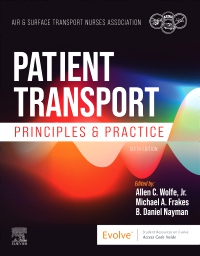
Patient Transport:Principles and Practice - Elsevier eBook on VitalSource, 6th Edition
by Air & Surface Transport Nurses Associati, Allen Wolfe, MSN, CNS, APRN, CFRN, CCRN, CTRN, TCRN, CMTE, FAASTN, Michael Frakes, APRN, FCCM, FAEN, FAASTN, FACHE and Danny Nayman, MBA, NRP, FP-C, CCP-C, CMTE
Elsevier eBook on VitalSource
ISBN:
9780443106231
Copyright:
2025
Publication Date:
02-14-2024
Page Count:
400
Imprint:
Elsevier
List Price:
$106.99
Was
$106.99
Now $96.29
Or $0.00 with a valid access code
**American Journal of Nursing (AJN) Book of the Year Awards, 2nd Place in Critical Care-Emergency Nursing, 2024**
Prepare for certification as a flight and ground transport nurse! ASTNA: Patient Transport: Principles & Practice, 6th Edition addresses the scenarios and injuries commonly encountered in transport nursing, and provides a comprehensive, one-of-a-kind study tool for taking certification exams including the CFRN®, CTRN®, FP-C®, and CCP-C®. Coverage includes the role of air and ground transport personnel, along with topics such as transport physiology, communications, teamwork, safety, airway management, shock, and the different types of trauma. New to this edition is an Aviation for Medical Personnel chapter. Written by the Air & Surface Transport Nurses Association, this resource helps you gain the knowledge and skills you need to succeed on your exam and to transport patients safely.
Prepare for certification as a flight and ground transport nurse! ASTNA: Patient Transport: Principles & Practice, 6th Edition addresses the scenarios and injuries commonly encountered in transport nursing, and provides a comprehensive, one-of-a-kind study tool for taking certification exams including the CFRN®, CTRN®, FP-C®, and CCP-C®. Coverage includes the role of air and ground transport personnel, along with topics such as transport physiology, communications, teamwork, safety, airway management, shock, and the different types of trauma. New to this edition is an Aviation for Medical Personnel chapter. Written by the Air & Surface Transport Nurses Association, this resource helps you gain the knowledge and skills you need to succeed on your exam and to transport patients safely.

-
- NEW! New Aviation for Medical Personnel chapter is written from the perspective of a veteran transport pilot, and provides valuable information on the idiosyncrasies, tips, and tricks about transport aircraft transport
- NEW! Updated and new content on diversity and inclusion covers this timely issue — both among colleagues and patients
- NEW! Additional information on technology used in transport nursing/critical care includes topics such as point-of-care ultrasound (POCUS)
- NEW! Content on COVID-19 as it relates to trauma transport is included
- NEW! More philosophical, psychological, and wellness-associated content is added
-
- In-depth coverage of expert care delivery in transport meets the needs of all healthcare providers including registered nurses, paramedics, physicians, respiratory therapists, pilots, mechanics, and communication specialists
- Real-life scenarios demonstrate how to apply concepts to situations similar to those seen in practice
- Information on important safety regulations is based on the latest updates from the Federal Aviation Association and the National Transportation Safety Board
- Coverage of injuries commonly encountered in flight and ground nursing includes discussions of pathophysiology, assessment, planning, implementation, and evaluation
- Detailed coverage of management issues include scene management, communication, safety, disaster management/triage, quality management, and marketing/public relations
- Focus on interprofessionalism and collaboration emphasizes the importance of teamwork in ensuring successful patient outcomes
- Evolve website includes 350 questions and answers mapped to the CRFN®/CTRN® exams for additional preparation
-
-

-
 Patient TransportHardcover
-
-
SECTION I History and the Current Role of Air and Ground Transport Personnel
1. History of Patient Transport
2. Members of the Transport Team and Preparation for Practice
3. Aviation for Medical Personnel
4. Military Patient Transport
SECTION II General Principles of Practice
5. Transport Physiology
6. Scene Operations and Safety
7. Communications
8. Teamwork and Human Performance
9. Patient Safety
10. Operational Safety and Survival
SECTION III Patient Care Principles
11. Patient Assessment
12. Airway Management
13. Mechanical Ventilation
14. Shock
SECTION IV Trauma
15. General Principles of Trauma Management
16. Neurologic Trauma
17. Thoracoabdominal Trauma
18. Musculoskeletal and Soft Tissue Trauma
19. Burn Trauma
20. Point-of-Care Ultrasound
SECTION V Professional Issues
21. Legal and Professional Issues in Critical Care Transport
22. Quality
23. Accreditation for Air and Ground Medical Transport
24. Mental Health and Wellness for the Provider
25. Post-Incident and Emergency Response Planning -
-
Ways of Reading
- The appearance of the text and page layout can be modified according to the capabilities of the reading system (font family and font size, spaces between paragraphs, sentences, words, and letters, as well as color of background and text)
- This e-publication is accessible to the full extent that the file format and types of content allow, on a specific reading device, by default, without necessarily including any additions such as textual descriptions of images or enhanced navigation
- No information about nonvisual reading is available
-
Conformance
- For detailed accessibility information, see Elsevier's website at https://www.elsevier.com/about/accessibility
- For queries regarding accessibility information, contact [email protected]
- The publication was certified on 18-11-2025
-
Navigation
- Table of contents to all chapters of the text via links
-
Rich Content
- No information is available
-
Hazards
- No information is available
-
Product Content
- No information is available
-
Legal Considerations
- No information is available
-
Additional Accessibility Information
- For readers with color vision deficiency, use of color (e.g., in diagrams, graphics and charts, in prompts, or on buttons inviting a response) is not the sole means of graphical distinction or of conveying information
- E-publication includes basic navigation (usually less detailed than TOC-based navigation)
- Where links, controls or buttons are included in the content, the purpose or functionality of each link, control or button is apparent from the associated text alone - or where it is unclear, separate link, control or button descriptions are provided
- All (or substantially all) textual matter is arranged in a single logical reading order (including text that is visually presented as separate from the main text flow, e.g., in boxouts, captions, tables, footnotes, endnotes, citations, etc.). Non-textual content is also linked from within this logical reading order. (Purely decorative non-text content can be ignored).
- The language of the text has been specified (e.g., via the HTML or XML lang attribute) to optimise text-to-speech (and other alternative renderings), both at the whole document level and, where appropriate, for individual words, phrases or passages in a different language.
-
Ways of Reading
Was
$106.99
Now $96.29
Or $0.00 with a valid access code

 as described in our