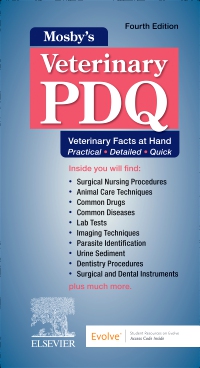

Mosby's Veterinary PDQ - Elsevier eBook on VitalSource, 4th Edition
Elsevier eBook on VitalSource
Now $20.99
**Selected for 2026 Doody's Core Titles in Veterinary Medicine**
Find practical, detailed, and quick veterinary information in this pocket-sized reference! Ideal for the clinical setting, Mosby's Veterinary PDQ, 4th Edition provides fast access to hundreds of veterinary facts, formulas, lab values, and procedures. Coverage includes key topics such as the physical exam, common diseases, emergency care, pharmacology, diagnostic procedures and imaging techniques, surgery and anesthesia, parasite identification, urinalysis, blood tests, and other lab work. A special section offers a guide to normal lab values. Written by expert clinician and vet tech educator Kristin Holtgrew-Bohling, this full-color guide makes it easy to find the information that is most useful in practice.
-
- NEW! Updated drug information includes the newest pharmacologic agents and their uses, dosage forms, and adverse side effects.
- NEW! New and updated images prepare you to perform routine procedures.
-
- Quick-access format is organized into 10 tabbed, color-coded sections, and makes it easy to find facts quickly
- Valuable formulas, conversions, and lab values make it easy to look up the data needed to deliver safe and effective veterinary care
- Information on topics such as dental imaging, surgery, and breathing circuits keeps you up to date on the latest techniques and equipment
- Easy-to-read charts and tables summarize important information that vet techs commonly use but rarely memorize
- Full-color photos and drawings illustrate procedures and tests, dental and surgical instruments, parasites, and urine and blood analysis
- Convenient size easily fits in the busy vet tech’s pocket for use while on the job
- Spiral binding allows you to lay the book flat or keep it open to a specific page, and durable pages can withstand everyday use in the clinical setting
-
-
-
 Mosby's Veterinary PDQSpiral Bound
-
-
PHYSICAL EXAMINATION
Anatomical Planes of Reference
Normal Physiological Data in Adult Dogs and Cats
Body Condition Scoring System
Nutritional Calculations
Nutrient Guidelines for Wellness
Mucus Membranes and Capillary Refill Time
Pain Scores
Estimating Degree of Dehydration
Physical Exam Findings by Body System
HEMATOLOGY, SEROLOGY, AND URINALYSIS
Anticoagulants
Hematology Reference Range Values
Hemostasis Reference Range Values
Hematology Morphology
WBC Morphology
Normal Chemistry
Urinalysis Gross Exam, Specific Gravity, and Stick Evaluation
Urinary Cellular Sediment Examination
Urinalysis Cast Sediment Examination—No Casts Should Be Present
Urine Crystal Sediment Examination
PARASITOLOGY
Common Parasite Prevention Recommendations
Parasite Identification and Treatment
Heartworm/Flea and Tick Preventatives for Dogs
Heartworm/Flea and Tick Preventatives for Cats
CYTOLOGY
DTM Fungal Culture Identification
Common Cell Types in Cytology Samples
Characteristics of Fluid Samples
Vaginal Cytology Interpretation
EMERGENCY AND PROCEDURES
Emergencies
Fluid Therapy
COMMON DISEASES OF DOGS AND CATS
Ophthalmology
Dermatology
Otic
Dental
Pulmonary
Cardiology
Gastrointestinal
Anal Glands
Urinary Tract
Orthopedics
Hematology
Endocrinology
Tick Borne
Neurology
Oncology
Reproduction
PHARMACOLOGY
Commonly Used Medical Prescription
Abbreviations
Conversion Factors
Common Medications
Antimicrobials
Antivirals
Antifungals
Analgesic and Antiinflammatory
Agents
Other Analgesics
Corticosteroids
Glycosaminoglycans
Opioid (Narcotic) Analgesics
Dermatology
Ear Medications
Eye Medications
Anticonvulsants
Cardiovascular Drugs
Antiarrhythmics
Respiratory Drugs
Gastrointestinal Drugs
Endocrine Drugs
Antidotes
Euthanasia Drugs
SURGERY AND ANESTHESIA
Normal Heart Rate and Blood Pressure in Dogs and Cats
Normal Blood Gas Values
Anesthesia Machines
Breathing Circuits
Oxygen Flow Rate Values
Endotracheal Tubes
Preanesthetics, Sedatives, Anesthetics
MLK Canine or Feline Patient Weight in Kilograms
Propofol CRI: Canine or Feline Patient Weight in Kilograms
Capnography
Electrocardiography
Common Abnormalities Seen on ECG
Surgical Instruments
Surgical Pack Storage
Pain Evaluation
DENTISTRY
Directional Terms Used in Dentistry
Common Dental Abbreviations and Symbols for Charting the Mouth
Dental Directional Terms
Dental Formulas for Cats and Dogs
Normal Root Numbers
Dental Imaging
Dental Instruments
Abnormalities
RECOMMENDATIONS AND PROTOCOLS
Common Vaccinations for Dogs
Common Vaccines for Cats
Retroviral Testing Recommendations in Cats
Vetoryl Treatment and Monitoring Flowchart
Vertebral Heart Score -
-
Ways of Reading
- The appearance of the text and page layout can be modified according to the capabilities of the reading system (font family and font size, spaces between paragraphs, sentences, words, and letters, as well as color of background and text)
- This e-publication is accessible to the full extent that the file format and types of content allow, on a specific reading device, by default, without necessarily including any additions such as textual descriptions of images or enhanced navigation
- All content can be read as read aloud speech or dynamic braille
- Has alternative text descriptions for images
-
Conformance
- The publication contains a conformance statement that it meets the EPUB Accessibility 1.1, WCAG 2.1, Level AA standard. Please see https://bornaccessible.benetech.org/certified-publishers/ for further details of our compatibility testing.
- The certifier's credential is https://bornaccessible.benetech.org/certified-publishers/
- For detailed accessibility information, see Elsevier's website at https://www.elsevier.com/about/accessibility
- For queries regarding accessibility information, contact [email protected]
- The publication was certified on 24-03-2026
-
Navigation
- Table of contents to all chapters of the text via links
- Index with links to referenced entries
- Elements such as headings, tables, etc. for structured navigation
- Page list to go to pages from the print source version
-
Rich Content
- Math formulas in accessible format (MathML)
- Chemical formulas in accessible format (MathML)
- Information-rich images are described by extended descriptions
-
Hazards
- The publication contains no hazards
-
Product Content
- Content includes any type of illustrations.
- The primary content is text.
- Content includes maps and/or other cartographic content.
- Content includes a significant number of actionable (clickable) web links to external content, downloadable resources, supplementary material, etc.
- Content includes a significant number of actionable (clickable) cross-references, hyperlinked notes and annotations, or with other actionable links between largely textual elements (e.g., quiz/test questions, 'choose your own ending', etc.).
- Content includes photographs, whether in a plate section / insert or not.
- Content includes figures, diagrams, charts and/or graphs, including other 'mechanical' (i.e. non-photographic) illustrations.
- Content is enhanced with additional images or graphical content such as supplementary photographs that are not included in a primary or 'unenhanced' version.
- Content includes images displayed in a specific order for the purpose of graphic storytelling or giving information (e.g. graphic novels, comics and manga). May include text integrated into the image (as speech and thought bubbles, textual 'sound' effects, captions etc.).
- Content includes text within images, including text-as-text embedded in diagrams, charts, or within images containing speech balloons, thought bubbles, captions, etc.
- Content includes visual content that is purely decorative and is not necessary to understanding of the content.
- Content includes mathematical notations, formulae.
- At least some text - including text within other images - is 'text as an image' (i.e., a picture of text).
- Product includes actionable (clickable) links to external interactive content.
-
Legal Considerations
- No information is available
-
Additional Accessibility Information
- Content is enhanced with ARIA roles to optimize organization and facilitate navigation
- Page breaks included from the original print source
- For readers with color vision deficiency, use of color (e.g., in diagrams, graphics and charts, in prompts, or on buttons inviting a response) is not the sole means of graphical distinction or of conveying information
- The body text is presented with a contrast ratio of at least 4.5:1 (or 3:1 for large/heading text)
- Ultra-high contrast between text and background
- E-publication includes basic navigation (usually less detailed than TOC-based navigation)
- Where links, controls or buttons are included in the content, the purpose or functionality of each link, control or button is apparent from the associated text alone - or where it is unclear, separate link, control or button descriptions are provided
- All (or substantially all) textual matter is arranged in a single logical reading order (including text that is visually presented as separate from the main text flow, e.g., in boxouts, captions, tables, footnotes, endnotes, citations, etc.). Non-textual content is also linked from within this logical reading order. (Purely decorative non-text content can be ignored).
- Content provides explanations for unusual words, abbreviations, acronyms, idioms, jargon in an accessible form, such as glossaries, scripted pop-ups.
- Where interactive content is included in the product, controls are provided (e.g., for speed, pause and resume, reset) and labelled to make their use clear.
- The language of the text has been specified (e.g., via the HTML or XML lang attribute) to optimise text-to-speech (and other alternative renderings), both at the whole document level and, where appropriate, for individual words, phrases or passages in a different language.
-
Ways of Reading

 as described in our