ISBN:
9780443107290
Copyright:
2024
Publication Date:
02-14-2024
Page Count:
236
Imprint:
Elsevier
List Price:
$78.99

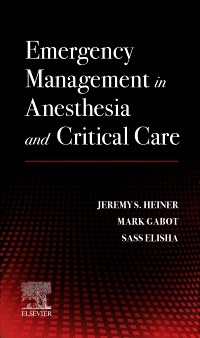
Emergency Management in Anesthesia and Critical Care - Elsevier E-Book on VitalSource, 1st Edition
by Jeremy S. Heiner, EdD, CRNA, Mark Gabot, DNP, CRNA and Sassoon Elisha, EdD, CRNA, Mark Gabot, DNP, CRNA and Sassoon Michael Elisha, EdD, APRN, CRNA
Elsevier eBook on VitalSource
ISBN:
9780443107290
Copyright:
2024
Publication Date:
02-14-2024
Page Count:
236
Imprint:
Elsevier
List Price:
$78.99
Was
$78.99
Now $55.29
Or $0.00 with a valid access code
Every moment counts when treating an emergency event. Emergency Management in Anesthesia and Critical Care provides quick access to essential information for rapidly identifying and treating complex medical emergencies. Its compact size makes this reference easy to carry in a pocket in the OR, ICU, ED, or critical care setting. An outline format with consistent headings and a logical organization puts vital content at your fingertips. It is also an ideal tool for developing and conducting crisis simulation scenarios to prepare for emergencies before they happen.
-
- NEW! Nora AI - an AI-powered learning assistant exclusive to Elsevier ebooks on VitalSource's Bookshelf® platform - offers built-in AI learning support that provides personalized answers based on content from the Elsevier ebook
- Convenient outline format features consistent headings, including Treatment, Physiology and Pathophysiology, Signs and Symptoms, Differential Diagnosis, and Suggested Readings
- Easy-to-read, uniform, and concise writing style makes this text a valuable resource for practicing clinicians, educators, and students
- Quick-reference format is ideal for use during simulations
- Coverage of common major critical events offers anesthetists quick access to vital information in the operating room
- Expert author team includes leading experts in anesthesia and critical care
-
SECTION 1 Airway Management Emergencies
1. Airway and Surgical Fire
2. Acute Gastric Regurgitation/Aspiration
3. Emergent Reintubation
4. Failed Airway
5. Laryngospasm
6. Stridor
7. Upper Airway Obstruction
SECTION 2 Respiratory Emergencies
8. Bronchospasm
9. Hypercarbia
10. Hypoxia
11. Pneumothorax, Hemothorax, and Tension Pneumothorax
SECTION 3 Cardiovascular Emergencies
12. Autonomic Hyperreflexia
13. Cardiac Dysrhythmias
14. Embolism
15. Hypertension
16. Hypotension
17. Myocardial Ischemia and Infarction
18. Pacemakers and Automated Internal
Cardiac Defibrillators (AICDs)
SECTION 4 Neurologic Emergencies
19. Acute Cerebral Vascular Accident
20. Increased Intracranial Pressure
21. High/Total Spinal Anesthesia
SECTION 5 Shock Emergencies
22. Anaphylactic Shock
23. Cardiac Compressive Shock
24. Cardiogenic Shock
25. Hypovolemic Shock (Acute Hmorrhage)
26. Neurogenic Shock
27. Septic Shock
SECTION 6 Renal Emergencies
28. Acute Renal Dysfunction
29. Electrolyte Abnormalities
SECTION 7 Endocrine Emergencies
30. Acute Adrenal Crisis
31. Diabetic Ketoacidosis
32. Pheochromocytoma
33. Thyroid Crisis/Storm
SECTION 8 Hematologic Emergencies
34. Disseminated Intravascular Coagulation (DIC)
35. Hemoglobinopathies
36. Transfusion-Related Emergencies
SECTION 9 Pharmacologic Emergencies
37. Local Anesthetic Systemic Toxicity (LAST)
38. Malignaant Hyperthermia (MH)
39. Neuroleptic Malignant Syndrome
SECTION 10 Obstetric Emergencies
40. Emergency Cesarean Section
41. Obstetric Hemorrhage
42. Preeclampsia and Eclampsia
SECTION 11 Equipment Emergencies
43. Anesthesia Machine Malfunction
44. Electrical Power Failure
SECTION 12 Miscellaneous Emergencies
45. Delayed Emergence
46. Hypothermia
47. Transurethral Resection of the Prostate (TURP) Syndrome -
-
Ways of Reading
- The appearance of the text and page layout can be modified according to the capabilities of the reading system (font family and font size, spaces between paragraphs, sentences, words, and letters, as well as color of background and text)
- This e-publication is accessible to the full extent that the file format and types of content allow, on a specific reading device, by default, without necessarily including any additions such as textual descriptions of images or enhanced navigation
- All content can be read as read aloud speech or dynamic braille
- Has alternative text descriptions for images
-
Conformance
- The publication contains a conformance statement that it meets the EPUB Accessibility 1.1, WCAG 2.1, Level AA standard. Please see https://bornaccessible.benetech.org/certified-publishers/ for further details of our compatibility testing.
- The certifier's credential is https://bornaccessible.benetech.org/certified-publishers/
- For detailed accessibility information, see Elsevier's website at https://www.elsevier.com/about/accessibility
- For queries regarding accessibility information, contact [email protected]
- The publication was certified on 18-02-2026
-
Navigation
- Table of contents to all chapters of the text via links
- Index with links to referenced entries
- Elements such as headings, tables, etc. for structured navigation
- Page list to go to pages from the print source version
-
Rich Content
- Information-rich images are described by extended descriptions
-
Hazards
- The publication contains no hazards
-
Product Content
- The primary content is text.
- Content includes a significant number of actionable (clickable) web links to external content, downloadable resources, supplementary material, etc.
- Content includes a significant number of actionable (clickable) cross-references, hyperlinked notes and annotations, or with other actionable links between largely textual elements (e.g., quiz/test questions, 'choose your own ending', etc.).
- Content includes additional textual content such as an interview, feature article, essay, bibliography, quiz/test, other background material, or text that is not included in a primary or 'unenhanced' version.
- Content includes supplementary text as promotional content such as, for example, a teaser chapter.
- Content includes figures, diagrams, charts and/or graphs, including other 'mechanical' (i.e. non-photographic) illustrations.
- Content includes text within images, including text-as-text embedded in diagrams, charts, or within images containing speech balloons, thought bubbles, captions, etc.
- Content includes chemical notations, formulae.
- At least some text - including text within other images - is 'text as an image' (i.e., a picture of text).
-
Legal Considerations
- No information is available
-
Additional Accessibility Information
- Content is enhanced with ARIA roles to optimize organization and facilitate navigation
- Page breaks included from the original print source
- For readers with color vision deficiency, use of color (e.g., in diagrams, graphics and charts, in prompts, or on buttons inviting a response) is not the sole means of graphical distinction or of conveying information
- The body text is presented with a contrast ratio of at least 4.5:1 (or 3:1 for large/heading text)
- Ultra-high contrast between text and background
- E-publication includes basic navigation (usually less detailed than TOC-based navigation)
- Where links, controls or buttons are included in the content, the purpose or functionality of each link, control or button is apparent from the associated text alone - or where it is unclear, separate link, control or button descriptions are provided
- All (or substantially all) textual matter is arranged in a single logical reading order (including text that is visually presented as separate from the main text flow, e.g., in boxouts, captions, tables, footnotes, endnotes, citations, etc.). Non-textual content is also linked from within this logical reading order. (Purely decorative non-text content can be ignored).
- Content provides explanations for unusual words, abbreviations, acronyms, idioms, jargon in an accessible form, such as glossaries, scripted pop-ups.
- Where interactive content is included in the product, controls are provided (e.g., for speed, pause and resume, reset) and labelled to make their use clear.
- The language of the text has been specified (e.g., via the HTML or XML lang attribute) to optimise text-to-speech (and other alternative renderings), both at the whole document level and, where appropriate, for individual words, phrases or passages in a different language.
-
Ways of Reading
Was
$78.99
Now $55.29
Or $0.00 with a valid access code

 as described in our