ISBN:
9780443108488
Copyright:
2021
Publication Date:
01-23-2023
Page Count:
576
Imprint:
Elsevier
List Price:
$35.99

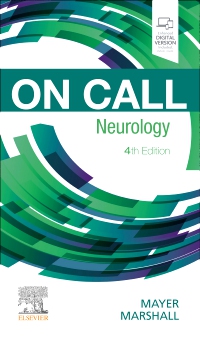
On Call Neurology - Elsevier eBook on VitalSource, 4th Edition
by Stephan A. Mayer, MD and Randolph S. Marshall, MD
Elsevier eBook on VitalSource
ISBN:
9780443108488
Copyright:
2021
Publication Date:
01-23-2023
Page Count:
576
Imprint:
Elsevier
List Price:
$35.99
Was
$35.99
Now $34.19
Or $0.00 with a valid access code
Ideal for any on-call professional, resident, or medical student, this popular reference covers the common problems you’ll encounter while on call in the hospital. On Call Neurology, 4th Edition, by Drs. Randolph S. Marshall and Stephan A. Mayer, fits perfectly in your pocket, ready to provide key information in time-sensitive, challenging situations. You’ll gain speed, skill, and knowledge with every call - from diagnosing a difficult or life-threatening situation to prescribing the right medication.
-
- NEW! Nora AI - an AI-powered learning assistant exclusive to Elsevier ebooks on VitalSource's Bookshelf® platform - offers built-in AI learning support that provides personalized answers based on content from the Elsevier ebook
- Features a logical, highly templated format so you can locate key information quickly
- Provides updated content and references, keeping you on the cutting edge of current, evidence-based information
- Includes the latest information on headache, demyelinating diseases, infections of the central nervous system, dementia, and more
- Highlights critical information, reducing the likelihood of error
- Provides an updated On Call Formulary covering the most common neurologic medications
- Delivers consistent, easy-to-follow coverage of the most common on-call problems and approaches, including what to do from the initial phone call, questions you should ask to assess the urgency of each situation, "Elevator Thoughts," how to immediately identify major threats to life, what to do at the bedside, and how to avoid common mistakes for every call
- Enhanced eBook version included with purchase. Your enhanced eBook allows you to access all of the text, figures, and references from the book on a variety of devices
-
-
 On Call NeurologyPaperback
-
-
1. Approach to the Neurologic Patient on Call: History Taking, Differential Diagnosis, and Anatomic Localization
2. The Neurologic Examiniation
3. Diagnostic Studies
Patient-Related Problems: The Common Calls
4. Acute Seizures and Status Epilepticus
5. Stupor and Coma
6. Acute Stroke
7. Spinal Cord Compression
8. Delirium and Amnesia
9. Head Injury
10. Focal Mass Lesions
11. Ataxia and Gait Failure
12. Acute Visual Disturbances
13. Increased Intracranial Pressure
14. Dizziness and Vertigo
15. Headache
16. Neuromuscular Respiratory Failure
17. Syncope
18. Pain Syndromes
19. Brain Death
Selected Neurologic Disorders
20. Nerve and Muscle Diseases
21. Demyelinating and Inflammatory Disorders of the Central Nervous System
22. Infections of the Central Nervous System
23. Neuro-oncology
24. Cerebrovascular Disease
25. Movement Disorders
26. Epilepsy and Seizure Disorders
27. Pediatric Neurology
28. Dementia -
-
Ways of Reading
- The appearance of the text and page layout can be modified according to the capabilities of the reading system (font family and font size, spaces between paragraphs, sentences, words, and letters, as well as color of background and text)
- This e-publication is accessible to the full extent that the file format and types of content allow, on a specific reading device, by default, without necessarily including any additions such as textual descriptions of images or enhanced navigation
- No information about nonvisual reading is available
-
Conformance
- No information is available
-
Navigation
- Table of contents to all chapters of the text via links
- Page list to go to pages from the print source version
-
Rich Content
- No information is available
-
Hazards
- No information is available
-
Product Content
- No information is available
-
Legal Considerations
- No information is available
-
Additional Accessibility Information
- Page breaks included from the original print source
- For readers with color vision deficiency, use of color (e.g., in diagrams, graphics and charts, in prompts, or on buttons inviting a response) is not the sole means of graphical distinction or of conveying information
- E-publication includes basic navigation (usually less detailed than TOC-based navigation)
- Where links, controls or buttons are included in the content, the purpose or functionality of each link, control or button is apparent from the associated text alone - or where it is unclear, separate link, control or button descriptions are provided
- All (or substantially all) textual matter is arranged in a single logical reading order (including text that is visually presented as separate from the main text flow, e.g., in boxouts, captions, tables, footnotes, endnotes, citations, etc.). Non-textual content is also linked from within this logical reading order. (Purely decorative non-text content can be ignored).
- The language of the text has been specified (e.g., via the HTML or XML lang attribute) to optimise text-to-speech (and other alternative renderings), both at the whole document level and, where appropriate, for individual words, phrases or passages in a different language.
-
Ways of Reading
Was
$35.99
Now $34.19
Or $0.00 with a valid access code

 as described in our