ISBN:
9780443108617
Copyright:
2023
Publication Date:
02-21-2025
Page Count:
416
Imprint:
Elsevier
List Price:
$37.99

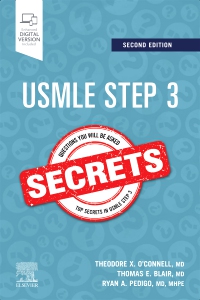
USMLE Step 3 Secrets - Elsevier eBook on VitalSource, 2nd Edition
by Theodore X. O'Connell, MD, Thomas E. Blair, MD and Ryan A. Pedigo, MD
Elsevier eBook on VitalSource
ISBN:
9780443108617
Copyright:
2023
Publication Date:
02-21-2025
Page Count:
416
Imprint:
Elsevier
List Price:
$37.99
Was
$37.99
Now $34.19
Or $0.00 with a valid access code
Succinct, easy to read, and highly effective—the highly regarded Secrets Series® provides students and practitioners in all areas of health care with focused, engaging resources for quick reference and exam review. In USMLE Step 3 Secrets, 2nd Edition, bestselling review author Dr. Ted O’Connell, along with co-authors Drs. Thomas Blair and Ryan Pedigo, offers practical, up-to-date coverage of the full range of topics on this high-stakes exam, positioning you to clear that final USMLE hurdle with confidence. This enjoyable, easy-to-read book features the Secrets’ popular question-and-answer format that prepares you for one of the most important exams you’ll take in your medical career.
-
- A concise, integrated, clinical overview of Step 3 content, perfect for a refresher and practical preparation for this challenging vignette-style exam
- Extensively revised and updated, reflecting high-yield content on the USMLE Step 3
- Highly engaging Q&A format interactively reviews your knowledge of diagnosis, treatment, and management of common disorders
- New full-color images, figures, tables, and summary boxes provide a concise visual overview of important board-relevant content
- Top 100 Secrets, tips, and memory aids offer a fast overview of the secrets you must know for success in practice and on exams
- Review board composed of students and residents who performed highly on all steps of the USMLE and have experience with USMLE-style question development
- Portable size makes it easy to carry with you for quick reference or review anywhere, anytime
- Enhanced eBook version included with purchase. Your enhanced eBook allows you to access all of the text, figures, and references from the book on a variety of devices
-
-
 USMLE Step 3 SecretsPaperback
-
-
1. General Principles
2. Disorders of the Nervous System and Special Senses
3. Disorders of the Respiratory System
4. Cardiovascular Disorders
5. Nutritional and Digestive System Disorders
6. Behavioral and Emotional Disorders
7. Disorders of the Musculoskeletal System
8. Disorders of the Skin and Subcutaneous Tissue
9. Disorders of the Endocrine System
10. Renal and Urinary Disorders
11. Diseases and Disorders of the Female Reproductive System
12. Pregnancy, Labor and Delivery, the Fetus, and the Newborn
13. Disorders of Blood
14. Disorders of the Male Reproductive System
15. Disorders of the Immune System
16. Clinical Case Scenarios -
-
Ways of Reading
- The appearance of the text and page layout can be modified according to the capabilities of the reading system (font family and font size, spaces between paragraphs, sentences, words, and letters, as well as color of background and text)
- This e-publication is accessible to the full extent that the file format and types of content allow, on a specific reading device, by default, without necessarily including any additions such as textual descriptions of images or enhanced navigation
- No information about nonvisual reading is available
-
Conformance
- No information is available
-
Navigation
- Table of contents to all chapters of the text via links
- Page list to go to pages from the print source version
-
Rich Content
- No information is available
-
Hazards
- No information is available
-
Product Content
- No information is available
-
Legal Considerations
- No information is available
-
Additional Accessibility Information
- Content is enhanced with ARIA roles to optimize organization and facilitate navigation
- Page breaks included from the original print source
- For readers with color vision deficiency, use of color (e.g., in diagrams, graphics and charts, in prompts, or on buttons inviting a response) is not the sole means of graphical distinction or of conveying information
- E-publication includes basic navigation (usually less detailed than TOC-based navigation)
- Where links, controls or buttons are included in the content, the purpose or functionality of each link, control or button is apparent from the associated text alone - or where it is unclear, separate link, control or button descriptions are provided
- All (or substantially all) textual matter is arranged in a single logical reading order (including text that is visually presented as separate from the main text flow, e.g., in boxouts, captions, tables, footnotes, endnotes, citations, etc.). Non-textual content is also linked from within this logical reading order. (Purely decorative non-text content can be ignored).
- The language of the text has been specified (e.g., via the HTML or XML lang attribute) to optimise text-to-speech (and other alternative renderings), both at the whole document level and, where appropriate, for individual words, phrases or passages in a different language.
-
Ways of Reading
Was
$37.99
Now $34.19
Or $0.00 with a valid access code

 as described in our