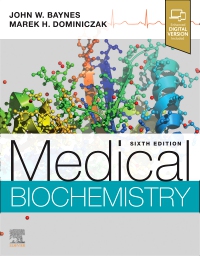

Medical Biochemistry Elsevier eBook on VitalSource, 6th Edition
Elsevier eBook on VitalSource
Now $63.89
**Selected for 2026 Doody's Core Titles in Biochemistry**
Written by carefully selected global experts, practicing physicians, and educators in the various sub-disciplines of biochemistry, Medical Biochemistry, 6th Edition, offers a unique combination of research and clinical practice tailored to today's integrated courses. Covering clinically relevant topics in greater detail than other texts, this outstanding resource provides a strong overview of traditional areas in medical biochemistry along with state-of-the-art coverage of today’s latest developments. You’ll learn basic science concepts alongside clinical cases that describe patients likely to be encountered in clinical training, as well as how to use laboratory tests to diagnose and monitor the most important conditions. Thorough yet accessible, this clinically focused text is useful from medical school to clinical practice.
-
- Features a strong clinical orientation, emphasizing the relevance of biochemistry to the daily practice of medicine
- Highlights the latest developments in regulatory and molecular biology, signal transduction, age-related chronic disease, epigenetics, and bioinformatics and the “-omics,” as well as important global medical issues such as diabetes mellitus, obesity and malnutrition, cancer and atherosclerotic cardiovascular disease, and nutrition and exercise
- Emphasizes clinical evaluation, maintenance of good health, and disease prevention, as well as translational medicine and the diagnosis and treatment of disease
- Contains organ-focused chapters addressing the biochemistry of the bone, kidney, liver, lungs and muscle; and system-focused chapters on the biochemistry of the immune and endocrine systems, neurochemistry and neurotransmission, and cancer
- Includes clear, colorful icons and illustrations that help you easily navigate the text and understand the material
- Provides online features such as challenging “Active Learning” questions for independent study, relevant websites that reinforce or supplement chapter content, 150+ multiple-choice and USMLE-style questions, a quick-reference glossary, additional images and case studies, references to current literature, and more
- Enhanced eBook version included with purchase. Your enhanced eBook allows you to access all of the text, figures, and references from the book on a variety of devices
-
-
 Medical BiochemistryPaperback
-
-
SECTION 1 Introduction
1. Biochemistry and Clinical Medicine: Introduction and Overview
SECTION 2 Molecules and Cells
2. Amino Acids and Proteins
3. Carbohydrates and Lipids
4. Membranes and Transport
SECTION 3 Metabolism
5. Oxygen Transport
6. Catalytic Proteins - Enzymes
7. Vitamins and Minerals
8. Bioenergetics and Oxidative Metabolism
9. Glycolysis and the Pentose Phosphate Pathway
10. The Tricarboxylic Acid Cycle
11. Fatty Acid and Triglyceride Catabolism
12. Biosynthesis and Storage of Carbohydrate
13. Biosynthesis and Storage of Fatty Acids
14. Biosynthesis of Cholesterol and Steroids
15. Biosynthesis and Degradation of Amino Acids
16. Biosynthesis and Degradation of Nucleotides
17. Complex Carbohydrates: Glycoproteins
18. Complex Lipids
19. The Extracellular Matrix
SECTION 4 Molecular Basis of Inheritance
20. Deoxyribonucleic Acid
21. Ribonucleic Acid
22. Protein Synthesis and Turnover
23. Regulation of Gene Expression: Basic Mechanisms
24. Genomics, Proteomics and Metabolomics
SECTION 5 Signalling and Growth
25. Membrane Receptors and Signal Transduction
26. Neurotransmitters
27. Biochemical Endocrinology
28. Cellular Homeostasis: Cell Growth and Cancer
29. Aging
SECTION 6 Fuels Nutrients and Minerals
30. Digestion and Absorption of Nutrients: The Gastrointestinal Tract
31. Glucose Homeostasis and Fuel Metabolism: Diabetes Mellitus
32. Nutrients and Diets
33. Lipoprotein Metabolism and Atherogenesis
SECTION 7 Specialized Tissues and Their Function
34. Role of Liver in Metabolism
35. Water and Electrolytes Homeostasis
36. The Lung and the Regulation of Hydrogen Ion Concentration (Acid–Base Balance)
37. Muscle: Energy Metabolism, Contraction, and Exercise
38. Bone Metabolism and Calcium Homeostasis
39. Neurochemistry
SECTION 8 Blood and Immunity. Clinical Biochemistry
40. Blood and Plasma Proteins
41. Hemostasis and Thrombosis
42. Oxidative Stress and Inflammation
43. The Immune Response: Innate and Adaptive Immunity
Appendix 1: Selected Clinical Laboratory Reference Ranges -
-
Ways of Reading
- The appearance of the text and page layout can be modified according to the capabilities of the reading system (font family and font size, spaces between paragraphs, sentences, words, and letters, as well as color of background and text)
- This e-publication is accessible to the full extent that the file format and types of content allow, on a specific reading device, by default, without necessarily including any additions such as textual descriptions of images or enhanced navigation
- No information about nonvisual reading is available
-
Conformance
- No information is available
-
Navigation
- Table of contents to all chapters of the text via links
- Page list to go to pages from the print source version
-
Rich Content
- No information is available
-
Hazards
- No information is available
-
Product Content
- No information is available
-
Legal Considerations
- No information is available
-
Additional Accessibility Information
- Page breaks included from the original print source
- For readers with color vision deficiency, use of color (e.g., in diagrams, graphics and charts, in prompts, or on buttons inviting a response) is not the sole means of graphical distinction or of conveying information
- E-publication includes basic navigation (usually less detailed than TOC-based navigation)
- Where links, controls or buttons are included in the content, the purpose or functionality of each link, control or button is apparent from the associated text alone - or where it is unclear, separate link, control or button descriptions are provided
- All (or substantially all) textual matter is arranged in a single logical reading order (including text that is visually presented as separate from the main text flow, e.g., in boxouts, captions, tables, footnotes, endnotes, citations, etc.). Non-textual content is also linked from within this logical reading order. (Purely decorative non-text content can be ignored).
- The language of the text has been specified (e.g., via the HTML or XML lang attribute) to optimise text-to-speech (and other alternative renderings), both at the whole document level and, where appropriate, for individual words, phrases or passages in a different language.
-
Ways of Reading

 as described in our