
ISBN:
9780443108969
Copyright:
2025
Publication Date:
09-20-2024
Page Count:
288
Imprint:
Elsevier
List Price:
$59.99

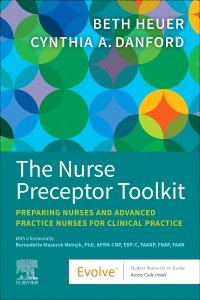
The Nurse Preceptor Toolkit - Elsevier E-Book on VitalSource, 1st Edition
by Beth Heuer, DNP, APRN-CNP, CPNP-PC, PMHS, FAANP and Cynthia A. Danford, PhD, CRNP, PPCNP-BC, CPNP-PC, FAAN
Elsevier eBook on VitalSource
ISBN:
9780443108969
Copyright:
2025
Publication Date:
09-20-2024
Page Count:
288
Imprint:
Elsevier
List Price:
$59.99
Was
$59.99
Now $52.79
Or $0.00 with a valid access code
Develop the skills necessary for precepting RN and APRN students and new orientees! The Nurse Preceptor Toolkit is written by and for RN and APRN clinicians and faculty members from a variety of levels, specialties, and settings. Using real-life examples and practical tips, this comprehensive resource answers the questions preceptors often ask when interacting with students of all levels, as well as new orientees. Within its pages, you’ll find everything you need to develop and solidify the clinical teaching skills essential to becoming an effective preceptor.
-
- This completely new book serves as a comprehensive resource for precepting both RN and APRN students and new orientees
- Coverage addresses questions preceptors have asked when interacting with students of all levels, as well as with new orientees
- Content is written by and for RN and APRN clinicians and faculty members from a variety of levels, specialties, and settings
- Real-life examples and practical tips guide the development and solidification of the clinical teaching skills needed to become an effective preceptor
- Coverage of essential precepting topics includes effective communication, flexibility, time management skills, providing feedback and support, an understanding of different adult learning styles, and the ability to confidently evaluate student knowledge and competencies
- Chapter objectives serve as “advance organizers” to help prepare you for the content that follows
- Exemplars model excellence in clinical precepting through contributor-authored stories of successful faculty-preceptor-learner partnerships related to the content of each chapter
- Boxes highlight tips from successful preceptors
- Appendices provide ready-to-use tools to enhance the preceptor-learner experience
-
PART I Setting the Stage
1. Introduction to Precepting
PART II Defining the Preceptor
2. Starting With the Basics
3. Why Precept?
4. Coaching and Mentoring
PART III Framing the Precepting Experience
5. Understanding the Learner and the Learning Process
6. Fostering Effective Preceptor-Learner Communication
7. The Learning Curve: A Parallel Venture for Preceptors and Learners
PART IV Clinical Judgment Skills and Precepting Models
8. Special Precepting Tools for Clinical Judgment
PART V Tools for Precepting
9. Expectations: Preceptors, Faculty, and Academic Programs
10. Providing a Well-Rounded Clinical Experience
11. Special Considerations When Precepting Nurse Practitioner Students
12. Precepting the Undergraduate and Graduate-Entry Nursing Student
13. Onboarding the New Nurse
14. Orienting the Advanced Practice Registered Nurse Student
15. Guiding the Nurse Practitioner Student Experience
16. Professional Development for the Preceptor and the Orientee
17. Managing Challenging Behaviors With Learners in Clinical Environments
18. Self-Care for the Busy Preceptor
19. Managing Barriers in the APRN Clinical Site
20. Documentation
21. Evaluation
22. Moving Into Leadership Roles Beyond Practice
23. Precepting in Global Health Experiences
24. Precepting in Specialty Settings
25. Bringing Closure to the Precepting Experience -
-
Ways of Reading
- The appearance of the text and page layout can be modified according to the capabilities of the reading system (font family and font size, spaces between paragraphs, sentences, words, and letters, as well as color of background and text)
- This e-publication is accessible to the full extent that the file format and types of content allow, on a specific reading device, by default, without necessarily including any additions such as textual descriptions of images or enhanced navigation
- All content can be read as read aloud speech or dynamic braille
- Has alternative text descriptions for images
-
Conformance
- The publication contains a conformance statement that it meets the EPUB Accessibility 1.1, WCAG 2.1, Level AA standard. Please see https://bornaccessible.benetech.org/certified-publishers/ for further details of our compatibility testing.
- The certifier's credential is https://bornaccessible.benetech.org/certified-publishers/
- For detailed accessibility information, see Elsevier's website at https://www.elsevier.com/about/accessibility
- For queries regarding accessibility information, contact [email protected]
- The publication was certified on 17-02-2026
-
Navigation
- Table of contents to all chapters of the text via links
- Index with links to referenced entries
- Elements such as headings, tables, etc. for structured navigation
- Page list to go to pages from the print source version
-
Rich Content
- Information-rich images are described by extended descriptions
-
Hazards
- The publication contains no hazards
-
Product Content
- The primary content is text.
- Content includes a significant number of actionable (clickable) web links to external content, downloadable resources, supplementary material, etc.
- Content includes a significant number of actionable (clickable) cross-references, hyperlinked notes and annotations, or with other actionable links between largely textual elements (e.g., quiz/test questions, 'choose your own ending', etc.).
- Content includes additional textual content such as an interview, feature article, essay, bibliography, quiz/test, other background material, or text that is not included in a primary or 'unenhanced' version.
- Content includes supplementary text as promotional content such as, for example, a teaser chapter.
- Content includes figures, diagrams, charts and/or graphs, including other 'mechanical' (i.e. non-photographic) illustrations.
- Content includes text within images, including text-as-text embedded in diagrams, charts, or within images containing speech balloons, thought bubbles, captions, etc.
- At least some text - including text within other images - is 'text as an image' (i.e., a picture of text).
-
Legal Considerations
- No information is available
-
Additional Accessibility Information
- Content is enhanced with ARIA roles to optimize organization and facilitate navigation
- Page breaks included from the original print source
- For readers with color vision deficiency, use of color (e.g., in diagrams, graphics and charts, in prompts, or on buttons inviting a response) is not the sole means of graphical distinction or of conveying information
- The body text is presented with a contrast ratio of at least 4.5:1 (or 3:1 for large/heading text)
- Ultra-high contrast between text and background
- E-publication includes basic navigation (usually less detailed than TOC-based navigation)
- Where links, controls or buttons are included in the content, the purpose or functionality of each link, control or button is apparent from the associated text alone - or where it is unclear, separate link, control or button descriptions are provided
- All (or substantially all) textual matter is arranged in a single logical reading order (including text that is visually presented as separate from the main text flow, e.g., in boxouts, captions, tables, footnotes, endnotes, citations, etc.). Non-textual content is also linked from within this logical reading order. (Purely decorative non-text content can be ignored).
- Content provides explanations for unusual words, abbreviations, acronyms, idioms, jargon in an accessible form, such as glossaries, scripted pop-ups.
- Where interactive content is included in the product, controls are provided (e.g., for speed, pause and resume, reset) and labelled to make their use clear.
- The language of the text has been specified (e.g., via the HTML or XML lang attribute) to optimise text-to-speech (and other alternative renderings), both at the whole document level and, where appropriate, for individual words, phrases or passages in a different language.
-
Ways of Reading

Was
$59.99
Now $52.79
Or $0.00 with a valid access code

 as described in our