ISBN:
9780443109065
Copyright:
2025
Publication Date:
05-24-2024
Page Count:
250
Imprint:
Elsevier
List Price:
$32.99

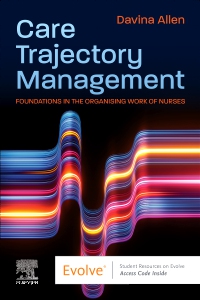
Care Trajectory Management for Nurses - Elsevier E-Book on VitalSource, 1st Edition
by Davina Allen, RN; BA(Hons); PhD
Elsevier eBook on VitalSource
ISBN:
9780443109065
Copyright:
2025
Publication Date:
05-24-2024
Page Count:
250
Imprint:
Elsevier
List Price:
$32.99
Was
$32.99
Now $29.69
Or $0.00 with a valid access code
Care trajectory management refers to the work that nurses do to coordinate and organise patient care. It’s a relatively unseen element of the nursing role that is absolutely vital for patient safety and quality care.
Care Trajectory Management: Foundations in the Organising Work of Nurses is the first ever textbook of its kind for nurse educators, practice facilitators and policy makers as well as undergraduate nurses. It is both a theoretical and practical resource covering the concepts and theories around the organisational components of nursing practice, derived the research of nurse academic Davina Allen.
This excellent book will help prepare nurses to be the ‘glue’ in increasingly complex healthcare systems, and provides an excellent foundation for embedding this important subject into student curricula.
Care Trajectory Management: Foundations in the Organising Work of Nurses is the first ever textbook of its kind for nurse educators, practice facilitators and policy makers as well as undergraduate nurses. It is both a theoretical and practical resource covering the concepts and theories around the organisational components of nursing practice, derived the research of nurse academic Davina Allen.
This excellent book will help prepare nurses to be the ‘glue’ in increasingly complex healthcare systems, and provides an excellent foundation for embedding this important subject into student curricula.
-
- The first textbook of its kind – a valuable resource for both experienced nurses and undergraduates
- Evidence-based – derived from research led by the author
- The history of nursing’s professional development
- Professional identity
- Healthcare quality and safety
- Healthcare systems
- Managing complexity
- Care coordination
- Tacit knowledge
- Nursing theory
- Organising work
- Care Trajectory Management Framework
- Translational mobilisation theory
- Illustrative case studies based on observational studies bring theory to life
- Exercises, quick quizzes and reflective practice help to apply learning
- Online downloadable workbooks to organise learning
-
-

-
 Care Trajectory ManagementPaperback
-
-
SECTION I What Is Care Trajectory Management and Why Does It Matter?
1. Concepts and Making the Invisible, Visible
2. Care Trajectories and Care Trajectory Management
3. The Complexities of Healthcare Work
4. Approaches to Organising Healthcare
5. Care Trajectory Management and Healthcare Quality and Safety
6. Care Trajectory Management and Professional Identity
SECTION II The Theory and Practice of Care Trajectory Management
7. Conceptualising Healthcare Organisation for Care Trajectory Management
8. Conceptualising Healthcare Work for Care Trajectory Management
9. Conceptualising Care Trajectory Management in Nursing Practice
10. Care Trajectory Management in Nursing Practice
Answers to Quick Quizzes
Indicative Answers to Selected Exercises -
-
Ways of Reading
- The appearance of the text and page layout can be modified according to the capabilities of the reading system (font family and font size, spaces between paragraphs, sentences, words, and letters, as well as color of background and text)
- This e-publication is accessible to the full extent that the file format and types of content allow, on a specific reading device, by default, without necessarily including any additions such as textual descriptions of images or enhanced navigation
- No information about nonvisual reading is available
-
Conformance
- No information is available
-
Navigation
- Table of contents to all chapters of the text via links
- Page list to go to pages from the print source version
-
Rich Content
- No information is available
-
Hazards
- No information is available
-
Product Content
- No information is available
-
Legal Considerations
- No information is available
-
Additional Accessibility Information
- Content is enhanced with ARIA roles to optimize organization and facilitate navigation
- Page breaks included from the original print source
- For readers with color vision deficiency, use of color (e.g., in diagrams, graphics and charts, in prompts, or on buttons inviting a response) is not the sole means of graphical distinction or of conveying information
- E-publication includes basic navigation (usually less detailed than TOC-based navigation)
- Where links, controls or buttons are included in the content, the purpose or functionality of each link, control or button is apparent from the associated text alone - or where it is unclear, separate link, control or button descriptions are provided
- All (or substantially all) textual matter is arranged in a single logical reading order (including text that is visually presented as separate from the main text flow, e.g., in boxouts, captions, tables, footnotes, endnotes, citations, etc.). Non-textual content is also linked from within this logical reading order. (Purely decorative non-text content can be ignored).
- The language of the text has been specified (e.g., via the HTML or XML lang attribute) to optimise text-to-speech (and other alternative renderings), both at the whole document level and, where appropriate, for individual words, phrases or passages in a different language.
-
Ways of Reading
Was
$32.99
Now $29.69
Or $0.00 with a valid access code

 as described in our