ISBN:
9780443110610
Copyright:
2027
Publication Date:
01-23-2026
Page Count:
1200
Imprint:
Mosby
List Price:
$81.99

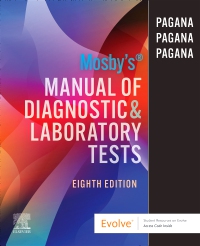
Mosby's Manual of Diagnostic and Laboratory Tests - Elsevier eBook on VitalSource, 8th Edition
by Kathleen Deska Pagana, PhD, RN, Timothy J. Pagana, MD, FACS and Theresa Noel Pagana Bullen, MD, FAAEM
Elsevier eBook on VitalSource
ISBN:
9780443110610
Copyright:
2027
Publication Date:
01-23-2026
Page Count:
1200
Imprint:
Mosby
List Price:
$81.99
Most review copies are eBooks – how fast!
A review copy request is most likely to be fulfilled as an eBook on VitalSource rather than a print product, unless no eBook is available. eBooks become available in as little as a few hours. Print products will take between 7 and 10 days to arrive. To request a print copy, please contact us through the Evolve Support Center for further assistance or contact your Elsevier Sales Rep.
**Selected for 2026 Doody's Core Titles as an Essential Purchase in Laboratory Technology**
Understanding and performing tests, interpreting lab results, and performing patient teaching are made easier with Mosby’s Manual of Diagnostic and Laboratory Tests, 8th Edition. This one-stop resource provides clear, concise, and consistent coverage of the most commonly performed diagnostic and laboratory tests. Valuable in academic and clinical settings alike, it is beloved for its full-color design, user-friendly organization, and illustrations that help clarify key concepts. Updated content with new tests ensures your students have the most current and relevant information available.
Understanding and performing tests, interpreting lab results, and performing patient teaching are made easier with Mosby’s Manual of Diagnostic and Laboratory Tests, 8th Edition. This one-stop resource provides clear, concise, and consistent coverage of the most commonly performed diagnostic and laboratory tests. Valuable in academic and clinical settings alike, it is beloved for its full-color design, user-friendly organization, and illustrations that help clarify key concepts. Updated content with new tests ensures your students have the most current and relevant information available.
-
- NEW! Streamlined lab test template provides need-to-know content in a more concise format
- NEW! Lab tests in this edition include acute kidney injury biomarkers, breath test, Cystatin C, Epi proColon, and Mpox
- Reorganized and combined lab tests help you find all necessary information on a topic in one place, such as computed tomography, genomic cancer testing, and virus testing.
-
- NEW! Streamlined lab test template provides need-to-know content in a more concise format
- NEW! Lab tests in this edition include acute kidney injury biomarkers, breath test, Cystatin C, Epi proColon, and Mpox
- Reorganized and combined lab tests help students find all necessary information on a topic in one place, such as computed tomography, genomic cancer testing, and virus testing
- Tests are presented comprehensively and consistently, in a sequence that best simulates priorities in clinical practice
- UNIQUE! Tests for Most Common Clinical Problem section highlights the integration of medical testing as it relates to a specific disease, clinical syndrome, or medical condition
- UNIQUE! Clinical Priorities boxes emphasize priorities and procedure considerations specific to understanding and performing tests
- UNIQUE! Test Results and Clinical Significance sections describe the significance of the test findings and discuss the pathophysiology of the disease process and how it relates to the test result
- UNIQUE! Home Care Responsibilities boxes focus on post-test factors for consideration
- UNIQUE! Critical Values sections indicate test values of particular significance
- UNIQUE! Icons indicate drugs that increase or decrease test values and patient teaching priorities
- UNIQUE! Common Reference Range section (for the most common tests) on the inside front cover offers quick access to this important information
- Age-Related Concerns boxes address pediatric and geriatric priorities
- Results are provided in SI units in addition to others, when applicable
-
1 Guidelines for Proper Test Preparation and Performance
2 Blood Studies
3 Electrodiagnostic Tests
4 Endoscopic Studies
5 Fluid Analysis Studies
6 Manometric Studies
7 Microbiologic Studies and Associated Testing
8 Nuclear Scanning
9 Stool Tests
10 Ultrasound Studies
11 Urine Studies
12 X-ray Studies
13 Miscellaneous Studies -
-
Ways of Reading
- The appearance of the text and page layout can be modified according to the capabilities of the reading system (font family and font size, spaces between paragraphs, sentences, words, and letters, as well as color of background and text)
- This e-publication is accessible to the full extent that the file format and types of content allow, on a specific reading device, by default, without necessarily including any additions such as textual descriptions of images or enhanced navigation
- All content can be read as read aloud speech or dynamic braille
- Has alternative text descriptions for images
-
Conformance
- The certifier's credential is https://bornaccessible.benetech.org/certified-publishers/
- For detailed accessibility information, see Elsevier's website at https://www.elsevier.com/about/accessibility
- For queries regarding accessibility information, contact [email protected]
- The publication was certified on 29-10-2025
-
Navigation
- Table of contents to all chapters of the text via links
- Index with links to referenced entries
- Elements such as headings, tables, etc. for structured navigation
- Page list to go to pages from the print source version
-
Rich Content
- Chemical formulas in accessible format (MathML)
- Information-rich images are described by extended descriptions
-
Hazards
- The publication contains no hazards
-
Product Content
- Content includes any type of illustrations.
- The primary content is text.
- Content includes maps and/or other cartographic content.
- Content includes a significant number of actionable (clickable) web links to external content, downloadable resources, supplementary material, etc.
- Content includes a significant number of actionable (clickable) cross-references, hyperlinked notes and annotations, or with other actionable links between largely textual elements (e.g., quiz/test questions, 'choose your own ending', etc.).
- Content includes photographs, whether in a plate section / insert or not.
- Content includes figures, diagrams, charts and/or graphs, including other 'mechanical' (i.e. non-photographic) illustrations.
- Content includes a significant number of web links (printed URLs, QR codes etc.).
- Content includes text within images, including text-as-text embedded in diagrams, charts, or within images containing speech balloons, thought bubbles, captions, etc.
- Content includes visual content that is purely decorative and is not necessary to understanding of the content.
- Content includes chemical notations, formulae.
- At least some text - including text within other images - is 'text as an image' (i.e., a picture of text).
-
Legal Considerations
- No information is available
-
Additional Accessibility Information
- Content is enhanced with ARIA roles to optimize organization and facilitate navigation
- Page breaks included from the original print source
- For readers with color vision deficiency, use of color (e.g., in diagrams, graphics and charts, in prompts, or on buttons inviting a response) is not the sole means of graphical distinction or of conveying information
- The body text is presented with a contrast ratio of at least 4.5:1 (or 3:1 for large/heading text)
- Text-to-speech has been optimized through provision of PLS lexicons, SSML or CSS Speech synthesis hints or other speech synthesis markup languages or hinting
- Ultra-high contrast between text and background
- E-publication includes basic navigation (usually less detailed than TOC-based navigation)
- Where links, controls or buttons are included in the content, the purpose or functionality of each link, control or button is apparent from the associated text alone - or where it is unclear, separate link, control or button descriptions are provided
- All (or substantially all) textual matter is arranged in a single logical reading order (including text that is visually presented as separate from the main text flow, e.g., in boxouts, captions, tables, footnotes, endnotes, citations, etc.). Non-textual content is also linked from within this logical reading order. (Purely decorative non-text content can be ignored).
- Where interactive content is included in the product, controls are provided (e.g., for speed, pause and resume, reset) and labelled to make their use clear.
- The language of the text has been specified (e.g., via the HTML or XML lang attribute) to optimise text-to-speech (and other alternative renderings), both at the whole document level and, where appropriate, for individual words, phrases or passages in a different language.
-
Ways of Reading


Most review copies are eBooks – how fast!
A review copy request is most likely to be fulfilled as an eBook on VitalSource rather than a print product, unless no eBook is available. eBooks become available in as little as a few hours. Print products will take between 7 and 10 days to arrive. To request a print copy, please contact us through the Evolve Support Center for further assistance or contact your Elsevier Sales Rep.

 as described in our