ISBN:
9780443111631
Copyright:
2025
Publication Date:
11-20-2024
Page Count:
528
Imprint:
Saunders
List Price:
$101.99

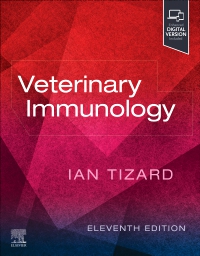
Veterinary Immunology - Elsevier eBook on VitalSource, 11th Edition
by Ian R. Tizard, BVMS, PhD, ACVM (Hons), DSc (Hons)
Elsevier eBook on VitalSource
ISBN:
9780443111631
Copyright:
2025
Publication Date:
11-20-2024
Page Count:
528
Imprint:
Saunders
List Price:
$101.99
Was
$101.99
Now $71.39
Or $0.00 with a valid access code
**Selected for 2026 Doody's Core Titles in Veterinary Medicine**
Exploring the immunologic concerns of both large and small animals, Veterinary Immunology, 11th Edition is the only complete resource on immunology for veterinary practitioners. This new edition has been meticulously updated to continue its trend of incorporating the latest advances and topics in the field. It features a straightforward presentation of basic immunologic principles along with thorough and timely information on the most significant immunologic diseases and responses seen in domestic animals. Vibrant images and wealth of clinical examples give you a better understanding of complex topics and concepts and how they come in to play during professional practice.
Exploring the immunologic concerns of both large and small animals, Veterinary Immunology, 11th Edition is the only complete resource on immunology for veterinary practitioners. This new edition has been meticulously updated to continue its trend of incorporating the latest advances and topics in the field. It features a straightforward presentation of basic immunologic principles along with thorough and timely information on the most significant immunologic diseases and responses seen in domestic animals. Vibrant images and wealth of clinical examples give you a better understanding of complex topics and concepts and how they come in to play during professional practice.
-
- NEW! Completely updated content covers the latest advances and topics in veterinary immunology, including cutting-edge information on drugs for the immune system, antibodies, vaccines, cancer immunology, and much more
- NEW! Enhanced ebook version, included with every new print purchase, features flashcards and enhanced animations, plus access to all the text, figures, and references, with the ability to search, customize content, make notes and highlights, and have content read aloud
- Comprehensive coverage clearly explains the general principles of immunology and provides information on the most significant immunologic diseases and immunologic responses seen in domestic animals
- A wealth of clinical examples show how principles are applied in the clinical setting
-
-
 Veterinary ImmunologyPaperback
-
-
1. Surviving in a Microbial World
2. Innate Immunity: How to Detect Invaders
3. Humoral Innate Immunity: Inflammation
4. Humoral Innate Immunity: Antimicrobial Peptides
5. Humoral Innate Immunity: The Complement System
6. Cellular Innate Immunity: Leukocytes
7. Cellular Innate Immunity: Macrophages and Recovery from Inflammation
8. Sickness: The Body’s Innate Responses
9. How Immune Cells Communicate: Cytokines and Their Receptors
10. Antigens: Triggers of Adaptive Immunity
11. Dendritic Cells, Antigen Processing, and Presentation
12. The Major Histocompatibility Complex
13. Lymphoid Organs: Their Structure and Functions
14. Lymphocytes
15. Helper T Cells: Diverse Responses to Antigens
16. B Cells and Their Response to Antigens
17. Antibodies: Soluble Antigen Receptors
18. How Antigen-Binding Receptors Are Made
19. T Cells and the Destruction of Intracellular Invaders
20. Innate Lymphoid Cells
21. Regulation of Adaptive Immunity
22. The Microbiota and the Immune System
23. Immunity on Body Surfaces
24. Immunity in the Fetus and Newborn
25. Vaccines and Their Production
26. The Use of Vaccines
27. Immunity to Bacteria and Fungi
28. Immunity to Viruses
29. Immunity to Parasites
30. Mast Cell– and Eosinophil-Mediated Hypersensitivity
31. Selected Allergic Diseases
32. Red Cell Antigens and Antibody-Mediated Hypersensitivity
33. Immune Complexes and Neutrophil-Mediated Hypersensitivity
34. T Cell–Mediated Hypersensitivities
35. Organ Graft Rejection and Pregnancy
36. Tumor Immunology and Immunotherapy
37. Autoimmune Diseases and the Loss of Tolerance
38. Selected Organ-Specific Autoimmune Diseases
39. Selected Immune-Mediated Inflammatory Diseases
40. Primary Immunodeficiency Diseases
41. Secondary Immunological Defects
42. Drugs and Other Agents That Affect the Immune System
43. Immunodiagnostic Methods -
-
Ways of Reading
- The appearance of the text and page layout can be modified according to the capabilities of the reading system (font family and font size, spaces between paragraphs, sentences, words, and letters, as well as color of background and text)
- This e-publication is accessible to the full extent that the file format and types of content allow, on a specific reading device, by default, without necessarily including any additions such as textual descriptions of images or enhanced navigation
- No information about nonvisual reading is available
-
Conformance
- For detailed accessibility information, see Elsevier's website at https://www.elsevier.com/about/accessibility
- For queries regarding accessibility information, contact [email protected]
- The publication was certified on 18-11-2025
-
Navigation
- Table of contents to all chapters of the text via links
-
Rich Content
- No information is available
-
Hazards
- No information is available
-
Product Content
- No information is available
-
Legal Considerations
- No information is available
-
Additional Accessibility Information
- For readers with color vision deficiency, use of color (e.g., in diagrams, graphics and charts, in prompts, or on buttons inviting a response) is not the sole means of graphical distinction or of conveying information
- E-publication includes basic navigation (usually less detailed than TOC-based navigation)
- Where links, controls or buttons are included in the content, the purpose or functionality of each link, control or button is apparent from the associated text alone - or where it is unclear, separate link, control or button descriptions are provided
- All (or substantially all) textual matter is arranged in a single logical reading order (including text that is visually presented as separate from the main text flow, e.g., in boxouts, captions, tables, footnotes, endnotes, citations, etc.). Non-textual content is also linked from within this logical reading order. (Purely decorative non-text content can be ignored).
- The language of the text has been specified (e.g., via the HTML or XML lang attribute) to optimise text-to-speech (and other alternative renderings), both at the whole document level and, where appropriate, for individual words, phrases or passages in a different language.
-
Ways of Reading
Was
$101.99
Now $71.39
Or $0.00 with a valid access code

 as described in our