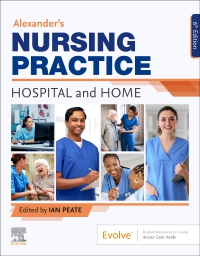
ISBN:
9780443112065
Copyright:
2025
Publication Date:
06-20-2024
Page Count:
900
Imprint:
Elsevier
List Price:
$47.99

Alexander's Nursing Practice - Elsevier E-Book on VitalSource, 6th Edition
by Ian Peate, OBE, FRCN, EN(G) RGN, DipN(Lond), RNT B.Ed (Hons), MA, LLM
Elsevier eBook on VitalSource
ISBN:
9780443112065
Copyright:
2025
Publication Date:
06-20-2024
Page Count:
900
Imprint:
Elsevier
List Price:
$47.99
Was
$47.99
Now $43.19
Or $0.00 with a valid access code
**Selected for 2026 Doody's Core Titles in Long Term Care**
**Selected for 2026 Doody's Core Titles as an Essential Purchase in Home Care**
Alexander’s Nursing Practice: Hospital and Home, Sixth Edition is the most comprehensive textbook available for undergraduate nursing students today.
This resource will prepare students for their future role as healthcare professionals in a variety of settings. It covers all the basics of nursing, including care of patients with common disorders, core nursing issues like medicines management and infection prevention and control, and how to nurse specific patient groups. The sixth edition has been fully updated to incorporate the latest evidence, policies and registration requirements, and reflects the transformative changes currently occurring in healthcare policies, procedures and technologies.
With a host of features to enhance the learning and teaching experience, this book will make a significant contribution to preparing compassionate nurses who will deliver patient-centred, high quality and holistic care.
**Selected for 2026 Doody's Core Titles as an Essential Purchase in Home Care**
Alexander’s Nursing Practice: Hospital and Home, Sixth Edition is the most comprehensive textbook available for undergraduate nursing students today.
This resource will prepare students for their future role as healthcare professionals in a variety of settings. It covers all the basics of nursing, including care of patients with common disorders, core nursing issues like medicines management and infection prevention and control, and how to nurse specific patient groups. The sixth edition has been fully updated to incorporate the latest evidence, policies and registration requirements, and reflects the transformative changes currently occurring in healthcare policies, procedures and technologies.
With a host of features to enhance the learning and teaching experience, this book will make a significant contribution to preparing compassionate nurses who will deliver patient-centred, high quality and holistic care.
-
- Designed to help the reader navigate the demands of the latest NMC educational requirements
- Expert team of contributors led by renowned editor, Ian Peate OBE FRCN
- Fully updated with the latest evidence and trends - incorporates the latest practice guidelines, research findings and clinical standards relevant to the nursing field
- Addresses the role of nurses in primary care settings, general practice nursing responsibilities, chronic disease management, health screening and the delivery of integrated, patient-centred care within the UK primary care landscape
- Richly illustrated throughout to reinforce key concepts, demonstrate clinical procedures and engage students in active learning
- Includes a wide range of helpful learning features including case studies and critical thinking exercises – helps the reader to analyse complex situations, make evidence-based decisions and communicate effectively with patients and healthcare team members
- Pedagogical features to help students navigate the textbook, organise their learning and review key concepts efficiently
- Supplemented with online material including MCQs, image bank, critical thinking questions, extra online material (supplementary text), website figure references and extra online images
-
-

-
 Alexander's Nursing PracticePaperback
-
-
1. On Being a Nurse
Section 1 Care of Patients With Common Disorders
2. Nursing Patients With Cardiovascular Disorders
3. Nursing Patients With Respiratory Disorders
4. Nursing Patients With Gastrointestinal, Liver and Biliary Disorders
5. Nursing Patients With Endocrine Disorders
6. Nursing Patients With Diabetes Mellitus
7. Nursing Patients With Disorders of the Lymphatic and Immune Systems
8. Nursing Patients With Disorders of the Breast and Reproductive Systems
PART 1 NURSING PATIENTS WITH DISORDERS OF THE FEMALE REPRODUCTIVE SYSTEM
PART 2 NURSING PATIENTS WITH DISORDERS OF THE BREAST
9. Nursing Patients With Disorders of the Male Reproductive Systems
10. Nursing Patients With Urinary Disorders
11. Nursing Patients With Disorders of the Nervous System
12. Nursing Patients With Musculoskeletal Disorders
13. Nursing Patients With Blood Disorders
14. Nursing Patients With Skin Disorders
15. Nursing Patients With Disorders of the Eye and Sight Impairment
16. Nursing Patients With Disorders of the Ear, Nose and Throat
Section 2 Core Nursing Issues
17. Pharmacology and Medicines Management
18. Infection Prevention and Control
19. The Deteriorating Patient, Recognising and Managing Shock
20. Pain Management
21. Maintaining Fluid, Electrolyte and Acid–Base Balance
22. Nutrition and Health
23. Tissue Viability and Managing Chronic Wounds
24. Maintaining Continence
Section 3 Nursing Specific Patient Groups
25. The Care of a Person Undergoing Surgery
26. Nursing the Patient Who Experiences Trauma
27. Nursing the Unconscious Patient
28. Nursing the Critically Ill Patient
29. Nursing the Patient With Burn Injury
30. Care and Rehabilitation of People With Long-Term Conditions
31. Nursing the Patient With Cancer
32. Nursing Patients Who Need Palliative Care
33. Nursing Care for Older People -
-
Ways of Reading
- The appearance of the text and page layout can be modified according to the capabilities of the reading system (font family and font size, spaces between paragraphs, sentences, words, and letters, as well as color of background and text)
- This e-publication is accessible to the full extent that the file format and types of content allow, on a specific reading device, by default, without necessarily including any additions such as textual descriptions of images or enhanced navigation
- No information about nonvisual reading is available
-
Conformance
- No information is available
-
Navigation
- Table of contents to all chapters of the text via links
- Page list to go to pages from the print source version
-
Rich Content
- No information is available
-
Hazards
- No information is available
-
Product Content
- No information is available
-
Legal Considerations
- No information is available
-
Additional Accessibility Information
- Content is enhanced with ARIA roles to optimize organization and facilitate navigation
- Page breaks included from the original print source
- For readers with color vision deficiency, use of color (e.g., in diagrams, graphics and charts, in prompts, or on buttons inviting a response) is not the sole means of graphical distinction or of conveying information
- E-publication includes basic navigation (usually less detailed than TOC-based navigation)
- Where links, controls or buttons are included in the content, the purpose or functionality of each link, control or button is apparent from the associated text alone - or where it is unclear, separate link, control or button descriptions are provided
- All (or substantially all) textual matter is arranged in a single logical reading order (including text that is visually presented as separate from the main text flow, e.g., in boxouts, captions, tables, footnotes, endnotes, citations, etc.). Non-textual content is also linked from within this logical reading order. (Purely decorative non-text content can be ignored).
- The language of the text has been specified (e.g., via the HTML or XML lang attribute) to optimise text-to-speech (and other alternative renderings), both at the whole document level and, where appropriate, for individual words, phrases or passages in a different language.
-
Ways of Reading
Was
$47.99
Now $43.19
Or $0.00 with a valid access code

 as described in our