ISBN:
9780443112348
Copyright:
2026
Publication Date:
04-09-2025
Page Count:
616
Imprint:
Elsevier
List Price:
$95.99

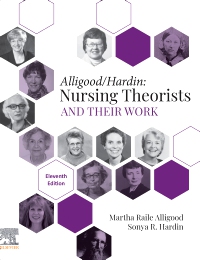
Nursing Theorists and Their Work - Elsevier eBook on VitalSource, 11th Edition
by Martha Raile Alligood, RN, PhD, ANEF and Sonya R. Hardin, PhD APRN NP-C FAAN
Elsevier eBook on VitalSource
ISBN:
9780443112348
Copyright:
2026
Publication Date:
04-09-2025
Page Count:
616
Imprint:
Elsevier
List Price:
$95.99
Was
$95.99
Now $86.39
Or $0.00 with a valid access code
**Selected for 2026 Doody's Core Titles as an Essential Purchase in Theory**
Understand the thinking of 39 leading nursing theorists in one comprehensive text! Nursing Theorists and Their Work, Eleventh Edition, provides a clear, in-depth look at nursing theories of historical and international significance. Each chapter presents a key nursing theory or philosophy, showing how systematic theoretical evidence enhances decision making, professionalism, and quality of care. Lead author Martha Raile Alligood is known nationally and internationally for her expertise in nursing theory. A classic in the field of nursing theory, this text uses objective critiques, case studies, and critical thinking activities to bridge the gap between nursing theory and application in the practice of nursing.
Understand the thinking of 39 leading nursing theorists in one comprehensive text! Nursing Theorists and Their Work, Eleventh Edition, provides a clear, in-depth look at nursing theories of historical and international significance. Each chapter presents a key nursing theory or philosophy, showing how systematic theoretical evidence enhances decision making, professionalism, and quality of care. Lead author Martha Raile Alligood is known nationally and internationally for her expertise in nursing theory. A classic in the field of nursing theory, this text uses objective critiques, case studies, and critical thinking activities to bridge the gap between nursing theory and application in the practice of nursing.
-
- New information on international theorists will be included
- New information the topic of clinical reasoning and judgment and how it relates to the various theories presented will be included
- The new AACN Essentials will be addressed and included where appropriate throughout the text
-
- NEW! Information on the state of nursing in health care after COVID-19 illustrates how nursing knowledge development continues to evolve, with new theories that address current health care needs for quality nursing care
- Theorist chapters written by scholars specializing in that theorist’s work - often having worked closely with the theorists — provide the most accurate and complete information possible
- Case studies at the end of each theorist chapter present the theory in a larger perspective, demonstrating how it can be applied in practice
- Critical thinking activities at the end of each theorist chapter help you to process the theory presented and apply it to personal and hypothetical nursing practice situations
- Theory-specific diagrams help you visualize and better understand inherently abstract concepts and their relationships
- Major Concepts and Definitions boxes outline a theory’s most significant ideas and clarifies vocabulary
- Brief summary sections offer valuable review for tests and validate comprehension
- Points for Further Study sections direct you to sources of additional information
- A diagram in each unit illustrates the level of abstraction of the theoretical knowledge presented
-
-
 Nursing Theorists and Their WorkPaperback
-
-
UNIT I Evolution of Nursing Theories
1. Introduction to Nursing Theory: Its History and Significance
UNIT II Nursing Philosophies
2. Nursing Theorists of Historical Significance
3. History of Nursing Science
4. Theory Development Process
5. The Structure and Analysis of Specialized Nursing Knowledge
UNIT III Nursing Conceptual Models
6. Florence Nightingale: Modern Nursing
7. Jean Watson: Watson’s Philosophy and Theory of Transpersonal Caring
8. Marilyn Anne Ray: Theory of Bureaucratic Caring
9. Patricia Benner: Caring, Clinical Wisdom, and Ethics in Nursing Practice
10. Kari Martinsen: Philosophy of Caring
11. Katie Eriksson: Theory of Caritative Caring
UNIT IV Theories and Grand Theories
12. Myra Estrin Levine: The Conservation Model
13. Martha E. Rogers: Unitary Human Beings
14. Dorothea E. Orem: Self-Care Deficit Theory of Nursing
15. Imogene M. King: Conceptual System and Theory of Goal Attainment
16. Betty Neuman: Systems Model
17. Sister Callista Roy: Adaptation Model
18. Dorothy Johnson: Behavioral System Model
UNIT V Middle-Range Theories
19. Anne Boykin and Savina O. Schoenhofer: The Theory of Nursing as Caring: A Model for Transforming Practice
20. Afaf Ibrahim Meleis: Transitions Theory
21. Nola J. Pender: Health Promotion Model
22. Madeleine M. Leininger: Theory of Culture Care Diversity and Universality
23. Margaret A. Newman: Health as Expanding Consciousness
24. Rosemarie Rizzo Parse: Humanbecoming
25. C. Erickson, Evelyn M. Tomlin, Mary Ann P. Swain: Modeling and Role-Modeling
26. Gladys L. Husted and James H. Husted: Symphonological Bioethical Theory
UNIT VI The Future of Nursing Theory
37. State of the Art and Science of Nursing Theory -
-
Ways of Reading
- The appearance of the text and page layout can be modified according to the capabilities of the reading system (font family and font size, spaces between paragraphs, sentences, words, and letters, as well as color of background and text)
- This e-publication is accessible to the full extent that the file format and types of content allow, on a specific reading device, by default, without necessarily including any additions such as textual descriptions of images or enhanced navigation
- No information about nonvisual reading is available
-
Conformance
- No information is available
-
Navigation
- Table of contents to all chapters of the text via links
- Page list to go to pages from the print source version
-
Rich Content
- No information is available
-
Hazards
- No information is available
-
Product Content
- No information is available
-
Legal Considerations
- No information is available
-
Additional Accessibility Information
- Content is enhanced with ARIA roles to optimize organization and facilitate navigation
- Page breaks included from the original print source
- For readers with color vision deficiency, use of color (e.g., in diagrams, graphics and charts, in prompts, or on buttons inviting a response) is not the sole means of graphical distinction or of conveying information
- E-publication includes basic navigation (usually less detailed than TOC-based navigation)
- Where links, controls or buttons are included in the content, the purpose or functionality of each link, control or button is apparent from the associated text alone - or where it is unclear, separate link, control or button descriptions are provided
- All (or substantially all) textual matter is arranged in a single logical reading order (including text that is visually presented as separate from the main text flow, e.g., in boxouts, captions, tables, footnotes, endnotes, citations, etc.). Non-textual content is also linked from within this logical reading order. (Purely decorative non-text content can be ignored).
- The language of the text has been specified (e.g., via the HTML or XML lang attribute) to optimise text-to-speech (and other alternative renderings), both at the whole document level and, where appropriate, for individual words, phrases or passages in a different language.
-
Ways of Reading
Was
$95.99
Now $86.39
Or $0.00 with a valid access code

 as described in our