ISBN:
9780443113871
Copyright:
2025
Publication Date:
01-01-2024
Page Count:
1112
Imprint:
Saunders
List Price:
$53.99

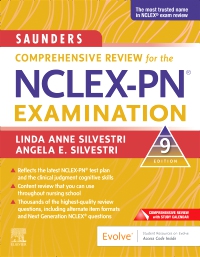
Saunders Comprehensive Review for the NCLEX-PN® Examination - Elsevier eBook on VitalSource, 9th Edition
by Linda Anne Silvestri, PhD, RN, ANEF, FAAN and Angela Silvestri, PhD, APRN, FNP-BC, CNE
Elsevier eBook on VitalSource
ISBN:
9780443113871
Copyright:
2025
Publication Date:
01-01-2024
Page Count:
1112
Imprint:
Saunders
List Price:
$53.99
Was
$53.99
Now $48.59
Or $0.00 with a valid access code
Get the best review for the NCLEX-PN® exam from the leading NCLEX® experts! Written by Linda Anne Silvestri and Angela E. Silvestri, Saunders Comprehensive Review for the NCLEX-PN® Examination, 9th Edition, provides everything you need to prepare for success on the NCLEX-PN. The book includes a review of all nursing content areas, more than 4,600 questions for the NCLEX, detailed rationales, test-taking tips and strategies, and questions for the Next-Generation NCLEX (NGN). The Evolve companion website simulates the exam-taking experience with customizable practice questions along with realistic practice tests. Based on Silvestri’s proven Pyramid to Success, this complete review is a perennial favorite of students preparing for the NCLEX.
New Edition Expected Availability: 03-08-2027

Saunders Comprehensive Review for the NCLEX-PN® Examination - Elsevier E-Book on VitalSource
Elsevier eBook on VitalSource
ISBN: 9780443280030
-
- NEW! Questions for the Next Generation NCLEX® (NGN) prepare you for the biggest change to the NCLEX-PN® test plan to date
- NEW! Thoroughly updated content incorporates clinical updates and reflects the latest NCLEX-PN test plan
- NEW! Clinical Judgment boxes identify clinical judgment situations, each addressing one of the six cognitive skills of the NCSBN Clinical Judgment Measurement Model
- NEW! Additional questions cover health problem areas and complex care
- NEW! Urinary and Bowel Elimination and Hygiene, Mobility, and Skin Integrity chapters are added to this edition
- UPDATED! Reorganized Foundation of Care unit makes this section more user-friendly for beginning nursing students
-
- More than 4,600 practice questions in the text and on the Evolve companion website offer ample testing practice
- Detailed test-taking strategy is included for each question, offering clues for analyzing and uncovering the correct answer option, with rationales provided for both correct and incorrect answers
- Pyramid Points icons indicate important information, identifying content that is likely to appear on the NCLEX-PN examination
- Pyramid Alerts appear in red text, highlighting important nursing concepts and identifying content that typically appears on the NCLEX-PN examination
- Priority Concepts — two in each chapter — discuss important content and nursing interventions and reflect the latest edition of Giddens’ Concepts for Nursing Practice text
- Priority Nursing Action boxes provide information about the steps nurses will take in clinical situations requiring clinical judgment and prioritization
- New graduate’s perspective is offered on how to prepare for the NCLEX-PN, in addition to nonacademic preparation, the CAT format, and test-taking strategies
- Mnemonics are included to help you remember important information
- Alternate item format questions cover multiple-response, prioritizing (ordered response), fill-in-the-blank, figure/illustration (hot spot), chart/exhibit, and audio questions
- Practice questions on the Evolve companion website are organized by content area, cognitive level, client needs area, integrated process, health problem, clinical judgment, and priority concepts, allowing completely customizable exams or study sessions
- Audio review summaries on the Evolve companion website cover pharmacology, acid-base balance, and fluids and electrolytes
-
Unit I: NCLEX-PN® Exam Preparation
1. The NCLEX-PN Examination
2. Self-Efficacy and Pathways to Success
3. The NCLEX-PN Examination from a Graduate's Perspective
4. Clinical Judgment and Test-Taking Strategies
Unit II: Professional Standards in Nursing
5. Population Health Nursing
6. Ethical and Legal Issues
7. Prioritizing Client Care: Leadership, Delegating, and Emergency Response Planning
Unit III: Foundations of Care
8. Fluids and Electrolytes
9. Acid-Base Balance
10. Vital Signs and Laboratory Reference Intervals
11. Nutrition
12. Health and Physical Assessment of the Adult Client
13. Safety and Infection Control
14. Medication Administration and Intravenous Therapies
15. Perioperative Nursing Care
16. Hygiene, Mobility, and Skin Integrity
17. Urinary and Bowel Elimination
Unit IV: Growth and Development Across the Life Span
18. Theories of Growth and Development
19. Growth, Development, and Stages of Life
20. Care of the Older Client
Unit V: Maternity Nursing
21. Reproductive System
22. Prenatal Period
23. Risk Conditions Related to Pregnancy
24. Labor and Birth
25. Problems with Labor and Birth
26. Postpartum Period
27. Postpartum Complications
28. Care of the Newborn
29. Maternity and Newborn Medications
Unit VI: Pediatric Nursing
30. Integumentary Problems
31. Hematological Problems
32. Oncological Problems
33. Metabolic and Endocrine Problems
34. Gastrointestinal Problems
35. Eye, Ear, and Throat Problems
36. Respiratory Problems
37. Cardiovascular Problems
38. Renal and Genitourinary Problems
39. Neurological and Cognitive Problems
40. Musculoskeletal Problems
41. Immune Disorders and Infectious Diseases
42. Pediatric Medication Administration and Calculations
Unit VII: Integumentary Problems of the Adult Client
43. Integumentary Problems
44. Integumentary Medications
Unit VIII: Oncological and Hematological Problems of the Adult Client
45. Oncological and Hematological Problems
46. Oncological and Hematological Medications
Unit IX: Endocrine Problems of the Adult Client
47. Endocrine Problems
48. Endocrine Medications
Unit X: Gastrointestinal Problems of the Adult Client
49. Gastrointestinal Problems
50. Gastrointestinal Medications
Unit XI: Respiratory Problems of the Adult Client
51. Respiratory Problems
52. Respiratory Medications
Unit XII: Cardiovascular Problems of the Adult Client
53. Cardiovascular Problems
54. Cardiovascular Medications
Unit XIII: Renal and Urinary Problems of the Adult Client
55. Renal and Urinary Problems
56. Renal and Urinary Medications
Unit XIV: Eye and Ear Problems of the Adult Client
57. Eye and Ear Problems
58. Eye and Ear Medications
Unit XV: Neurological Problems of the Adult Client
59. Neurological Problems
60. Neurological Medications
Unit XVI: Musculoskeletal Problems of the Adult Client
61. Musculoskeletal Problems
62. Musculoskeletal Medications
Unit XVII: Immune Problems of the Adult Client
63. Immune Problems
64. Immunological Medications
Unit XVIII: Mental Health Problems of the Adult Client
65. Foundations of Psychiatric Mental Health Nursing
66. Mental Health Problems
67. Addictions
68. Crisis Theory and Intervention
69. Psychiatric Medications
Unit XIX: Complex Care
70. Complex Care -
-
Ways of Reading
- The appearance of the text and page layout can be modified according to the capabilities of the reading system (font family and font size, spaces between paragraphs, sentences, words, and letters, as well as color of background and text)
- This e-publication is accessible to the full extent that the file format and types of content allow, on a specific reading device, by default, without necessarily including any additions such as textual descriptions of images or enhanced navigation
- All content can be read as read aloud speech or dynamic braille
- Has alternative text descriptions for images
-
Conformance
- The publication contains a conformance statement that it meets the EPUB Accessibility 1.1, WCAG 2.1, Level AA standard. Please see https://bornaccessible.benetech.org/certified-publishers/ for further details of our compatibility testing.
- The certifier's credential is https://bornaccessible.benetech.org/certified-publishers/
- For detailed accessibility information, see Elsevier's website at https://www.elsevier.com/about/accessibility
- For queries regarding accessibility information, contact [email protected]
- The publication was certified on 06-02-2026
-
Navigation
- Table of contents to all chapters of the text via links
- Index with links to referenced entries
- Elements such as headings, tables, etc. for structured navigation
- Page list to go to pages from the print source version
-
Rich Content
- Math formulas in accessible format (MathML)
- Chemical formulas in accessible format (MathML)
- Information-rich images are described by extended descriptions
-
Hazards
- The publication contains no hazards
-
Product Content
- The primary content is text.
- Content includes a significant number of actionable (clickable) web links to external content, downloadable resources, supplementary material, etc.
- Content includes a significant number of actionable (clickable) cross-references, hyperlinked notes and annotations, or with other actionable links between largely textual elements (e.g., quiz/test questions, 'choose your own ending', etc.).
- Content includes additional textual content such as an interview, feature article, essay, bibliography, quiz/test, other background material, or text that is not included in a primary or 'unenhanced' version.
- Content includes photographs, whether in a plate section / insert or not.
- Content includes figures, diagrams, charts and/or graphs, including other 'mechanical' (i.e. non-photographic) illustrations.
- Content includes a significant number of web links (printed URLs, QR codes etc.).
- Content includes images displayed in a specific order for the purpose of graphic storytelling or giving information (e.g. graphic novels, comics and manga). May include text integrated into the image (as speech and thought bubbles, textual 'sound' effects, captions etc.).
- Content includes text within images, including text-as-text embedded in diagrams, charts, or within images containing speech balloons, thought bubbles, captions, etc.
- Content includes visual content that is purely decorative and is not necessary to understanding of the content.
- Content includes chemical notations, formulae.
- Content includes mathematical notations, formulae.
- At least some text - including text within other images - is 'text as an image' (i.e., a picture of text).
-
Legal Considerations
- No information is available
-
Additional Accessibility Information
- Content is enhanced with ARIA roles to optimize organization and facilitate navigation
- Page breaks included from the original print source
- For readers with color vision deficiency, use of color (e.g., in diagrams, graphics and charts, in prompts, or on buttons inviting a response) is not the sole means of graphical distinction or of conveying information
- The body text is presented with a contrast ratio of at least 4.5:1 (or 3:1 for large/heading text)
- Ultra-high contrast between text and background
- E-publication includes basic navigation (usually less detailed than TOC-based navigation)
- Where links, controls or buttons are included in the content, the purpose or functionality of each link, control or button is apparent from the associated text alone - or where it is unclear, separate link, control or button descriptions are provided
- All (or substantially all) textual matter is arranged in a single logical reading order (including text that is visually presented as separate from the main text flow, e.g., in boxouts, captions, tables, footnotes, endnotes, citations, etc.). Non-textual content is also linked from within this logical reading order. (Purely decorative non-text content can be ignored).
- Content provides explanations for unusual words, abbreviations, acronyms, idioms, jargon in an accessible form, such as glossaries, scripted pop-ups.
- Where interactive content is included in the product, controls are provided (e.g., for speed, pause and resume, reset) and labelled to make their use clear.
- The language of the text has been specified (e.g., via the HTML or XML lang attribute) to optimise text-to-speech (and other alternative renderings), both at the whole document level and, where appropriate, for individual words, phrases or passages in a different language.
-
Ways of Reading


Was
$53.99
Now $48.59
Or $0.00 with a valid access code

 as described in our