ISBN:
9780443114588
Copyright:
2025
Publication Date:
03-22-2024
Page Count:
424
Imprint:
Elsevier
List Price:
$65.99

Netter's Essential Physiology - Elsevier E-Book on VitalSource, 3rd Edition
by Susan Mulroney, PhD and Adam Myers, PhD
Elsevier eBook on VitalSource
ISBN:
9780443114588
Copyright:
2025
Publication Date:
03-22-2024
Page Count:
424
Imprint:
Elsevier
List Price:
$65.99
Was
$65.99
Now $46.19
Or $0.00 with a valid access code
**Selected for 2026 Doody's Core Titles in Physiology**
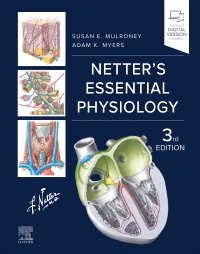
Clear, focused, and highly visual, Netter's Essential Physiology, 3rd Edition, uses a concise, clinical approach to help you grasp key concepts quickly and easily. Illustrated by the world-renowned Frank H. Netter, MD, and artists working in his tradition, this readable text combines easy-to-understand prose with clinical correlations, “light bulb” side notes, end-of-chapter questions, and helpful videos to ensure a complete understanding of complex content. It’s an ideal text for a basic understanding of physiology, as an overview of the subject, or as a supplement to lectures.
Clear, focused, and highly visual, Netter's Essential Physiology, 3rd Edition, uses a concise, clinical approach to help you grasp key concepts quickly and easily. Illustrated by the world-renowned Frank H. Netter, MD, and artists working in his tradition, this readable text combines easy-to-understand prose with clinical correlations, “light bulb” side notes, end-of-chapter questions, and helpful videos to ensure a complete understanding of complex content. It’s an ideal text for a basic understanding of physiology, as an overview of the subject, or as a supplement to lectures.
-
- NEW! Nora AI - an AI-powered learning assistant exclusive to Elsevier ebooks on VitalSource's Bookshelf® platform - offers built-in AI learning support that provides personalized answers based on content from the Elsevier ebook
- Uses beautifully clear drawings and diagrams from the Netter collection to teach key points quickly, effectively, and memorably
- Contains "light bulb" boxes that use memorable details or examples to foster “a-ha” learning moments
- Includes expanded pathophysiology content with more clinical correlates, including the fallacy of race-dependent differences in normal GFR values and pulmonary function.
- Features new illustrations for GI physiology, and updated figures throughout to better reflect the diversity in human populations
- Contains more practice questions per section
- Provides video tutorials that explain challenging but essential physiology concepts
- An eBook version is included with purchase. The eBook allows you to access all of the text, figures, and references, plus videos and additional self-assessment questions, with the ability to search, make notes and highlights, and have content read aloud
-
-
 Netter's Essential PhysiologyPaperback
-
-
Section 1 CELL PHYSIOLOGY, FLUID HOMEOSTASIS, AND MEMBRANE TRANSPORT
1. The Cell and Fluid Homeostasis
2. Membrane Transport and Cell Signaling Mechanisms
Section 2 THE NERVOUS SYSTEM AND MUSCLE
3. Nerve and Muscle Physiology
4. Organization and General Functions of the Nervous System
5. Sensory Physiology
6. The Somatic Motor System
7. The Autonomic Nervous System
Section 3 CARDIOVASCULAR PHYSIOLOGY
8. The Blood
9. Overview of the Heart and Circulation
10. Cardiac Electrophysiology
11. Flow, Pressure, and Resistance
12. The Cardiac Pump
13. The Peripheral Circulation
Section 4 RESPIRATORY PHYSIOLOGY
14. Pulmonary Ventilation and Perfusion and Diffusion of Gases
15. The Mechanics of Breathing
16. Oxygen and Carbon Dioxide Transport and Control of Respiration
Section 5 RENAL PHYSIOLOGY
17. Overview, Glomerular Filtration, and Renal Clearance
18. Renal Transport Processes
19. Urine Concentration and Dilution Mechanisms
20. Regulation of Extracellular Fluid Volume and Osmolarity
21. Regulation of Acid-Base Balance by the Kidneys
Section 6 GASTROINTESTINAL PHYSIOLOGY
22. Overview of the Gastrointestinal Tract
23. Motility Through the Gastrointestinal Tract
24. Gastrointestinal Secretions
25. Hepatobiliary Function
26. Digestion and Absorption
Section 7 ENDOCRINE PHYSIOLOGY
27. General Principles of Endocrinology and Pituitary and Hypothalamic Hormones
28. Thyroid Hormones
29. Adrenal Hormones
30. The Endocrine Pancreas
31. Calcium-Regulating Hormones
32. Hormones of the Reproductive System -
-
Ways of Reading
- The appearance of the text and page layout can be modified according to the capabilities of the reading system (font family and font size, spaces between paragraphs, sentences, words, and letters, as well as color of background and text)
- This e-publication is accessible to the full extent that the file format and types of content allow, on a specific reading device, by default, without necessarily including any additions such as textual descriptions of images or enhanced navigation
- No information about nonvisual reading is available
-
Conformance
- No information is available
-
Navigation
- Table of contents to all chapters of the text via links
- Page list to go to pages from the print source version
-
Rich Content
- No information is available
-
Hazards
- No information is available
-
Product Content
- No information is available
-
Legal Considerations
- No information is available
-
Additional Accessibility Information
- Content is enhanced with ARIA roles to optimize organization and facilitate navigation
- Page breaks included from the original print source
- For readers with color vision deficiency, use of color (e.g., in diagrams, graphics and charts, in prompts, or on buttons inviting a response) is not the sole means of graphical distinction or of conveying information
- E-publication includes basic navigation (usually less detailed than TOC-based navigation)
- Where links, controls or buttons are included in the content, the purpose or functionality of each link, control or button is apparent from the associated text alone - or where it is unclear, separate link, control or button descriptions are provided
- All (or substantially all) textual matter is arranged in a single logical reading order (including text that is visually presented as separate from the main text flow, e.g., in boxouts, captions, tables, footnotes, endnotes, citations, etc.). Non-textual content is also linked from within this logical reading order. (Purely decorative non-text content can be ignored).
- The language of the text has been specified (e.g., via the HTML or XML lang attribute) to optimise text-to-speech (and other alternative renderings), both at the whole document level and, where appropriate, for individual words, phrases or passages in a different language.
-
Ways of Reading
Was
$65.99
Now $46.19
Or $0.00 with a valid access code

 as described in our