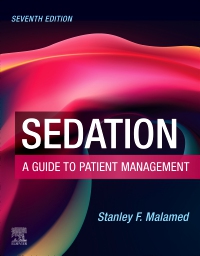

Sedation - Elsevier E-Book on VitalSource, 7th Edition
Elsevier eBook on VitalSource
Help your students master the latest techniques in dental sedation and anxiety management! Written by sedation expert Stanley Malamed, DDS, Sedation: A Guide to Patient Management, 7th Edition, features the most current recommendations from the ADA, the American Dental Society of Anesthesiology, and the American Society of Anesthesiologists, providing comprehensive coverage of sedation techniques and protocols for diverse patient populations, including pediatric and medically compromised individuals. With extensive updates on sedation advancements, a new chapter on regulation, and enhanced illustrations of the latest practices, this edition equips students with the essential knowledge to ensure safe and effective patient care in sedation dentistry.
-
- NEW! Extensive content revisions incorporate the most up-to-date, clinically relevant information on advances in sedation dentistry, including considerable updates to techniques, the addition of several new drugs, updates on monitoring, and special considerations
- NEW! Chapter addresses the regulation of sedation and general anesthesia
- NEW! Figures, charts, and illustrations reflect the latest equipment, procedures, and practices used in dental sedation
- NEW! Enhanced eBook version, included with every new print purchase, allows digital access to all the text, figures, and references, with the ability to search, customize content, make notes and highlights, and have content read aloud
- UPDATED! The latest practice guidelines established by the ADA, the American Dental Society of Anesthesiology, and the American Society of Anesthesiologists, providing for sedation by non-anesthesiologists are included throughout the text
- Comprehensive art and illustrations support key concepts in sedation dentistry
- Coverage of all potential patient groups includes pediatric, geriatric, physically compromised, and medically compromised patients, with treatment protocols for these unique populations
- Expert authorship from Stanley Malamed, an essential figure in the field, provides students with experienced guidance across all areas of sedation dentistry and local anesthesia
- UPDATED! Summary boxes and tables highlight key concepts to facilitate learning and serve as review and study tools
-
-
 Evolve Resources for SedationResources
 -
 SedationPaperback
-
-
Section I: Introduction
1. Pain and Anxiety in Dentistry
Section II : Spectrum of Pain and Anxiety Control
2. Introduction to Sedation
3. The Spectrum of Pain and Anxiety Control
4. Physical and Psychological Evaluation
5. Monitoring During Sedation
6. Nondrug Techniques: Iatrosedation and Hypnosis
Section III : Oral and Intramuscular Sedation
7. Oral Sedation
8. Sublingual, Transdermal, and Intranasal Sedation
9. Intramuscular Sedation
Section IV: Inhalation Sedation
10. Inhalation Sedation: Historical Perspective
11. Inhalation Sedation: Rationale
12. Pharmacology, Anatomy, and Physiology
13. Inhalation Sedation Equipment
14. Inhalation Sedation: Techniques of Administration
15. Inhalation Sedation: Complications
16. Contemporary Issues Surrounding Nitrous Oxide
17. Practical Considerations
18. Teaching Inhalation Sedation: History and Present Guidelines
Section V : Intravenous Sedation
19. Intravenous Sedation: Historical Perspective
20. Intravenous Moderate Sedation: Rationale
21. Armamentarium
22. Anatomy for Venipuncture
23. Venipuncture Technique
24. Pharmacology
25. Intravenous Moderate Sedation: Techniques of Administration
26. Intravenous Sedation: Complications
27. Practical Considerations
28. Guidelines for Teaching
Section VI : General Anesthesia
29. Fundamentals of General Anesthesia
30. Armamentarium: Equipment, Drugs, and Techniques
Section VII : Emergency Preparation and Management
31. Preparation for Emergencies
32. Emergency Drugs and Equipment
33. Management of Emergencies
Section VIII : Special Considerations
34. The Pediatric Patient
35. The Geriatric Patient
36. The Medically Compromised Patient
37. The Physically Compromised Patient
38. Neurologic Illnesses and Other Conditions
39. The Regulation of Sedation and General Anesthesia
40. Medicolegal Considerations
41. The Controversial Development of Anesthesiology in Dentistry -
-
Ways of Reading
- The appearance of the text and page layout can be modified according to the capabilities of the reading system (font family and font size, spaces between paragraphs, sentences, words, and letters, as well as color of background and text)
- This e-publication is accessible to the full extent that the file format and types of content allow, on a specific reading device, by default, without necessarily including any additions such as textual descriptions of images or enhanced navigation
- All content can be read as read aloud speech or dynamic braille
- Has alternative text descriptions for images
-
Conformance
- The certifier's credential is https://bornaccessible.benetech.org/certified-publishers/
- For detailed accessibility information, see Elsevier's website at https://www.elsevier.com/about/accessibility
- For queries regarding accessibility information, contact [email protected]
- The publication was certified on 19-03-2026
-
Navigation
- Table of contents to all chapters of the text via links
- Index with links to referenced entries
- Elements such as headings, tables, etc. for structured navigation
- Page list to go to pages from the print source version
-
Rich Content
- Math formulas in accessible format (MathML)
- Chemical formulas in accessible format (MathML)
- Information-rich images are described by extended descriptions
-
Hazards
- The publication contains no hazards
-
Product Content
- Content includes any type of illustrations.
- The primary content is text.
- Content includes maps and/or other cartographic content.
- Content includes a significant number of actionable (clickable) web links to external content, downloadable resources, supplementary material, etc.
- Content includes a significant number of actionable (clickable) cross-references, hyperlinked notes and annotations, or with other actionable links between largely textual elements (e.g., quiz/test questions, 'choose your own ending', etc.).
- Content includes additional textual content such as an interview, feature article, essay, bibliography, quiz/test, other background material, or text that is not included in a primary or 'unenhanced' version.
- Content includes photographs, whether in a plate section / insert or not.
- Content includes figures, diagrams, charts and/or graphs, including other 'mechanical' (i.e. non-photographic) illustrations.
- Content includes animated / interactive illustrations, e.g., animated diagrams, charts, graphs or other illustrations (usually without sound).
- Content includes narrative animation, e.g., cartoon, animatic or CGI animation (usually includes sound).
- Content includes a significant number of web links (printed URLs, QR codes etc.).
- Content includes images displayed in a specific order for the purpose of graphic storytelling or giving information (e.g. graphic novels, comics and manga). May include text integrated into the image (as speech and thought bubbles, textual 'sound' effects, captions etc.).
- Content includes text within images, including text-as-text embedded in diagrams, charts, or within images containing speech balloons, thought bubbles, captions, etc.
- At least some text - including text within other images - is 'text as an image' (i.e., a picture of text).
- Product includes actionable (clickable) links to external interactive content.
-
Legal Considerations
- No information is available
-
Additional Accessibility Information
- Content is enhanced with ARIA roles to optimize organization and facilitate navigation
- Page breaks included from the original print source
- For readers with color vision deficiency, use of color (e.g., in diagrams, graphics and charts, in prompts, or on buttons inviting a response) is not the sole means of graphical distinction or of conveying information
- The body text is presented with a contrast ratio of at least 4.5:1 (or 3:1 for large/heading text)
- Ultra-high contrast between text and background
- E-publication includes basic navigation (usually less detailed than TOC-based navigation)
- Where links, controls or buttons are included in the content, the purpose or functionality of each link, control or button is apparent from the associated text alone - or where it is unclear, separate link, control or button descriptions are provided
- All (or substantially all) textual matter is arranged in a single logical reading order (including text that is visually presented as separate from the main text flow, e.g., in boxouts, captions, tables, footnotes, endnotes, citations, etc.). Non-textual content is also linked from within this logical reading order. (Purely decorative non-text content can be ignored).
- Where interactive content is included in the product, controls are provided (e.g., for speed, pause and resume, reset) and labelled to make their use clear.
- The language of the text has been specified (e.g., via the HTML or XML lang attribute) to optimise text-to-speech (and other alternative renderings), both at the whole document level and, where appropriate, for individual words, phrases or passages in a different language.
-
Ways of Reading

 as described in our