ISBN:
9780443116452
Copyright:
2025
Publication Date:
12-19-2024
Page Count:
328
Imprint:
Elsevier
List Price:
$94.99

Textbook of Clinical Hemodynamics - Elsevier E-Book on VitalSource, 3rd Edition
by Michael Ragosta, MD
Elsevier eBook on VitalSource
ISBN:
9780443116452
Copyright:
2025
Publication Date:
12-19-2024
Page Count:
328
Imprint:
Elsevier
List Price:
$94.99
Was
$94.99
Now $66.49
Or $0.00 with a valid access code
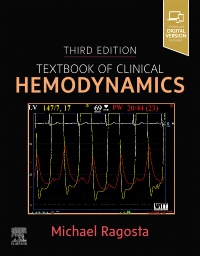
A highly clinical focus and clear, vibrant illustrations make Textbook of Clinical Hemodynamics, 3rd Edition, by Dr. Michael Ragosta, the resource of choice for accurately analyzing hemodynamic waveforms generated in cardiac catheterization labs. This easy-to-use, disease-oriented reference—ideal for physicians, nurses, and technicians—offers the unparalleled detail and visual support you need for interpreting the findings you encounter in practice. New coverage throughout keeps everyone on the cardiac team up to date with the latest concepts and skills, ensuring more effective monitoring and treatment of patients with cardiac disease.
-
- Provides a disease-oriented assessment of waveform data that demonstrates how both qualitative and quantitative interpretation can affect clinical decision making.
- Features extensive updates throughout, with greatly expanded coverage of aortic valve disorders (TAVI) and left-ventricular hemodynamics, heart failure, and shock.
- Contains two new chapters: Diastology, with cardiac catheterization findings and echocardiographic depictions of diastolic function in health and disease states; and Bedside Hemodynamic Monitoring in the Intensive Care Unit, focusing on indications, procedural aspects, available options, and the clinical utility of hemodynamic monitoring in the critically ill patient.
- More than 100 brand-new, full-color images provide clear visuals for a more complete understanding of complex concepts.
- Covers the most recent advances in the field, with emphasis on mitral and aortic valvular heart disease, coronary hemodynamics, cardiogenic shock, pulmonary hypertension, and mechanical circulatory support—all areas that have seen the most recent growth and change.
- Includes an updated Easy Reference Appendix with clinically useful formulas and data.
-
-
 Textbook of Clinical HemodynamicsPaperback
-
-
1. Introduction to Hemodynamic Assessment in the Cardiac Catheterization Laboratory
2. Normal Waveforms, Artifacts, and Pitfalls
3. Cardiac Outputs and Shunts
4. Bedside Hemodynamic Monitoring in the Intensive Care Unit
5. Mitral Valve Disorders
6. Aortic Valve Disorders
7. Hypertrophic Cardiomyopathy and Related Disorders
8. Right-Sided Heart Disorders
9. Pulmonary Hypertension
10. Pericardial and Restrictive Myocardial Diseases
11. Left Ventricular Hemodynamics, Heart Failure, Shock, and Mechanical Circulatory Support
12. Hemodynamics of Diastolic Function in Health and Disease
13. Congenital Heart Disease
14. Coronary and Peripheral Artery Hemodynamics -
-
Ways of Reading
- The appearance of the text and page layout can be modified according to the capabilities of the reading system (font family and font size, spaces between paragraphs, sentences, words, and letters, as well as color of background and text)
- This e-publication is accessible to the full extent that the file format and types of content allow, on a specific reading device, by default, without necessarily including any additions such as textual descriptions of images or enhanced navigation
- No information about nonvisual reading is available
-
Conformance
- No information is available
-
Navigation
- Table of contents to all chapters of the text via links
- Page list to go to pages from the print source version
-
Rich Content
- No information is available
-
Hazards
- No information is available
-
Product Content
- No information is available
-
Legal Considerations
- No information is available
-
Additional Accessibility Information
- Content is enhanced with ARIA roles to optimize organization and facilitate navigation
- Page breaks included from the original print source
- For readers with color vision deficiency, use of color (e.g., in diagrams, graphics and charts, in prompts, or on buttons inviting a response) is not the sole means of graphical distinction or of conveying information
- E-publication includes basic navigation (usually less detailed than TOC-based navigation)
- Where links, controls or buttons are included in the content, the purpose or functionality of each link, control or button is apparent from the associated text alone - or where it is unclear, separate link, control or button descriptions are provided
- All (or substantially all) textual matter is arranged in a single logical reading order (including text that is visually presented as separate from the main text flow, e.g., in boxouts, captions, tables, footnotes, endnotes, citations, etc.). Non-textual content is also linked from within this logical reading order. (Purely decorative non-text content can be ignored).
- The language of the text has been specified (e.g., via the HTML or XML lang attribute) to optimise text-to-speech (and other alternative renderings), both at the whole document level and, where appropriate, for individual words, phrases or passages in a different language.
-
Ways of Reading
Was
$94.99
Now $66.49
Or $0.00 with a valid access code

 as described in our