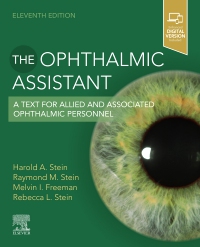

The Ophthalmic Assistant Elsevier eBook on VitalSource, 11th Edition
Elsevier eBook on VitalSource
Now $68.39
Covering all the knowledge and skills needed for everyday duties as well as success on certification and recertification exams, The Ophthalmic Assistant, 11th Edition, is an essential resource for allied health personnel working in ophthalmology, optometry, opticianry, and other eye care settings. Drs. Harold A. Stein, Raymond M. Stein, and Melvin I. Freeman are joined by new editor Dr. Rebecca Stein and several new contributing authors who provide practical, up-to-date guidance on ocular diseases, surgical procedures, medications, and equipment, as well as paramedical procedures and office management for today’s practice. This outstanding reference and review tool provides essential knowledge and guidance for ophthalmic assistants, technicians, and technologists as critical members of the eye care team.
-
- Keeps you up to date with coverage of key topics such as topography-guided PRK, cataract surgery with multifocal IOLs to treat presbyopia, and OCT and OCTA, as well as the latest information on basic science, new testing procedures and equipment, and two new chapters on refractive surgery and eye banking
- Provides full-color visual guidance for identification of ophthalmic disorders, explanations of difficult concepts, and depictions of the newest equipment used in ophthalmology and optometry—more than 1,000 images in all
- Features more than 400 interactive multiple-choice review questions that test your knowledge and understanding of key concepts
- Includes a bonus color-image atlas that tests your clinical recognition of disease and disorders of the eye
- Contains convenient quick-reference appendices with hospital/practice forms for more efficient patient record keeping, conversion tables, and numerous language translations, plus information on ocular emergencies, pharmaceuticals, and more
- Enhanced eBook version included with purchase. Your enhanced eBook allows you to access all of the text, figures, and references from the book on a variety of devices
-
-
 The Ophthalmic AssistantPaperback
-
-
Section One: Basic Sciences
1. Anatomy of the eye
2. Physiology of the eye
3. Optics
4. Pharmacology
5. Microbiology
Section Two: Clinical Practice
6. Office efficiency and public relations
7. History taking
8. Preliminary examination
9. Vision function and impairment
10. Understanding ophthalmic equipment
11. Refractive errors and how to correct them
12. History of spectacles
13. Facts about glasses
14. Rigid contact lenses: basics
15. Soft contact lenses
16. Advanced techniques in soft and rigid contact lens fitting
17. Dry eyes
18. Managing a contact lens practice
19. Visual fields
20. Automated visual field testing
Section Three: Common Clinical Eye Problems or Common Clinical Conditions
21. Ocular Injuries
22. The urgent case
23. Common eye disorders
24. Common retinal disorders
25. Glaucoma
26. Uveitis
27. Examination of the newborn, infant and small child
28. Maintenance of ophthalmic equipment and instruments
Section Four: Surgical Technique
29. Aseptic technique and minor office surgery
30. The operative patient
31. Highlights of ocular surgery
32. Surgical Correction of Presbyopia
33. Assisting the Surgeon
34. Lasers in ophthalmology
35. Ambulatory surgery
36. Refractive surgery
37. Corneal Collagen Cross Linking in the Management of ectatic diseases
38. Wavefront aberrations and custom ablation
Section Five: Ocular imaging
39. Optical coherence tomography
40. Computerized corneal topography
41. Specular microscopy
42. Diagnostic ultrasound
Section Six: Special procedures
43. Ocular motility and binocular vision
44. Ophthalmic photography
45. Visual aids for the partially sighted
Section Seven: Community ocular programs
46. Blind persons in the modern world
47. Art and the eye
48. Cardiopulmonary resuscitation
Section Eight: Expanded roles in eye care delivery
49. Computers in ophthalmic practice
Section Nine: Role of assistants in eye care
50. Allied health personnel in ophthalmology
51. Ophthalmology ethics
52. Ophthalmic allied health personnel: scope of practice
53. Testing of ophthalmic skills
54. The development of ophthalmic assistants in North America
55. Ophthalmic assisting in the international community and in the prevention of blindness
Section Ten: Atlas of Clinical Ophthalmic Disorders
56. Atlas of Clinical Ophthalmic Disorders -
-
Ways of Reading
- The appearance of the text and page layout can be modified according to the capabilities of the reading system (font family and font size, spaces between paragraphs, sentences, words, and letters, as well as color of background and text)
- This e-publication is accessible to the full extent that the file format and types of content allow, on a specific reading device, by default, without necessarily including any additions such as textual descriptions of images or enhanced navigation
- No information about nonvisual reading is available
-
Conformance
- No information is available
-
Navigation
- Table of contents to all chapters of the text via links
- Page list to go to pages from the print source version
-
Rich Content
- No information is available
-
Hazards
- No information is available
-
Product Content
- No information is available
-
Legal Considerations
- No information is available
-
Additional Accessibility Information
- Page breaks included from the original print source
- For readers with color vision deficiency, use of color (e.g., in diagrams, graphics and charts, in prompts, or on buttons inviting a response) is not the sole means of graphical distinction or of conveying information
- E-publication includes basic navigation (usually less detailed than TOC-based navigation)
- Where links, controls or buttons are included in the content, the purpose or functionality of each link, control or button is apparent from the associated text alone - or where it is unclear, separate link, control or button descriptions are provided
- All (or substantially all) textual matter is arranged in a single logical reading order (including text that is visually presented as separate from the main text flow, e.g., in boxouts, captions, tables, footnotes, endnotes, citations, etc.). Non-textual content is also linked from within this logical reading order. (Purely decorative non-text content can be ignored).
- The language of the text has been specified (e.g., via the HTML or XML lang attribute) to optimise text-to-speech (and other alternative renderings), both at the whole document level and, where appropriate, for individual words, phrases or passages in a different language.
-
Ways of Reading

 as described in our