ISBN:
9780443118654
Copyright:
2026
Publication Date:
02-21-2025
Page Count:
606
Imprint:
Elsevier
List Price:
$134.99

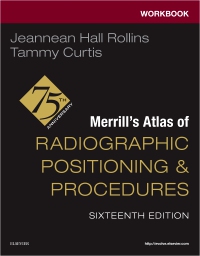
Workbook for Merrill's Atlas of Radiographic Positioning and Procedures -Elsevier eBook on VitalSource, 16th Edition
by Jeannean Hall Rollins, MRC, BSRT(R)(CV)(M) and Tammy Curtis, PhD, RT(R)(CT)(CHES)
Elsevier eBook on VitalSource
ISBN:
9780443118654
Copyright:
2026
Publication Date:
02-21-2025
Page Count:
606
Imprint:
Elsevier
List Price:
$134.99
Was
$134.99
Now $128.24
Or $0.00 with a valid access code
Reinforce your understanding of radiographic positioning and procedures with this practical workbook! Corresponding to the content in Merrill's Atlas of Radiographic Positioning and Procedures, 16th Edition, this workbook helps you review and practice essential radiographic terminology, anatomy, and positioning concepts. Exercises include multiple-choice and matching questions, imaging evaluation, and more. Written by the textbook’s authors, this workbook prepares you for success on the ARRT certification exam and in clinical radiography practice.
-
- NEW! Patient positioning photos enhance chapters on the abdomen, thoracic viscera, bony thorax, and pelvis and hip
- NEW! Additional review questions in many of the chapters offer expanded self-assessment opportunities
- UPDATED! Measurement units match the format used in imaging texts and the ASRT (SI units as primary, then traditional units in parentheses)
- STREAMLINED! Decimal values replace fractions throughout the workbook
- Anatomy exercises reinforce understanding with multiple-choice, matching, and short-answer questions, labeling and identification diagrams, and crossword puzzles
- Positioning exercises include multiple-choice, matching, short-answer, true/false, and fill-in-the blank questions, labeling and identification diagrams, and comparisons of standard radiographic projections
- Exercises on identifying errors in radiographs prepare you to evaluate radiographs in clinical situations
- Pathology exercises help you understand which projections will best demonstrate various pathologies
- Self-tests at the end of each chapter include review questions, enabling you to assess your comprehension and measure your own progress
-
-

-
 Merrill's Atlas of Radiographic Positioning and Procedures - 3-Volume Set - Elsevier eBook on VitalSourceElsevier eBook on VitalSource
 -

-
-
1. Preliminary Steps in Radiography
2. General Anatomy and Radiographic Positioning Terminology
3. Thoracic Viscera: Chest and Upper Airway
4. Abdomen
5. Upper Extremity
6. Shoulder Girdle
7. Lower Extremity
8. Pelvis and Hip
9. Vertebral Column
10. Bony Thorax
11. Cranium
12. Trauma Radiography
13. Contrast Arthrography
14. Myelography and Other Central Nervous System Imaging
15. Digestive System: Salivary Glands, Alimentary Canal, and Biliary System
16. Urinary System and Venipuncture
17. Reproductive System
18. Mammography
19. Mobile Radiography
20. Surgical Radiography
21. Pediatric Imaging
22. Geriatric Radiography
23. Sectional Anatomy for Radiographers
24. Computed Tomography
25. Vascular, Cardiac, and Interventional Radiography -
-
Ways of Reading
- The appearance of the text and page layout can be modified according to the capabilities of the reading system (font family and font size, spaces between paragraphs, sentences, words, and letters, as well as color of background and text)
- This e-publication is accessible to the full extent that the file format and types of content allow, on a specific reading device, by default, without necessarily including any additions such as textual descriptions of images or enhanced navigation
- No information about nonvisual reading is available
-
Conformance
- For detailed accessibility information, see Elsevier's website at https://www.elsevier.com/about/accessibility
- For queries regarding accessibility information, contact [email protected]
- The publication was certified on 18-11-2025
-
Navigation
- Table of contents to all chapters of the text via links
-
Rich Content
- No information is available
-
Hazards
- No information is available
-
Product Content
- No information is available
-
Legal Considerations
- No information is available
-
Additional Accessibility Information
- For readers with color vision deficiency, use of color (e.g., in diagrams, graphics and charts, in prompts, or on buttons inviting a response) is not the sole means of graphical distinction or of conveying information
- E-publication includes basic navigation (usually less detailed than TOC-based navigation)
- Where links, controls or buttons are included in the content, the purpose or functionality of each link, control or button is apparent from the associated text alone - or where it is unclear, separate link, control or button descriptions are provided
- All (or substantially all) textual matter is arranged in a single logical reading order (including text that is visually presented as separate from the main text flow, e.g., in boxouts, captions, tables, footnotes, endnotes, citations, etc.). Non-textual content is also linked from within this logical reading order. (Purely decorative non-text content can be ignored).
- The language of the text has been specified (e.g., via the HTML or XML lang attribute) to optimise text-to-speech (and other alternative renderings), both at the whole document level and, where appropriate, for individual words, phrases or passages in a different language.
-
Ways of Reading
Was
$134.99
Now $128.24
Or $0.00 with a valid access code

 as described in our