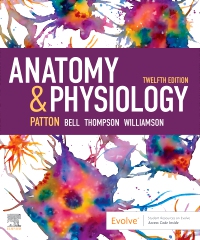

Anatomy & Physiology with Brief Atlas of the Human Body and Quick Guide to the Language of Science and Medicine - Elsevier E-Book on VitalSource, 12th Edition
Elsevier eBook on VitalSource
-
- NEW! Microbiome chapter discusses the microbial systems that are essential for human development, immunity, and nutrition, relating microbiome dysfunction to autoimmune diseases such as diabetes, rheumatoid arthritis, muscular dystrophy, multiple sclerosis, and fibromyalgia
- NEW! Updated Career Choices boxes spotlight new individuals and their advances in the sciences
- NEW! Complete Anatomy videos on Evolve relate to the content within specific chapters (13 videos total)
-
- NEW! Microbiome chapter discusses the microbial systems that are essential for human development, immunity, and nutrition, relating microbiome dysfunction to autoimmune diseases such as diabetes, rheumatoid arthritis, muscular dystrophy, multiple sclerosis, and fibromyalgia
- NEW! Updated Career Choices boxes spotlight new individuals and their advances in the sciences
- NEW! Complete Anatomy videos on Evolve relate to the content within specific chapters (13 videos total)
- Conversational, storytelling writing style breaks down information into brief chapters and chunks of information, making it easier to understand concepts
- Packaged with the Brief Atlas and Quick Guide of the Human Body, which contains images from some of the world's best medical atlases, to give students a manageable overview of the human body in an easy-to-use size and format
- 1,400 full-color photographs and drawings bring difficult A&P concepts to life and illustrate the most current scientific knowledge
- UNIQUE! Clear View of the Human Body transparencies allow students to peel back the layers of the body, with a 22-page, full-color insert showing the male and female human body along several planes
- The Big Picture and Cycle of Life sections in each chapter help students comprehend the interrelation of body systems and how the structure and function of these change in relation to age and development
- Interesting sidebars and boxes include Language of Science and Medicine, Mechanisms of Disease, Health Matters, Diagnostic Study, FYI, Sports and Fitness, and Career Choices
- Connect It! features call attention to online articles that expand on and apply A&P concepts
- Learning features include outlines, key terms, and study hints at the start of each chapter
- Chapter summaries, review questions, and critical thinking questions help students consolidate their knowledge after reading each chapter
- Quick Check questions reinforce learning by prompting students to review what they have just read
- Diverse illustrations and images reflect more accurately the wide spectrum of humanity
- Comprehensive glossary on the Evolve companion website includes more terms than in similar textbooks, each with an easy pronunciation guide and simplified translation of word parts — essential features for learning to use scientific and medical terminology
- All content aligns with HAPS learning outcomes, ensuring that students learn A&P competencies and core concepts
-
-
 Sherpath for Patton Anatomy and PhysiologySherpath Book-Organized
 -

-
-
UNIT 1: The Body as a Whole
1. Organization of the Body
2. Homeostasis
3. Chemical Basis of Life
4. Biomolecules
5. Cell Structure
6. Cell Function
7. Cell Growth & Development
8. Introduction to Tissues
9. Tissue Types
UNIT 2: Support & Movement
10. Skin
11. Skeletal Tissues
12. Axial Skeleton
13. Appendicular Skeleton
14. Articulations
15. Axial Muscles
16. Appendicular Muscles
17. Muscle Contraction
UNIT 3: Communication, Control, & Integration
18. Nervous System Cells
19. Nervous Signaling
20. Central Nervous System
21. Peripheral Nervous System
22. Autonomic Nervous System
23. General Senses
24. Special Senses
25. Endocrine Regulation
26. Endocrine Glands
UNIT 4: Transportation & Defense
27. Blood
28. Heart
29. Blood Vessels
30. Circulation of Blood
31. Lymphatic System
32. Innate Immunity
33. Adaptive Immunity
34. Stress
UNIT 5: Respiration, Nutrition & Excretion
35. Respiratory Tract
36. Ventilation
37. Gas Exchange & Transport
38. Upper Digestive Tract
39. Lower Digestive Tract
40. Digestion & Absorption
41. Nutrition & Metabolism
42. Urinary System
43. Fluid & Electrolyte Balance
44. Acid-Base BalanceUNIT 6: Reproduction & Development
45. Genital Systems
46. Reproduction
47. Growth, Development & Aging
48. Genetics & Heredity
49. Human Microbiome -
-
Ways of Reading
- The appearance of the text and page layout can be modified according to the capabilities of the reading system (font family and font size, spaces between paragraphs, sentences, words, and letters, as well as color of background and text)
- This e-publication is accessible to the full extent that the file format and types of content allow, on a specific reading device, by default, without necessarily including any additions such as textual descriptions of images or enhanced navigation
- All content can be read as read aloud speech or dynamic braille
-
Conformance
- The certifier's credential is https://bornaccessible.benetech.org/certified-publishers/
- For detailed accessibility information, see Elsevier's website at https://www.elsevier.com/about/accessibility
- For queries regarding accessibility information, contact [email protected]
- The publication was certified on 03-09-2025
-
Navigation
- Table of contents to all chapters of the text via links
- Page list to go to pages from the print source version
-
Rich Content
- No information is available
-
Hazards
- No information is available
-
Product Content
- No information is available
-
Legal Considerations
- No information is available
-
Additional Accessibility Information
- Content is enhanced with ARIA roles to optimize organization and facilitate navigation
- Page breaks included from the original print source
- For readers with color vision deficiency, use of color (e.g., in diagrams, graphics and charts, in prompts, or on buttons inviting a response) is not the sole means of graphical distinction or of conveying information
- The body text is presented with a contrast ratio of at least 4.5:1 (or 3:1 for large/heading text)
- Ultra-high contrast between text and background
- E-publication includes basic navigation (usually less detailed than TOC-based navigation)
- Where links, controls or buttons are included in the content, the purpose or functionality of each link, control or button is apparent from the associated text alone - or where it is unclear, separate link, control or button descriptions are provided
- All (or substantially all) textual matter is arranged in a single logical reading order (including text that is visually presented as separate from the main text flow, e.g., in boxouts, captions, tables, footnotes, endnotes, citations, etc.). Non-textual content is also linked from within this logical reading order. (Purely decorative non-text content can be ignored).
- Where interactive content is included in the product, controls are provided (e.g., for speed, pause and resume, reset) and labelled to make their use clear.
- The language of the text has been specified (e.g., via the HTML or XML lang attribute) to optimise text-to-speech (and other alternative renderings), both at the whole document level and, where appropriate, for individual words, phrases or passages in a different language.
-
Ways of Reading

 as described in our