
ISBN:
9780443120664
Copyright:
2024
Publication Date:
06-06-2023
Page Count:
665
Imprint:
Butterworth-Heinemann
List Price:
$105.99

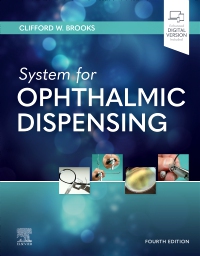
System for Ophthalmic Dispensing,Elsevier E-Book on VitalSource, 4th Edition
by Clifford W. Brooks, OD
Elsevier eBook on VitalSource
ISBN:
9780443120664
Copyright:
2024
Publication Date:
06-06-2023
Page Count:
665
Imprint:
Butterworth-Heinemann
List Price:
$105.99
Was
$105.99
Now $93.27
Or $0.00 with a valid access code
**Selected for Doody’s Core Titles® 2024 in Optometry**
Understand and meet your patients’ eyewear needs with the reference that covers every aspect of dispensing ― from basic terminology to frame selection to eyewear fitting, adjusting, and repairing. System for Ophthalmic Dispensing, 4th Edition, provides a step-by-step system for properly fitting and adjusting eyewear, including the nuances of lens selection, making it an ideal resource both for students who are just learning about dispensing and practitioners who want to keep their skills up to date. Thorough discussions of every topic and hundreds of newly revised and enhanced review questions make this a one-stop educational and clinical resource for today’s eyecare professionals.
Understand and meet your patients’ eyewear needs with the reference that covers every aspect of dispensing ― from basic terminology to frame selection to eyewear fitting, adjusting, and repairing. System for Ophthalmic Dispensing, 4th Edition, provides a step-by-step system for properly fitting and adjusting eyewear, including the nuances of lens selection, making it an ideal resource both for students who are just learning about dispensing and practitioners who want to keep their skills up to date. Thorough discussions of every topic and hundreds of newly revised and enhanced review questions make this a one-stop educational and clinical resource for today’s eyecare professionals.
-
- Explains the "how" and "why" behind lens selection to help you better understand and meet the vision needs of those you serve
- Includes in-depth discussions of all types of lenses, including multifocal, progressive, absorptive, safety, recreational, aspheric, high index, and lens coatings
- Provides updated coverage of the latest dispensing procedures and equipment
- Discusses the use of spectacle lenses for the control of myopia
- Contains more than 700 high-quality figures demonstrating how to adjust frames, the optics of lenses, and how light travels through lenses. Photos are all taken from the perspective of the person who is adjusting the frame
- Features more than 600 interactive review questions along with answers, explanations, and worked problems—all newly revised for this edition
-
1. Frame Types and Parts
2. Frame Measurements and Markings
3. Measuring the Interpupillary Distance
4. Frame Selection
5. Reference Point Placement, Multifocal Height, and Blank Size Determination
6. Ordering and Verification
7. Lens Insertion
8. Standard Alignment
9. Adjusting the Frame
10. Frame Repairs and Modifications
11. Review of Elementary Mathematical Principles
12. Characteristics of Ophthalmic Lenses
13. Lens Curvature and Thickness
14. Optical Considerations With Increasing Lens Power
15. Optical Prism: Power and Base Direction
16. Optical Prism: Decentration and Thickness
17. Fresnel Prisms and Lenses
18. Lens Design
19. Segmented Multifocal Lenses
20. Progressive Addition Lenses
21. Anisometropia
22. Absorptive Lenses
23. Lens Materials, Safety Eyewear, and Sports Eyewear
24. How Lenses Are Edged -
-
Ways of Reading
- The appearance of the text and page layout can be modified according to the capabilities of the reading system (font family and font size, spaces between paragraphs, sentences, words, and letters, as well as color of background and text)
- This e-publication is accessible to the full extent that the file format and types of content allow, on a specific reading device, by default, without necessarily including any additions such as textual descriptions of images or enhanced navigation
- No information about nonvisual reading is available
-
Conformance
- For detailed accessibility information, see Elsevier's website at https://www.elsevier.com/about/accessibility
- For queries regarding accessibility information, contact [email protected]
- The publication was certified on 18-11-2025
-
Navigation
- Table of contents to all chapters of the text via links
-
Rich Content
- No information is available
-
Hazards
- No information is available
-
Product Content
- No information is available
-
Legal Considerations
- No information is available
-
Additional Accessibility Information
- For readers with color vision deficiency, use of color (e.g., in diagrams, graphics and charts, in prompts, or on buttons inviting a response) is not the sole means of graphical distinction or of conveying information
- E-publication includes basic navigation (usually less detailed than TOC-based navigation)
- Where links, controls or buttons are included in the content, the purpose or functionality of each link, control or button is apparent from the associated text alone - or where it is unclear, separate link, control or button descriptions are provided
- All (or substantially all) textual matter is arranged in a single logical reading order (including text that is visually presented as separate from the main text flow, e.g., in boxouts, captions, tables, footnotes, endnotes, citations, etc.). Non-textual content is also linked from within this logical reading order. (Purely decorative non-text content can be ignored).
- The language of the text has been specified (e.g., via the HTML or XML lang attribute) to optimise text-to-speech (and other alternative renderings), both at the whole document level and, where appropriate, for individual words, phrases or passages in a different language.
-
Ways of Reading
Was
$105.99
Now $93.27
Or $0.00 with a valid access code

 as described in our