ISBN:
9780443121869
Copyright:
2026
Publication Date:
03-31-2025
Page Count:
375
Imprint:
Elsevier
List Price:
$89.99
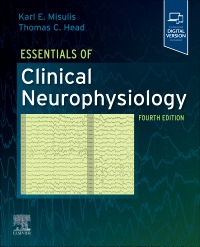
Essentials of Clinical Neurophysiology, 4th Edition
by Karl E. Misulis, MD, PhD and Thomas C. Head, MD
Paperback
ISBN:
9780443121869
Copyright:
2026
Publication Date:
03-31-2025
Page Count:
375
Imprint:
Elsevier
List Price:
$89.99
In Stock
Most review copies are eBooks – how fast!
A review copy request is most likely to be fulfilled as an eBook on VitalSource rather than a print product, unless no eBook is available. eBooks become available in as little as a few hours. Print products will take between 7 and 10 days to arrive. To request a print copy, please contact us through the Evolve Support Center for further assistance or contact your Elsevier Sales Rep.
Up-to-date and easy to read, Essentials of Clinical Neurophysiology, Fourth Edition, details the basics of normal and abnormal neurologic function and provides authoritative clinical guidance on performing and interpreting today's full range of neurophysiologic studies. Drs. Karl E. Misulis and Thomas C. Head cover recent advances in technology as well as changes in training and practice patterns for EEG, EMG, EP, intraoperative monitoring, sleep studies, and autonomic testing. Offering a practical overview of this complex field, this one-stop resource is an excellent tool for board review and preparation.
-
- Covers a wide variety of the studies used to evaluate epilepsy, coma, dementia, movement disorders, neuromuscular diseases, nerve dysfunction, sleep apnea, narcolepsy, and more
- Features numerous illustrations that highlight key content and promote visual understanding
- Includes a new Key Points section to begin each chapter and offers suggested readings for further study
- Discusses new technologies and explains their clinical implications
- An ideal resource for neurology residents, fellows in neurophysiology and EEG/EMG, those studying for recertification, and EEG/EMG technicians
- An eBook version is included with purchase. The eBook allows you to access all of the text, figures, and references, with the ability to search, customize your content, make notes and highlights, and have content read aloud. Additional digital ancillary content may publish up to 6 weeks following the publication date
-
PART 1 Basic Science
1. Neurophysiology
2. Technology
3. Approach to Data Interpretation
4. Common Artifacts and Their Physics
5. Best Practices
PART 2 Electroencephalography
6. Physiology of Electroencephalography
7. Technical Aspects of the Electroencephalography
8. Normal Electroencephalography
9. Abnormal Electroencephalography
10. Seizures
11. Pediatric Electroencephalography
12. Electroclinical Syndromes
13. Nonepileptic Disorders
14. Special Studies in Electroencephalography
PART 3 Nerve Conduction Studies and Electromyography
15. Physiology of Nerve Conduction Study and Electromyography
16. Methods
17. Approach to Clinical Questions
18. Neuropathies
19. Myopathies
20. Neuromuscular Junction Defects
PART 4 Evoked Potentials an Intraoperative Neurological Monitoring
21. Overview
22. Visual Evoked Potentials
23. Brainstem Auditory Evoked Potential
24. Somatosensory Evoked Potential
25. Motor Evoked Potential
26. Electromyography and Cranial Nerve Monitoring in IONM
27. Electroencephalography, Cortical Mapping, and Anesthetic Considerations in IONM
PART 5 Polysomnography
28. Sleep Physiology
29. Polysomnography Methods
30. Polysomnography in Sleep Disorders
PART 6 Autonomic Testing
31. Neuroanatomy of the Autonomic Nervous System
32. Autonomic Testing -
No accessibility information is available for this product.
In Stock
Most review copies are eBooks – how fast!
A review copy request is most likely to be fulfilled as an eBook on VitalSource rather than a print product, unless no eBook is available. eBooks become available in as little as a few hours. Print products will take between 7 and 10 days to arrive. To request a print copy, please contact us through the Evolve Support Center for further assistance or contact your Elsevier Sales Rep.

 as described in our