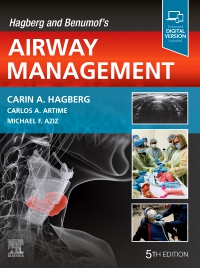

Hagberg and Benumof's Airway Management - Elsevier E-Book on VitalSource, 5th Edition
Elsevier eBook on VitalSource
Now $172.79
**Selected for 2026 Doody's Core Titles as an Essential Purchase in Critical Care**
Considered the go-to reference in airway management not only in anesthesia practice but also in emergency medicine and intensive care settings, Hagberg and Benumof's Airway Management ensures that practitioners worldwide are familiar and proficient with the most recent developments in equipment and scientific knowledge in this fast-changing area. Covering all aspects of this fundamental practice, the new 5th Edition facilitates the safe performance of airway management for all airway practitioners, regardless of specialty, using a concise, how-to approach, carefully chosen illustrations, and case examples and analysis throughout.
-
The only volume of its kind completely dedicated to airway management, this edition features:
- Well-illustrated and tightly focused coverage, with anatomical drawings, charts, algorithms, photos, and imaging studies for quick reference—many new to this edition
- Key Points in every chapter, as well as up-to-date information on the latest ASA guidelines
- Two new chapters covering Combination Techniques and Human Factors in Airway Management; all other chapters have been thoroughly revised to reflect current thinking and practice
- A significantly expanded video library, including intubating the COVID-19 patient and new videos on ultrasonography of the airway
- Enhanced eBook version included with purchase. Your enhanced eBook allows you to access all of the text, figures, and references from the book on a variety of devices
-
-
 Hagberg and Benumof's Airway ManagementHardcover
-
-
PART 1. Basic Clinical Science Considerations
1. Functional Anatomy of the Airway
2. Radiographic and Cross-Sectional Imaging of the Airway
3. Ultrasonography in Airway Management
4. Physics of the Airway
5. Physiology of the Airway
6. Airway Pharmacology
7. Physiologic and Pathophysiologic Responses to Intubation
PART 2. The Difficult Airway: Definition, Assessment, Planning, and Algorithms
8. Definition and Incidence of the Difficult Airway
9. Airway Assessment and Prediction of the Difficult Airway
10. Development of an Airway Management Plan
11. Algorithms for Management of the Difficult Airway
12. Human Factors in Airway Management
PART 3. Preintubation-Ventilation Procedures
13. Preparation of the Patient for Awake Intubation
14. Aspiration Prevention and Prophylaxis: Preoperative Considerations for the Full Stomach Patient
15. Perioxygenation
16. Techniques to Induce General Anesthesia
PART 4. The Airway Techniques
17. History of Airway Management
18. Noninvasive Management of the Airway
19. Supraglottic Airway Techniques
20. Laryngoscopic Tracheal Intubation
21. Nonvisual Techniques of Tracheal Intubation
22. Intubating Introducers and Lighted and Optical Stylets
23. Video-Assisted Laryngoscopy
24. Flexible Scope Intubation Techniques
25. Combination Techniques
26. Lung Isolation Techniques
27. Rigid Bronchoscopy
28. Percutaneous Emergency Airway Access
29. Surgical Airway in Emergent and Nonemergent Contexts
30. Confirmation of Tracheal Intubation
PART 5. Difficult Airway Situations
31. Prehospital Airway Management
32. Cardiopulmonary Resuscitation and Airway Management
33. Austere Environment and Disaster Preparedness
34. Airway Management in Trauma
35. Airway Management in Burn Patients
36. Airway Management in Pediatric Patients
37. Airway Management in Obstetric Patients
38. Airway Management in Head and Neck Surgery
39. Airway Management in Neurosurgical Patients
40. Obesity, Sleep Apnea, the Airway, and Anesthesia
41. Regional Anesthesia and the Difficult Airway
42. Airway Management in Non-Operating Room Locations
43. Airway Management in Intensive Care Medicine
PART 6. Postintubation Procedures
44. The Endotracheal Tube and Respiratory Care
45. Mechanical Ventilation
46. Monitoring the Airway and Pulmonary Function
47. Extubation and Reintubation of the Difficult Airway
48. Complications of Managing the Airway
PART 7. Societal Considerations
49. Airway Management Education
50. Dissemination of Critical Airway Information
51. Airway Research
52. Airway Management and Outcomes Reporting
53. Role of the Airway Community -
-
Ways of Reading
- The appearance of the text and page layout can be modified according to the capabilities of the reading system (font family and font size, spaces between paragraphs, sentences, words, and letters, as well as color of background and text)
- This e-publication is accessible to the full extent that the file format and types of content allow, on a specific reading device, by default, without necessarily including any additions such as textual descriptions of images or enhanced navigation
- No information about nonvisual reading is available
-
Conformance
- No information is available
-
Navigation
- Table of contents to all chapters of the text via links
- Page list to go to pages from the print source version
-
Rich Content
- No information is available
-
Hazards
- No information is available
-
Product Content
- No information is available
-
Legal Considerations
- No information is available
-
Additional Accessibility Information
- Page breaks included from the original print source
- For readers with color vision deficiency, use of color (e.g., in diagrams, graphics and charts, in prompts, or on buttons inviting a response) is not the sole means of graphical distinction or of conveying information
- E-publication includes basic navigation (usually less detailed than TOC-based navigation)
- Where links, controls or buttons are included in the content, the purpose or functionality of each link, control or button is apparent from the associated text alone - or where it is unclear, separate link, control or button descriptions are provided
- All (or substantially all) textual matter is arranged in a single logical reading order (including text that is visually presented as separate from the main text flow, e.g., in boxouts, captions, tables, footnotes, endnotes, citations, etc.). Non-textual content is also linked from within this logical reading order. (Purely decorative non-text content can be ignored).
- The language of the text has been specified (e.g., via the HTML or XML lang attribute) to optimise text-to-speech (and other alternative renderings), both at the whole document level and, where appropriate, for individual words, phrases or passages in a different language.
-
Ways of Reading

 as described in our