ISBN:
9780443125515
Copyright:
2025
Publication Date:
10-04-2024
Page Count:
288
Imprint:
Elsevier
List Price:
$34.99

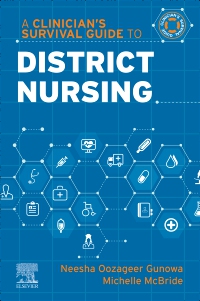
A Clinician's Survival Guide to District Nursing - Elsevier E-Book on VitalSource, 1st Edition
by Neesha Oozageer Gunowa, PhD, MSc, BSc (Hons), DN, RN, SFHEA, QN and Michelle McBride, MSc, BSc (Hons), DN, RN, SFHEA, QN
Elsevier eBook on VitalSource
ISBN:
9780443125515
Copyright:
2025
Publication Date:
10-04-2024
Page Count:
288
Imprint:
Elsevier
List Price:
$34.99
Was
$34.99
Now $33.24
Or $0.00 with a valid access code
A Clinician’s Survival Guide to District Nursing covers the specialist skills and knowledge nurses need to join the rapidly expanding, increasingly important community nursing workforce.
The book is a quick reference guide designed to support autonomous decision making amid the wide range of conditions district nurses are expected to manage, recognising and highlighting the advanced skills of district nurses. It will help the reader understand what it means to work in the community, acquire the fundamental knowledge of clinical skills necessary to ensure best practice, and explore ways of working to ensure optimal care delivery through joined-up health and social services.
Written by specialists in community nursing, this indispensable new book is ideal for students exploring district nursing as a career option, as well as nurses transitioning to a district nursing team role.
The book is a quick reference guide designed to support autonomous decision making amid the wide range of conditions district nurses are expected to manage, recognising and highlighting the advanced skills of district nurses. It will help the reader understand what it means to work in the community, acquire the fundamental knowledge of clinical skills necessary to ensure best practice, and explore ways of working to ensure optimal care delivery through joined-up health and social services.
Written by specialists in community nursing, this indispensable new book is ideal for students exploring district nursing as a career option, as well as nurses transitioning to a district nursing team role.
-
- NEW! Nora AI - an AI-powered learning assistant exclusive to Elsevier ebooks on VitalSource's Bookshelf® platform - offers built-in AI learning support that provides personalized answers based on content from the Elsevier ebook
- Covers important issues including leadership, quality improvement and the integrated care system
- Up-to-date and contemporary - incorporates changes to clinical care and management, including the impact of COVID-19
- Clear, concise and easy to follow
- Bullet points and diagrams make it easy to understand difficult concepts
- Reflective activities reinforce learning
- Case studies highlight best practice
- Complements university programmes focusing on community services
-
1. The Role of Community and District Nurses
2. Community Nursing and System Working
3. Economic Value of Community Nursing
4. Autonomous Practice and Safe Ways of Working Alone
5. Infection Prevention and Control in the Community
6. Promoting Equity in Community Nursing
7. Intersecting Pathways: Exploring Population Health, Public Health and Health Promotion
8. Clinical Assessment
9. Long-Term Conditions Management
10. Physical Health in Community Nursing
11. Mental Health in Community Nursing
12. Palliative Care by Community Nurses
13. Caseload Management
14. Leadership and Career Progression
15. Quality and Safety in the Community
16. Introduction to Digital Health Management
17. Nursing Research in the Community
18. Health and Well-being of District and Community Nurses -
-
Ways of Reading
- The appearance of the text and page layout can be modified according to the capabilities of the reading system (font family and font size, spaces between paragraphs, sentences, words, and letters, as well as color of background and text)
- This e-publication is accessible to the full extent that the file format and types of content allow, on a specific reading device, by default, without necessarily including any additions such as textual descriptions of images or enhanced navigation
- No information about nonvisual reading is available
-
Conformance
- No information is available
-
Navigation
- Table of contents to all chapters of the text via links
- Page list to go to pages from the print source version
-
Rich Content
- No information is available
-
Hazards
- No information is available
-
Product Content
- No information is available
-
Legal Considerations
- No information is available
-
Additional Accessibility Information
- Content is enhanced with ARIA roles to optimize organization and facilitate navigation
- Page breaks included from the original print source
- For readers with color vision deficiency, use of color (e.g., in diagrams, graphics and charts, in prompts, or on buttons inviting a response) is not the sole means of graphical distinction or of conveying information
- E-publication includes basic navigation (usually less detailed than TOC-based navigation)
- Where links, controls or buttons are included in the content, the purpose or functionality of each link, control or button is apparent from the associated text alone - or where it is unclear, separate link, control or button descriptions are provided
- All (or substantially all) textual matter is arranged in a single logical reading order (including text that is visually presented as separate from the main text flow, e.g., in boxouts, captions, tables, footnotes, endnotes, citations, etc.). Non-textual content is also linked from within this logical reading order. (Purely decorative non-text content can be ignored).
- The language of the text has been specified (e.g., via the HTML or XML lang attribute) to optimise text-to-speech (and other alternative renderings), both at the whole document level and, where appropriate, for individual words, phrases or passages in a different language.
-
Ways of Reading

Was
$34.99
Now $33.24
Or $0.00 with a valid access code

 as described in our