
ISBN:
9780443125683
Copyright:
2027
Page Count:
100
Imprint:
Elsevier
List Price:
$199.99
Gray's Surgical Anatomy, 2nd Edition
by Peter A. Brennan, OBE, MD, PhD, FRCS, FRCSI, Hon FRCSGlas, FRCSEd, Susan Standring, MBE, PhD, DSc, Hon FAS, Hon FRCS and Sam M. Wiseman, BSc, MD, FRCSC, FACS
Hardcover
ISBN:
9780443125683
Copyright:
2027
Page Count:
100
Imprint:
Elsevier
List Price:
$199.99
$199.99
Free Shipping!
Not Yet Available
Coming Soon!
Expected availability date: 08-21-2026
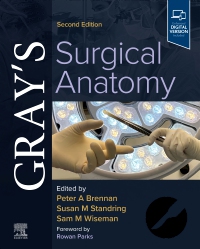
Written and edited by expert surgeons in collaboration with a world-renowned anatomist, this exquisitely illustrated reference consolidates surgical, anatomical, and technical knowledge for the entire human body in a single volume. Part of the highly respected Gray's family of texts and atlases, this fully revised and updated resource brings to life the applied anatomical knowledge that is critically important in the operating theatre, with a high level of detail to ensure safe and effective surgical practice. Gray's Surgical Anatomy, 2nd Edition, is unique in the field—serving as a textbook of regional anatomy as well as an atlas for operative procedures—making it an invaluable practical resource for surgeons and surgical trainees at all levels of experience, as well as medical students, radiologists, and anatomists.
Gray's Surgical Anatomy is especially appropriate for surgeons in training and has become the “go-to” five-star text for postgraduate examinations where candidates are required to demonstrate a knowledge of applied surgical anatomy.
Gray's Surgical Anatomy is especially appropriate for surgeons in training and has become the “go-to” five-star text for postgraduate examinations where candidates are required to demonstrate a knowledge of applied surgical anatomy.
-
- Expert content written by surgeons for surgeons, overseen by co-editors and internationally recognised surgeons Peter A. Brennan and Sam Wiseman, with all anatomical detail quality assured by co-editor and Gray's Anatomy Editor-in-Chief, Susan Standring; section editors and contributors are global leaders in areas such as head and neck surgery, cardiothoracic surgery, and general surgery
- Features superb colour photographs from the operating theatre, accompanied by detailed explanatory artwork and figures from the latest imaging modalities, plus summary tables, dozens of cadaveric and intra-operative videos, up-to-date self-assessment questions, and case-based scenarios—making it an ideal reference and learning package for surgeons and trainees at all levels
- Reflects contemporary practice with chapters logically organised by anatomical region, designed for relevance to surgeons across a wide range of subspecialties, practice types, and clinical settings, and aligned with the requirements of current surgical training curricula
- Contains new sections on Surgical Anatomy Teaching: Evidenced Based Approaches; Moral Injury/Moral Damage; Endovascular Surgery; and Gender Reassignment Surgery/Transgender Surgery; as well as enhanced coverage of human factors and minimising error; the root of the neck; vascular anatomy; considerations relevant to robotic surgery; and much more
- Maximises day-to-day practical application with depictions of key anatomical features and relationships that are essential for safe surgical practice throughout, as well as clearly signposted “Tips and Anatomical Hazards”
- Integrates essential anatomy for robotic and minimal access approaches, including laparoscopic and endoscopic techniques
- Provides online access to supplementary operative and cadaveric dissections videos and self-assessment material to bring content to life, add further clarity, and test your understanding of key surgical anatomy concepts
- An eBook version is included with purchase. The eBook allows you to access all of the text, figures, and references, with the ability to search, make notes and highlights, and have content read aloud
-
SECTION 1 INTRODUCTION
1. A short history of surgery
2. Understanding human factors to improve patient safety and team performance
3. Beyond location and function: the evolution of anatomy education for surgeons
4. Moral injury – the concept and its implications
SECTION 2 HEAD AND NECK
5. Overview of the head and neck
6. Facial bone osteology and nasoethmoidal complex
7. Face and scalp
8. Orbital anatomy
9. Orbit and eye
10. Nose and paranasal sinuses
11. Infratemporal fossa and pterygopalatine fossa
12. Temporomandibular joint
13. Mouth
14. Salivary glands
15. External and middle ear
16. Temporal bone
17. Neck
18. Pharynx
19. Larynx
20. Thyroid and parathyroid glands
SECTION 3 NEUROANATOMY
21. Overview of neurosurgical anatomy
22. Suprasellar and paraclinoidal regions
23. Cerebellopontine angle
24. Foramen magnum and inferior clivus
25. Ventricular system
26. Cerebral hemispheres and white matter tracts
27. Cerebral vasculature
28. Basal ganglia and thalamus
29. Brainstem and pineal region
30. Spinal cord
SECTION 4 BACK AND SPINE
31. Overview of the back and spine
32. Intervertebral joints, foramina and ligaments
33. Cervical spine
34. Thoracic spine
35. Lumbar spine, sacrum and coccyx
36. Anatomy of lumbar puncture and epidural analgesia
SECTION 5 UPPER LIMB
37. Overview of the upper limb
38. Supraclavicular and infraclavicular regions
39. Axilla
40. Shoulder girdle and upper arm
41. Elbow and forearm
42. Wrist and hand
SECTION 6 THORAX
43. Overview of the thorax and diaphragm and surgical anatomy of the chest wall
44. Great vessels: surgical access
45. Oesophagus, thoracic duct and lymphatics
46. Pleura and thoracic sympathetic trunk
47. Lungs, bronchi and trachea
48. Thymus
49. Pericardium and pericardial drainage
50. Echocardiographic anatomy of the heart
51. Mitral and tricuspid valves
52. Aortic valve, aortic root, left ventricular outflow tract and pulmonary valve
53. Ventricles, coronary vessels and access to conduits for grafting
54. Breast
55. Endovascular surgery
SECTION 7 ABDOMEN
56. Overview of the abdomen
57. Anterior abdominal wall
58. Inguinal region
59. Posterior abdominal wall and retroperitoneum
60. The mesentery, peritoneum and peritoneal cavity
61. Abdominal oesophagus and stomach
62. Small intestine
63. Colon, rectum and anus
64. Liver
65. Liver biopsy, resections and a brief overview of transplantation
66. Pancreas, gallbladder and biliary tree
67. Spleen
68. Adrenal glands
69. Development and congenital anomalies of the gastrointestinal tract and its adnexae
70. Endoscopic anatomy of the gastrointestinal tract
SECTION 8 PELVIC VISCERA: UROGENITAL SYSTEM
71. Overview of pelvic viscera
72. Kidneys and ureters
73. Bladder and urethra
74. Pelvic inlet, pelvic floor and perineum
75. Male reproductive system
76. Prostate
77. Female reproductive system
78. Gender-affirming surgery/transgender surgery
79. Development and congenital anomalies of the urogenital system
SECTION 9 BONY PELVIS AND LOWER LIMB
80. Overview of the pelvis and lower limb
81. Vascular anatomy of the lower limb
82. Innervation of the lower limb and nerve blockade techniques
83. Pelvic girdle
84. Hip
85. Thigh
86. Popliteal fossa
87. Knee
88. Compartments of the leg
89. Ankle
90. Foot -
No accessibility information is available for this product.
$199.99
Free Shipping!
Not Yet Available
Coming Soon!
Expected availability date: 08-21-2026

 as described in our