ISBN:
9780443125768
Copyright:
2026
Publication Date:
08-28-2025
Page Count:
368
Imprint:
Elsevier
List Price:
$31.99

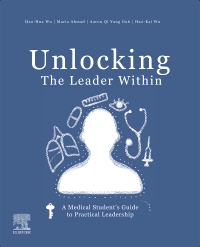
Unlocking the Leader Within: A Medical Student’s Guide to Practical Leadership - Elsevier E-Book on VitalSource, 1st Edition
by Hao-Hua Wu, MD, Maria Ahmad, MBBS (Dist.), BSc (Hons), PGCert (MedEd), FHEA, Aaron Qi Yang Goh, MBBS and Hao-Kai Wu
Elsevier eBook on VitalSource
ISBN:
9780443125768
Copyright:
2026
Publication Date:
08-28-2025
Page Count:
368
Imprint:
Elsevier
List Price:
$31.99
Was
$31.99
Now $28.79
Or $0.00 with a valid access code
Becoming a leader enables you to inspire, galvanize, and achieve your dreams as an aspiring healthcare provider. Strong leadership skills are needed in modern clinical settings to enhance teamwork, communication, and collaboration. Don’t wait until you have completed training or are given a title to start on your leadership journey—start today. Unlocking the Leader Within: A Medical Student’s Guide to Practical Leadership is a unique and practical resource that equips you with real-world strategies to succeed in patient-centered care.
Discover 14 leadership principles that will allow you to excel as medical trainee.
This student-focused text emphasizes that leadership principles are learned, not innate. Any person equipped with these 14 leadership principles can be a successful leader, regardless of level of training. An emphasis on how to optimize teamwork as a trainee makes this resource unique among leadership books and ideal for medical students and in-training physician assistants and nurse practitioners, as well as all professional health care providers.
Discover 14 leadership principles that will allow you to excel as medical trainee.
This student-focused text emphasizes that leadership principles are learned, not innate. Any person equipped with these 14 leadership principles can be a successful leader, regardless of level of training. An emphasis on how to optimize teamwork as a trainee makes this resource unique among leadership books and ideal for medical students and in-training physician assistants and nurse practitioners, as well as all professional health care providers.
-
- Synthesizes the 14 most important leadership principles for medical trainees in two parts: 8 skills for self-mastery and 6 skills for effective teamwork.
- Illustrates how popular leadership principles such as emotional intelligence, conflict resolution, avoiding burnout, and confident humility can be applied in a healthcare setting.
- Offers realistic examples of how to apply these principles to the critical parts of medical training.
-
-
 Unlocking the Leader WithinPaperback
-
-
1. Introduction
2. Emotional Intelligence
3. Effective Communication
4. Find Your Why and Build Good Habits
5. Personality Type
6. Confident Humility and Why It Matters in the Hospital
7. Leadership Styles
8. Avoiding Burnout
9. Adaptability and creative responses to setbacks and obstacles
10. Characteristics of Successful Teams
11. Conflict Resolution
12. Galvanize Those Around You
13. Delegation
14. Positionless Leadership
15. Feedback
16. Clinical Rotations
17. Letters of Recommendation
18. Research
19. Leadership Activities
20. The Art of the Successful Interview
21. Conclusion -
-
Ways of Reading
- The appearance of the text and page layout can be modified according to the capabilities of the reading system (font family and font size, spaces between paragraphs, sentences, words, and letters, as well as color of background and text)
- This e-publication is accessible to the full extent that the file format and types of content allow, on a specific reading device, by default, without necessarily including any additions such as textual descriptions of images or enhanced navigation
- No information about nonvisual reading is available
-
Conformance
- No information is available
-
Navigation
- Table of contents to all chapters of the text via links
- Page list to go to pages from the print source version
-
Rich Content
- No information is available
-
Hazards
- No information is available
-
Product Content
- No information is available
-
Legal Considerations
- No information is available
-
Additional Accessibility Information
- Content is enhanced with ARIA roles to optimize organization and facilitate navigation
- Page breaks included from the original print source
- For readers with color vision deficiency, use of color (e.g., in diagrams, graphics and charts, in prompts, or on buttons inviting a response) is not the sole means of graphical distinction or of conveying information
- E-publication includes basic navigation (usually less detailed than TOC-based navigation)
- Where links, controls or buttons are included in the content, the purpose or functionality of each link, control or button is apparent from the associated text alone - or where it is unclear, separate link, control or button descriptions are provided
- All (or substantially all) textual matter is arranged in a single logical reading order (including text that is visually presented as separate from the main text flow, e.g., in boxouts, captions, tables, footnotes, endnotes, citations, etc.). Non-textual content is also linked from within this logical reading order. (Purely decorative non-text content can be ignored).
- The language of the text has been specified (e.g., via the HTML or XML lang attribute) to optimise text-to-speech (and other alternative renderings), both at the whole document level and, where appropriate, for individual words, phrases or passages in a different language.
-
Ways of Reading
Was
$31.99
Now $28.79
Or $0.00 with a valid access code

 as described in our