ISBN:
9780443126529
Copyright:
2026
Publication Date:
10-17-2025
Page Count:
200
Imprint:
Elsevier
List Price:
$36.99

Transcultural Care - Elsevier E-Book on VitalSource, 1st Edition
by Irena Papadopoulos
Elsevier eBook on VitalSource
ISBN:
9780443126529
Copyright:
2026
Publication Date:
10-17-2025
Page Count:
200
Imprint:
Elsevier
List Price:
$36.99
Was
$36.99
Now $35.14
Or $0.00 with a valid access code
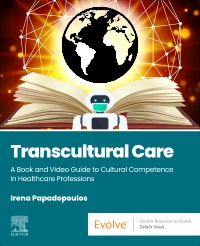
Cultural competence is not just a theoretical concept but a practical necessity. Evidence has established that effective, efficient, and compassionate care in an increasingly diverse world cannot be achieved unless the health workforce is culturally competent. Transcultural Care by Irena Papadopoulos, a leading expert in transcultural health and nursing, offers a comprehensive guide to understanding and implementing cultural competence in healthcare settings. This book and its accompanying videos are designed to help a wide range of students and professionals navigate the complexities of cultural diversity in patient care.
Through a systematic exploration of key concepts such as communication, compassion, and ethical practice, the author introduces the readers to essential cultural competence models, including her own established Papadopoulos, Tilki, and Taylor model. The content also delves into the emerging roles of AI and robotics in healthcare, providing a forward-thinking perspective on how technology intersects with cultural competence. The book also introduces the post-human theory, exploring its relevance to cultural and compassionate competence in health care.
Transcultural Care is not just a textbook, but a practical resource with case studies, exercises, and interesting videos that allow self-paced learning. Whether you are a student, a qualified healthcare professional looking to enhance your skills, or an educator preparing the next generation of culturally competent and compassionate caregivers, this book is an invaluable addition to your library.
Through a systematic exploration of key concepts such as communication, compassion, and ethical practice, the author introduces the readers to essential cultural competence models, including her own established Papadopoulos, Tilki, and Taylor model. The content also delves into the emerging roles of AI and robotics in healthcare, providing a forward-thinking perspective on how technology intersects with cultural competence. The book also introduces the post-human theory, exploring its relevance to cultural and compassionate competence in health care.
Transcultural Care is not just a textbook, but a practical resource with case studies, exercises, and interesting videos that allow self-paced learning. Whether you are a student, a qualified healthcare professional looking to enhance your skills, or an educator preparing the next generation of culturally competent and compassionate caregivers, this book is an invaluable addition to your library.
-
- Explores fundamental principles of cultural competence and their application in healthcare, written by a leading authority
- Introduces the post-human theory
- Accompanied by engaging videos to break down complex topics into digestible segments
- Includes activities sections and exercises designed to reinforce learning
- Structured layout with Learning Objectives and Key Points for easy reference
- Includes chapters on the impact of COVID-19 and the role of AI and robotics in culturally competent care
-
-
 Evolve Resources for Transcultural CareResources
 -
 Transcultural CarePaperback
-
-
1. Culture and Its Relevance in Health and Care
2. Cultural Competence for the 21st Century
3. Key Concepts. The Big Six Cs
4. Culturally Competent and Virtuous Leadership
5. Culturally Competent and Compassionate Spiritual Care. Lessons From the COVID-19 Pandemic
6. Cultural Competence in AI and Robotics. Implications for Healthcare and Nursing -
-
Ways of Reading
- The appearance of the text and page layout can be modified according to the capabilities of the reading system (font family and font size, spaces between paragraphs, sentences, words, and letters, as well as color of background and text)
- This e-publication is accessible to the full extent that the file format and types of content allow, on a specific reading device, by default, without necessarily including any additions such as textual descriptions of images or enhanced navigation
- No information about nonvisual reading is available
-
Conformance
- No information is available
-
Navigation
- Table of contents to all chapters of the text via links
- Page list to go to pages from the print source version
-
Rich Content
- No information is available
-
Hazards
- No information is available
-
Product Content
- No information is available
-
Legal Considerations
- No information is available
-
Additional Accessibility Information
- Content is enhanced with ARIA roles to optimize organization and facilitate navigation
- Page breaks included from the original print source
- For readers with color vision deficiency, use of color (e.g., in diagrams, graphics and charts, in prompts, or on buttons inviting a response) is not the sole means of graphical distinction or of conveying information
- E-publication includes basic navigation (usually less detailed than TOC-based navigation)
- Where links, controls or buttons are included in the content, the purpose or functionality of each link, control or button is apparent from the associated text alone - or where it is unclear, separate link, control or button descriptions are provided
- All (or substantially all) textual matter is arranged in a single logical reading order (including text that is visually presented as separate from the main text flow, e.g., in boxouts, captions, tables, footnotes, endnotes, citations, etc.). Non-textual content is also linked from within this logical reading order. (Purely decorative non-text content can be ignored).
- The language of the text has been specified (e.g., via the HTML or XML lang attribute) to optimise text-to-speech (and other alternative renderings), both at the whole document level and, where appropriate, for individual words, phrases or passages in a different language.
-
Ways of Reading
Was
$36.99
Now $35.14
Or $0.00 with a valid access code

 as described in our