ISBN:
9780443128264
Copyright:
2026
Publication Date:
08-21-2025
Page Count:
352
Imprint:
Elsevier
List Price:
$85.99

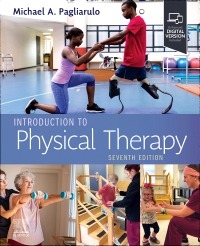
Introduction to Physical Therapy - Elsevier eBook on VitalSource, 7th Edition
by Michael A. Pagliarulo, PT, MA, BA, BS, EdD
Elsevier eBook on VitalSource
ISBN:
9780443128264
Copyright:
2026
Publication Date:
08-21-2025
Page Count:
352
Imprint:
Elsevier
List Price:
$85.99
Most review copies are eBooks – how fast!
A review copy request is most likely to be fulfilled as an eBook on VitalSource rather than a print product, unless no eBook is available. eBooks become available in as little as a few hours. Print products will take between 7 and 10 days to arrive. To request a print copy, please contact us through the Evolve Support Center for further assistance or contact your Elsevier Sales Rep.
Give your students an insightful and thorough overview of both the profession and the practice of physical therapy with Introduction to Physical Therapy, 7th Edition. This comprehensive text walks students through the key aspects of a career in physical therapy — including the role of the physical therapist and physical therapist assistant, practice settings, the APTA, and laws, policies, and regulations — and then goes on to detail the practice of physical therapy and the functions, disorders, and therapies of the major organ systems. The seventh edition features updated chapters on the physical therapist assistant and the American Physical Therapy Association; as well as updated content, references, and coverage of the latest trends in health care. Paired with an abundance of learning aides like learning objectives, chapter outlines, review questions, and more; this highly visual text gives students the complete foundation they need to successfully grow their professional knowledge and skills.
-
- NEW! Revised content and up-to-date references throughout the text equip students with the most current coverage of relevant topics for today’s PT and PTA professionals
- UPDATED! The Physical Therapist Assistant, American Physical Therapy Association, and Effective Communication in the Profession of Physical Therapy in the 21st Century chapters feature the latest information and insights
- NEW! Enhanced ebook version, included with every new print purchase, features additional review questions and answers, plus digital access to all the text, figures, and references, with the ability to search, customize content, make notes and highlights, and have content read aloud
- The latest information on current trends in health care and the profession of physical therapy keeps students current on the latest issues
- Numerous learning aides include chapter outlines, key terms, learning objectives, boxes, tables, summaries, suggested readings, and review questions
- An overview of the profession combined with clinical information gives students a solid foundation in the practice of physical therapy
-
PART I Profession
1. The Profession of Physical Therapy: Definition and Development
2. Characteristics and Roles of Physical Therapists
3. The Physical Therapist Assistant
4. American Physical Therapy Association
5. Laws, Regulations, and Policies
6. Financing Health Care and Reimbursement (Payment) in Physical Therapist Practice
7. Effective Communication for Physical Therapists in the 21st Century
PART II Practice
8. Prevention, Health Promotion, and Wellness in Physical Therapist Practice
9. Physical Therapy for Musculoskeletal Conditions
10. Physical Therapy for Neuromuscular Conditions
11. Physical Therapy in Cardiovascular and Pulmonary Conditions
12. Physical Therapy for Integumentary Conditions
13. Physical Therapy for Pediatric Conditions
14. Physical Therapy for the Older Adult -
-
Ways of Reading
- The appearance of the text and page layout can be modified according to the capabilities of the reading system (font family and font size, spaces between paragraphs, sentences, words, and letters, as well as color of background and text)
- This e-publication is accessible to the full extent that the file format and types of content allow, on a specific reading device, by default, without necessarily including any additions such as textual descriptions of images or enhanced navigation
- No information about nonvisual reading is available
-
Conformance
- For detailed accessibility information, see Elsevier's website at https://www.elsevier.com/about/accessibility
- For queries regarding accessibility information, contact [email protected]
- The publication was certified on 18-11-2025
-
Navigation
- Table of contents to all chapters of the text via links
-
Rich Content
- No information is available
-
Hazards
- No information is available
-
Product Content
- No information is available
-
Legal Considerations
- No information is available
-
Additional Accessibility Information
- For readers with color vision deficiency, use of color (e.g., in diagrams, graphics and charts, in prompts, or on buttons inviting a response) is not the sole means of graphical distinction or of conveying information
- E-publication includes basic navigation (usually less detailed than TOC-based navigation)
- Where links, controls or buttons are included in the content, the purpose or functionality of each link, control or button is apparent from the associated text alone - or where it is unclear, separate link, control or button descriptions are provided
- All (or substantially all) textual matter is arranged in a single logical reading order (including text that is visually presented as separate from the main text flow, e.g., in boxouts, captions, tables, footnotes, endnotes, citations, etc.). Non-textual content is also linked from within this logical reading order. (Purely decorative non-text content can be ignored).
- The language of the text has been specified (e.g., via the HTML or XML lang attribute) to optimise text-to-speech (and other alternative renderings), both at the whole document level and, where appropriate, for individual words, phrases or passages in a different language.
-
Ways of Reading


Most review copies are eBooks – how fast!
A review copy request is most likely to be fulfilled as an eBook on VitalSource rather than a print product, unless no eBook is available. eBooks become available in as little as a few hours. Print products will take between 7 and 10 days to arrive. To request a print copy, please contact us through the Evolve Support Center for further assistance or contact your Elsevier Sales Rep.

 as described in our